
Who was St Mungo? The patron saint of Glasgow explained
If you have ever walked past Glasgow Cathedral and wondered about the name carved above its doors, or noticed the strange symbols on the city's coat of arms, you have already brushed up against the story of St Mungo. He is one of those figures from early medieval Britain whose life sits somewhere between recorded history and folklore, yet whose influence on a modern city is still visible today.
St Mungo, also known by his birth name Kentigern, was a sixth-century monk and bishop credited with founding the settlement that eventually grew into Glasgow. His story combines genuine historical traces with vivid legends that were passed down for centuries before anyone wrote them down. Understanding who he was means separating what can reasonably be accepted as fact from what grew up around his memory as devotional storytelling.
Where the name Mungo comes from and who he really was
Most historical sources agree that the saint's given name was Kentigern, a name with Brittonic roots meaning something like "chief lord" or "hound lord." The nickname Mungo, which means roughly "dear one" or "beloved," is said to have been given to him affectionately by his teacher, a monk named Serf, during his childhood years at a religious community.
Kentigern was believed to have been born around the middle of the sixth century, likely somewhere in the region that is now southern Scotland or northern England. The exact dates are uncertain, since the earliest biographies of his life were written centuries after he died, drawing on oral tradition rather than contemporary records.
He is traditionally remembered as a bishop who worked to spread Christianity among the Britons of the old kingdom of Strathclyde. At a time when organized church structures were still forming in that part of Britain, figures like Kentigern played a role similar to that of traveling missionaries, establishing small communities of worship that later became permanent settlements.
Quick fact: The city of Glasgow's motto, "Let Glasgow flourish," is often linked back to a blessing attributed to St Mungo, reflecting how deeply his memory is woven into the city's identity.
The legend of his birth and unusual early life
The story of Kentigern's birth, as told in later medieval accounts, reads almost like a rescue narrative. His mother, a princess named Teneu, was said to have become pregnant outside of marriage, which in the social and religious context of the time was treated as a serious offense. According to the legend, her own father ordered her punished by being thrown from a cliff.
She survived the fall, the story goes, and was later found drifting in a small boat, having washed ashore near a religious settlement. There she gave birth to the boy who would become Kentigern. The community that took her in was associated with the monk Serf, who raised the child and gave him the nickname that stuck for the rest of his life.
Whatever the historical kernel behind this tale, it reflects a common pattern in saints' lives from this period: a dramatic, almost miraculous beginning meant to signal that the child was marked for a special religious purpose from birth. These origin stories were not written as literal history but as a way of expressing the spiritual significance later generations attached to the saint.
How Mungo came to found Glasgow
As an adult, Kentigern is said to have traveled to the area along the River Clyde, where he established a small monastic community. This settlement, built near a stream the Britons called Molendinar Burn, is traditionally regarded as the origin point of the city of Glasgow.
He reportedly served as bishop over a wide and sparsely populated region, working among communities that had only recently, or only partially, adopted Christian practice. At one point, according to tradition, political pressures forced him to leave the area for a time, and he is said to have traveled south into Wales before eventually returning to Strathclyde later in life.
During his time away, legend connects him with St Asaph in north Wales, where some traditions say he helped establish another religious community. When he returned to the Clyde valley, he is remembered as continuing his work until his death, which later sources place around the early seventh century.
The four miracles behind Glasgow's coat of arms
Perhaps the most recognizable legacy of St Mungo in modern Glasgow is the set of four symbolic miracles tied to his life, each represented on the city's historic coat of arms. These four images are still visible on municipal buildings, street furniture, and even the crest of Glasgow's football clubs.
- The bird: A robin that belonged to St Serf's community was killed, reportedly by other students, and young Kentigern was blamed. According to the legend, he prayed over the bird and it was restored to life.
- The tree: As a boy, Kentigern was responsible for keeping a fire burning at the monastery but had let it go out. Unable to find fuel, he is said to have used hazel branches that should not have burned, yet the fire relit as if by miracle.
- The bell: A bell associated with Kentigern was said to have been brought from Rome and used in his ministry to call people to prayer and to mourn the dead, though the original bell has long since been lost.
- The fish: A queen had been given a ring by her husband, the king, but gave it away to someone else. When the king demanded to see it, Kentigern is said to have retrieved it from a salmon caught in the River Clyde, saving the queen from disgrace or worse.
These four stories, often summarized with the phrase "the bird, the tree, the bell, and the fish," are not meant to be read as factual events. They function more like a visual shorthand, a way of teaching about faith, mercy, and the power of prayer through memorable images that could be understood even by people who could not read.
Where St Mungo is buried and how he is remembered today
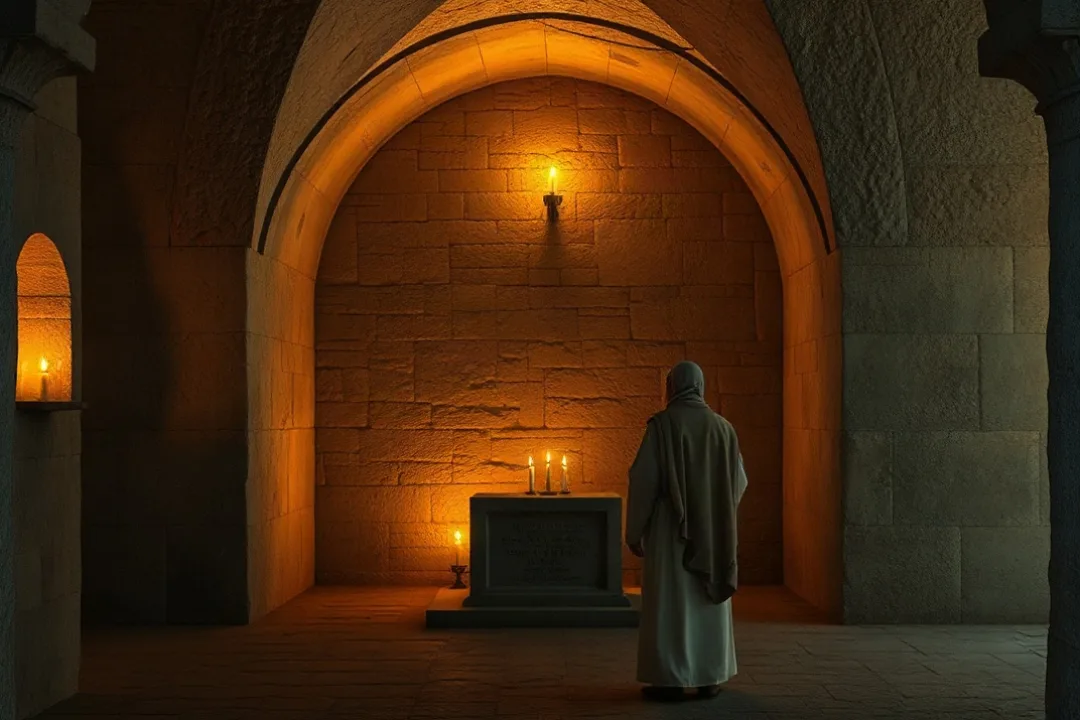
St Mungo is traditionally believed to be buried in the crypt of Glasgow Cathedral, which is itself sometimes referred to as St Mungo's Cathedral. The cathedral, parts of which date to the medieval period, stands near the site of his original monastic settlement and remains an active place of worship.
His feast day is observed on January 13, and while formal religious observance of this day has become less widespread over time, his memory persists strongly in secular Glasgow culture. Streets, schools, hospitals, and even a popular museum, St Mungo Museum of Religious Life and Art, carry his name.
Early medieval biographies describe Kentigern as a figure devoted to quiet acts of mercy rather than dramatic confrontation, a contrast to some of his more combative contemporaries among the early British saints.
For visitors interested in tracing his legacy directly, a few places offer a tangible connection to his story:
- Glasgow Cathedral crypt, said to hold his tomb and a long-standing site of pilgrimage.
- St Mungo Museum of Religious Life and Art, located near the cathedral, which explores his legacy alongside broader religious history.
- Molendinar Burn, the now largely culverted stream near which his original settlement is believed to have stood.
- St Asaph Cathedral in Wales, connected to the period of his life spent away from Scotland.
Why his story still resonates centuries later
Part of the reason St Mungo's story has endured is that it blends two things people tend to respond to: a believable human struggle and a set of vivid, almost fable-like miracles. He is not presented as flawless or untouchable. The legends around his birth, in particular, acknowledge hardship and social judgment before turning toward restoration and purpose.
His association with Glasgow also gives the story a concrete anchor. Unlike some early saints whose connection to a specific place feels vague or symbolic, Mungo is tied directly to the river, the land, and the early religious community that grew into one of Scotland's largest cities. That physical continuity, reinforced by the cathedral that still bears his name, has helped keep his memory active long after the religious context that originally shaped his story.
Frequently asked questions
Is St Mungo the same person as St Kentigern?
Yes. Kentigern was his given name, while Mungo was an affectionate nickname meaning roughly "dear one," said to have been given to him by his teacher during childhood. Both names refer to the same sixth-century figure.
Why is St Mungo connected to Glasgow specifically?
Tradition holds that he founded a monastic settlement near the River Clyde, close to a stream called Molendinar Burn, which later developed into the city of Glasgow. He is considered the city's founding religious figure and patron saint.
What do the symbols on Glasgow's coat of arms represent?
The bird, tree, bell and fish each represent a legendary miracle attributed to St Mungo, including reviving a dead bird, relighting a fire with unlikely branches, using a bell in his ministry, and recovering a lost ring from a fish.
When is St Mungo's feast day celebrated?
His feast day falls on January 13. While formal religious observance has become less common over time, his legacy remains strongly present in Glasgow through place names, institutions, and the city's historic symbols.
Leave a Reply