
St. Bede: the English monk who became history's voice

If you've come across the name St. Bede on a church calendar, a school, or in a footnote of a history book, you might be wondering who this man actually was and why he still matters more than thirteen centuries after his death. The short answer is that Bede was a monk, scholar, and historian living in northern England whose writings shaped how the Western world understood its own past, measured time, and told the story of Christianity in Britain. His most famous book is still read by historians today, and the Catholic Church honors him as a saint and a Doctor of the Church.
Bede spent nearly his entire life inside the walls of a monastery, yet his influence reached far beyond the cloister. Understanding who he was means looking at his quiet daily routine, the books he produced, and the lasting mark he left on how people in the English-speaking world count their years and remember their history.
Who was St. Bede and where did he come from
Bede was born around the year 673 in the kingdom of Northumbria, in what is now northeastern England. At around age seven, his family sent him to the monastery at Wearmouth, and shortly after he moved to the sister monastery at Jarrow, where he would remain for the rest of his life. This was not unusual for the time; monasteries often raised and educated boys who showed promise, and Bede's talent for learning became obvious early.
He was ordained a deacon at nineteen and a priest at thirty, both earlier than the usual canonical age, which suggests his abbots recognized something exceptional in him. Jarrow had an unusually well-stocked library for a monastery of its size, built up through the efforts of its founding abbots, who traveled to Rome and brought back manuscripts. That library gave Bede access to classical and Christian texts that most scholars in Britain simply could not reach.
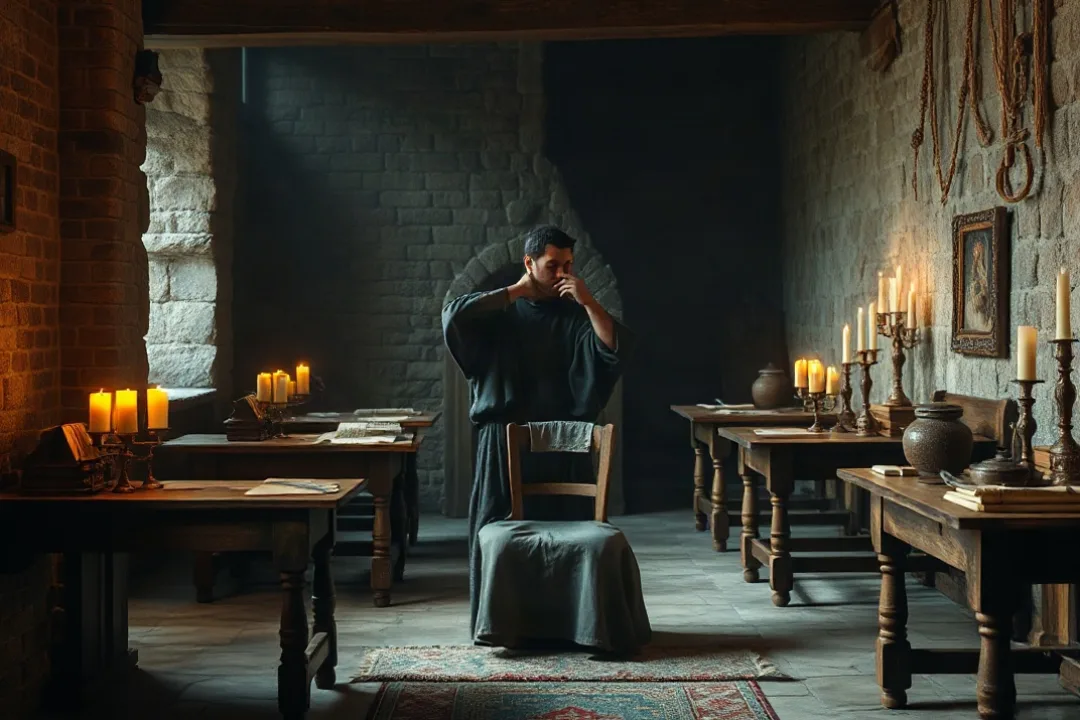
He rarely left the monastery grounds. By his own account, his life followed a steady rhythm: prayer, the singing of the monastic hours, teaching, and writing. He described his own purpose simply, saying that it was always his delight to learn, to teach, and to write.
What St. Bede actually wrote and why it mattered
Bede produced roughly forty works over his lifetime, covering biblical commentary, grammar, poetry, science, and history. A few stand out as particularly important.
- The Ecclesiastical History of the English People, completed around 731, is his masterpiece. It traces the arrival of Christianity in Britain and the conversion of the Anglo-Saxon kingdoms, weaving together political events, miracle stories, and church history into a single narrative.
- On the Reckoning of Time, a work on calendars and chronology, which helped popularize the practice of dating events from the birth of Christ, the system now known as AD (Anno Domini).
- Numerous biblical commentaries, which explained scripture passages for other monks and students, often drawing on earlier Church Fathers but adding his own careful observations.
- Educational texts on grammar and natural science, meant to train young monks in Latin and basic knowledge of the natural world.
The Ecclesiastical History is the work most people associate with Bede, and for good reason. Before he wrote it, there was no single, organized account of how Christianity had spread across the various Anglo-Saxon kingdoms. Bede gathered letters, oral traditions, and records from multiple monasteries to build a coherent timeline, something no one in Britain had attempted on that scale before.
"I have made it my business... to gather together whatever I could find, whether written or by tradition, concerning the history of the church in Britain." This is the spirit in which Bede describes his approach to writing his history, treating careful research as a form of service to the Church.
Why Bede's work on time still shapes the modern calendar
One of Bede's quieter but more lasting contributions involves something most people never think twice about: how we number years. Before his writings became widely known, different regions of Europe used different systems to date events, often tied to the reign of a particular emperor or king.
Bede championed the dating system proposed earlier by a monk named Dionysius Exiguus, which counted years from the birth of Christ. Through the popularity of his historical and chronological writings, this method spread across medieval Europe and eventually became the standard calendar system still used around the world. Every time someone writes a date using AD or its secular equivalent, they are using a convention that Bede helped make common practice.
He also worked out methods for calculating the date of Easter, a genuinely complicated problem in his era because different churches followed different formulas. His writings on this subject helped bring more uniformity to how Christian communities in Britain observed the liturgical calendar.
Worth remembering: Bede never traveled outside a small region of northern England, yet his writings on chronology influenced how dates are recorded across the entire Western world to this day.
Why he is called "the Venerable"
The title "Venerable," which almost always accompanies Bede's name, has a specific history. Shortly after his death in 735, communities who valued his scholarship and holiness began referring to him with this title, a term traditionally used for someone recognized as having lived a life of notable virtue and wisdom.
A popular medieval legend claims that a scribe inscribing Bede's tomb struggled to find a word to complete an epitaph in Latin verse, writing "Hac sunt in fossa Bedae... ossa" and leaving a blank space for a word describing him. According to the story, an angel finished the line overnight by adding "venerabilis," meaning venerable. Historians generally treat this as a charming legend rather than fact, but it shows how quickly Bede's reputation for sanctity grew after his death.
The title stuck permanently. Centuries later, in 1899, Pope Leo XIII formally declared Bede a Doctor of the Church, an honor given to saints whose writings are considered especially valuable for understanding Christian doctrine. Bede remains the only person from medieval England to hold this title, and one of the few Doctors of the Church from the early medieval period in general.
How St. Bede is remembered and honored today
The Catholic Church celebrates St. Bede's feast day on May 25, commemorating the date of his death in 735. He is honored as a patron of scholars, historians, and students, a fitting connection given his lifelong devotion to learning and teaching.
Bede's remains were eventually moved from Jarrow to Durham Cathedral in England, where a tomb in the Galilee Chapel still marks his resting place and draws visitors interested in medieval history and English Christianity. Durham's connection to Bede is a source of local pride, and the cathedral regularly highlights his legacy for visitors.
His name lives on in institutions across the English-speaking world. Several schools, colleges, and parishes bear his name, often chosen specifically because of his association with scholarship, careful research, and dedication to teaching. A few practical examples of how his legacy continues:
- Academic institutions named after him often emphasize rigorous study and intellectual honesty, mirroring his own methodical approach to research.
- Historians and medievalists still consult his Ecclesiastical History as a primary source for understanding early Anglo-Saxon England, since few other written records from that period survive.
- Liturgical calendars in Catholic and some Anglican traditions include readings or references to Bede around his feast day, highlighting excerpts from his writings.
What makes Bede's story compelling isn't dramatic events or worldly influence in the way a king or bishop might have had. He never held political power and rarely left his monastery. His significance comes almost entirely from the quality and care of his intellectual work, the patient accumulation of knowledge and its careful transmission to future generations.
That quiet persistence is part of why his memory endures. In an era when written records were scarce and literacy itself was rare outside religious institutions, Bede treated the act of recording history and knowledge as a serious spiritual discipline. He believed that preserving accurate information about the Church's past and understanding the created world were both ways of honoring God, and he approached both tasks with the same careful attention.
What makes Bede's approach to history still relevant
Modern historians who study Bede's methods often point out something unusual for his era: he tried, as much as the sources available to him allowed, to distinguish between reliable testimony and uncertain legend. He frequently names his sources, explains how he obtained information, and notes when he is relying on secondhand reports rather than firsthand accounts.
This habit of citing sources might seem unremarkable by today's standards, but in the eighth century it was far from universal practice. Many chronicles from the period blend fact and legend without distinction. Bede's comparative carefulness is part of why modern scholars consider the Ecclesiastical History a genuinely useful historical document rather than simply a collection of pious stories.
At the same time, readers should understand that Bede wrote as a monk whose purpose went beyond simple record-keeping. He wanted his history to show how divine providence worked through events, and he included accounts of miracles and visions that reflect the religious worldview of his time. Reading Bede well means appreciating both his genuine historical discipline and the theological lens through which he interpreted events.
That combination, rigorous for its era yet unmistakably devotional in purpose, is part of what makes him such a distinctive figure. He wasn't writing secular history in the modern sense, but he also wasn't simply retelling legends uncritically. He occupied a middle ground that few of his contemporaries managed, and that balance is a major reason his work survived and continued to be copied, studied, and trusted for centuries after his death.
Frequently asked questions
What is St. Bede best known for?
He is best known for writing the Ecclesiastical History of the English People, completed around 731, which traces the spread of Christianity across Anglo-Saxon Britain. He also helped popularize the AD dating system still used today.
Why is Bede called 'the Venerable'?
The title reflects the deep respect his contemporaries and later generations had for his learning and holiness. A medieval legend claims an angel added the word to his tomb inscription, but historians view this as legend rather than fact.
When is St. Bede's feast day?
The Catholic Church celebrates his feast day on May 25, marking the anniversary of his death in 735. He is honored as a patron of scholars, historians, and students.
Where is St. Bede buried?
His remains rest in Durham Cathedral in England, specifically in the Galilee Chapel. They were moved there from the monastery at Jarrow sometime after his death, and the tomb is still visited by historians and pilgrims today.
Leave a Reply