
St. Nicholas: the real bishop behind the Santa Claus legend
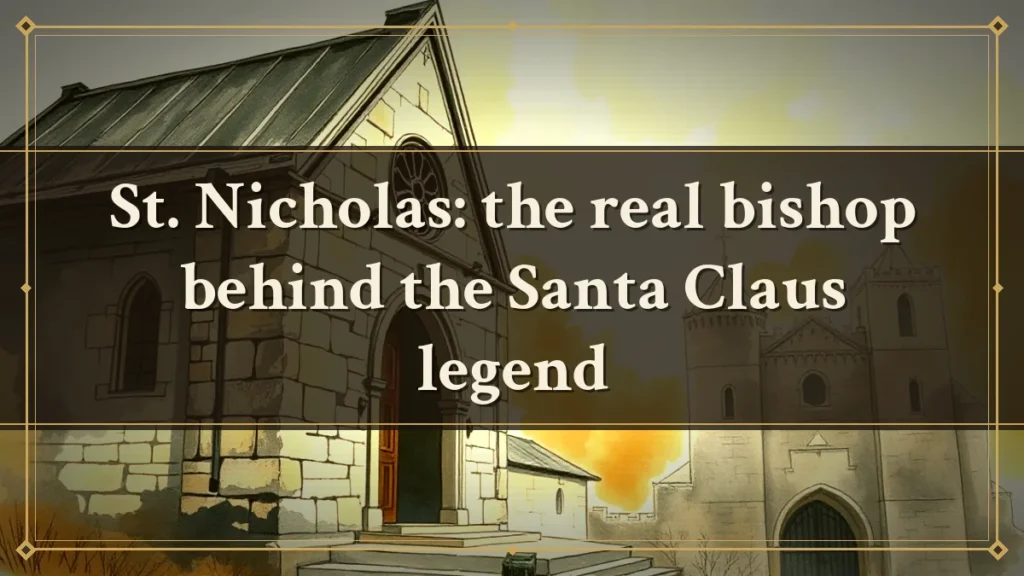
St. Nicholas was a real bishop who lived in the fourth century in what is now southwestern Turkey, and almost everything people associate with Santa Claus traces back to his life and the stories told about him afterward. He was not a jolly man in a red suit who lived at the North Pole. He was a Christian leader in the Greek city of Myra, known during his lifetime and for centuries after for his generosity, his defense of the poor, and his fierce loyalty to his faith during a period when Christians faced real persecution.
Very little about his life was written down while he was alive. Most of what we know comes from accounts written generations, even centuries, later, which means historians treat many details with caution. Still, the core facts are considered reliable: he was born around the year 270 in the city of Patara, became bishop of Myra, and died around 343. His feast day, December 6, marks the anniversary of his death.
Who was the man behind the legend
Nicholas grew up in a wealthy Christian family but lost his parents at a young age, reportedly to an epidemic. Rather than keeping the inheritance for himself, he is said to have used it to help people in need throughout his community. This single detail, more than any other, shaped the entire tradition that followed him.
He lived during a dangerous time for Christians. Early in his life, the Roman Empire under Diocletian carried out one of its harshest persecutions, and some accounts claim Nicholas was imprisoned for his faith. Later, after Christianity was legalized under Constantine, Nicholas is believed to have attended the First Council of Nicaea in 325, a major gathering of bishops that defined core Christian beliefs still recited today.
As bishop, he was known for three qualities that appear again and again in the old stories: generosity toward the poor, protection of children and the vulnerable, and a willingness to stand up to unjust authority. Whether or not every anecdote is historically precise, these themes were consistent enough across different regions and centuries that they clearly reflected something true about the man's reputation.
The legends that shaped his reputation
Most of the famous Nicholas stories were recorded well after his death, passed down orally before being written into hagiographies. They read more like moral tales than biography, but they explain exactly why his cult spread so widely across Europe.
- The three daughters' dowry: A poor father in Myra had no money to provide dowries for his three daughters, which meant they faced being sold into servitude. Nicholas is said to have secretly dropped bags of gold through the family's window, or down the chimney in some versions, on three separate nights so the father would never know who to thank.
- The sailors in the storm: Sailors caught in a violent storm near Myra prayed for help, and a figure matching Nicholas appeared, calmed the sea, and guided their ship safely to shore. This story made him the patron saint of sailors across the Mediterranean.
- The grain miracle: During a famine, Nicholas reportedly convinced sailors carrying grain for the emperor to give some to the starving city of Myra, promising their cargo would not be short when they delivered it. According to the legend, the grain was never missing despite the gift.
- The resurrection of three children: A darker, later legend claims Nicholas restored to life three children who had been murdered by an innkeeper during a famine. This gruesome tale cemented his role as a protector of children specifically.
One widely repeated but almost certainly embellished story claims Nicholas slapped the heretic Arius during the Council of Nicaea for denying the divinity of Christ. Most historians treat this as later folklore rather than fact, though it illustrates how firmly people wanted to believe he fought for orthodox teaching.
Worth knowing: Nicholas is recognized as a patron saint of children, sailors, merchants, students, and even pawnbrokers, whose traditional three-ball sign is sometimes linked to the three bags of gold from the dowry legend.
How his remains ended up in Italy
Nicholas was originally buried in Myra, and his tomb became a popular pilgrimage site for centuries. In 1087, Italian sailors from Bari removed his remains and brought them to their city, reportedly to protect them from the Muslim conquest of the region and to boost Bari's religious prestige.
His bones still rest in the Basilica di San Nicola in Bari today, and the city holds major celebrations every May to mark the arrival of the relics. A separate set of bone fragments ended up in Venice, and scientific analysis conducted in recent decades confirmed that the remains in both cities likely belonged to the same individual, lending some physical credibility to a figure long known mostly through stories.
How a Greek bishop became Santa Claus
The transformation from venerated saint to the modern Santa Claus happened gradually, through different cultures adapting his story to their own traditions.
In the Netherlands, Nicholas became Sinterklaas, a tall, dignified figure who arrives by boat from Spain in mid-November and delivers gifts to children on December 5, the eve of his feast day. Dutch settlers carried this tradition to America, particularly to New York, which was originally the Dutch colony of New Amsterdam.
Over the nineteenth century, American writers and illustrators reshaped the figure further. Washington Irving's satirical writings mentioned a pipe-smoking Nicholas flying over rooftops, and the 1823 poem commonly known as "A Visit from St. Nicholas" (often attributed to Clement Clarke Moore) introduced the sleigh, the reindeer, and the chimney entrance that are now standard. Illustrator Thomas Nast later gave Santa his rounder, red-suited look in political cartoons during the mid-to-late 1800s, and Coca-Cola's advertising in the 1930s cemented that image worldwide.
So the jolly, gift-giving figure familiar to American children today is really a layered composite: a historical Greek bishop, Dutch Sinterklaas folklore, British Father Christmas traditions, and American commercial art, all blended into one character.
St. Nicholas Day traditions around the world
In many European countries, December 6 is celebrated as St. Nicholas Day, separate from Christmas itself, and it keeps much more of the original religious character.
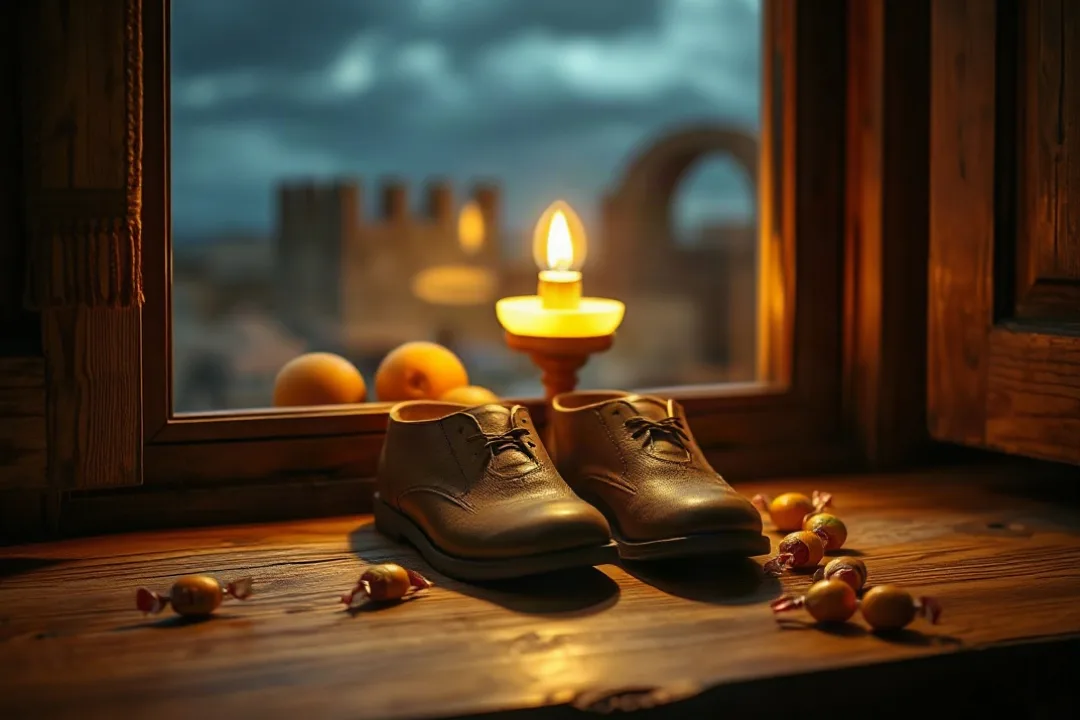
- Germany and Austria: Children leave a shoe or boot outside their door on the night of December 5. By morning, Nicholas has filled it with small treats, nuts, oranges, or chocolate coins, assuming the child behaved well during the year.
- The Netherlands: Sinterklaas arrives with his helpers and children leave out a shoe, often with a carrot for his horse, hoping for small gifts and sweets the next morning.
- Poland and parts of Eastern Europe: St. Nicholas visits schools and homes dressed as a bishop, sometimes testing children on their prayers or good behavior before handing out gifts.
- Eastern Orthodox communities: Nicholas is venerated as one of the most important saints in the tradition, with liturgies, blessings, and charitable acts marking his feast rather than secular gift exchanges.
These celebrations tend to focus on modest treats and moral lessons about generosity rather than the large-scale gift-giving associated with Christmas Day in the United States.
Ways to mark St. Nicholas Day with your own family
You do not need a strong religious background to appreciate the holiday's focus on quiet generosity. Families who want to bring some of the tradition into their own home have several simple options.
- Set out shoes or stockings on the night of December 5 and fill them with small treats, fruit, or a modest gift for the children to find on the morning of December 6.
- Use the day to talk about anonymous generosity, perhaps by having each family member do one kind act for someone else without revealing who did it.
- Bake traditional treats associated with the holiday, such as spiced cookies or orange-flavored pastries common in European celebrations.
- Read one of the classic legends aloud, such as the story of the three daughters' dowry, and discuss what the story says about helping others quietly.
- Donate to a local charity or food bank as a family activity tied specifically to the saint's reputation for feeding the hungry and helping the poor.
A gentle reminder: Many of the original stories emphasize that Nicholas gave without wanting credit. Keeping any family tradition simple and low-key often captures that spirit better than an elaborate gift exchange.
Common mistakes and misconceptions about St. Nicholas
Confusion between the historical saint and the modern commercial Santa Claus leads to a few recurring misunderstandings.
- Assuming every legend is historically documented. Most stories, including the dowry tale and the resurrection of the children, were written centuries after his death and should be understood as devotional folklore rather than verified biography.
- Mixing up St. Nicholas Day and Christmas. In much of Europe these are two distinct holidays, celebrated nearly three weeks apart, each with its own customs.
- Thinking the North Pole connection is ancient. The idea of Santa living at the North Pole is a nineteenth-century American invention and has no connection to the historical bishop of Myra.
- Overlooking his role in other cultures. Because the American Santa Claus is so dominant globally, many people don't realize how seriously Nicholas is still venerated as a saint in Orthodox and Catholic communities, independent of any gift-giving tradition.
- Forgetting the charitable core of the story. It's easy to focus on the magic and the presents while missing that nearly every original legend is really about quiet, anonymous kindness toward people in genuine need.
Understanding these distinctions helps explain why a fourth-century bishop from a small Mediterranean city still shapes December celebrations for millions of families who have likely never set foot near his original hometown.
Nicholas of Myra left behind no writings of his own, yet the generosity attributed to him outlived every emperor who ruled during his lifetime.
Frequently asked questions
Was St. Nicholas a real historical person?
Yes. He was a bishop in the city of Myra, in present-day Turkey, who lived roughly from 270 to 343 AD. Specific anecdotes about him were recorded later and should be treated as folklore, but his existence and role as bishop are historically accepted.
Why is St. Nicholas associated with gift-giving?
Legends describe him secretly giving gold to a poor family so their daughters wouldn't be sold into servitude, and generally using his inheritance to help the needy. That reputation for quiet, generous giving became the foundation for later gift-giving traditions tied to his name.
What is the difference between St. Nicholas Day and Christmas?
St. Nicholas Day falls on December 6 and is celebrated separately from Christmas in many European countries, often with small treats left in shoes on the night before. Christmas, on December 25, developed its own separate traditions, though in the United States the two figures have largely merged into one Santa Claus.
Where are St. Nicholas's remains located today?
His bones were moved from Myra to Bari, Italy, in 1087 and remain in the Basilica di San Nicola there. A smaller portion of relics is also kept in Venice, and scientific testing has suggested both sets likely belong to the same person.
Leave a Reply