
Saint Oswald: the warrior king who became a saint

Saint Oswald was a 7th-century king of Northumbria, in what is now northern England, who is venerated as a martyr and a model of Christian kingship. He ruled from roughly 634 to 641, helped establish Christianity in his kingdom after years of exile among Irish monks, and died in battle against a pagan rival king. Within a generation of his death, people across England and parts of continental Europe were already honoring him as a saint.
His story blends political history, missionary work and popular devotion in a way that tells you a great deal about how sainthood was understood in early medieval Britain. Unlike saints known mainly for quiet piety, Oswald was a ruler who fought wars, built alliances and died violently, yet was embraced by the church as holy almost immediately.
Who was Saint Oswald of Northumbria
Oswald was born around 604, the son of Æthelfrith, a Northumbrian king, and Acha, a princess from the rival kingdom of Deira. When his father was killed and a new ruler took the Northumbrian throne, Oswald and his brothers fled into exile. They spent years among the Scots and Irish on the island of Iona, where Irish monks had founded an influential monastery.
That exile shaped the rest of his life. On Iona, Oswald was baptized and raised within a monastic Christian culture very different from the pagan Anglo-Saxon world he had left behind. He learned the Irish language, absorbed Irish spiritual practices, and formed close ties with the monastic community that would later send missionaries to his kingdom.
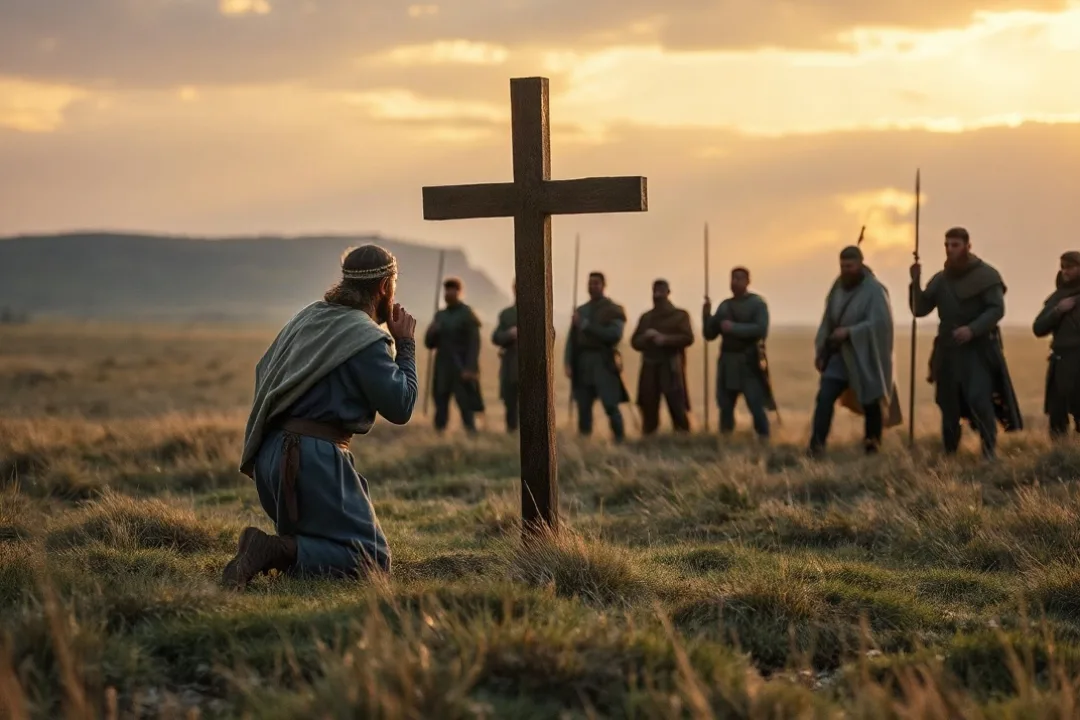
When the political situation in Northumbria shifted again, Oswald returned from exile to reclaim his family's lands. He defeated the forces of a rival ruler, Cadwallon of Gwynedd, at the Battle of Heavenfield around 634, becoming king of a reunited Northumbria. According to early accounts, before that decisive battle Oswald set up a wooden cross and prayed with his soldiers, asking for divine help against a much larger force.
How Oswald became king and spread Christianity
Once he secured the throne, Oswald set about establishing Christianity as the faith of his kingdom. He did not do this alone. Remembering his years on Iona, he sent for a monk named Aidan to come and lead the missionary effort in Northumbria.
Aidan founded a monastery on the tidal island of Lindisfarne, which became one of the most important centers of learning and faith in early medieval Britain. The partnership between king and monk was unusually close and practical:
- Oswald reportedly acted as an interpreter for Aidan in the early days, since Aidan spoke Irish and many Northumbrians did not understand it well.
- The king granted land and resources so that churches and monastic communities could take root across his territory.
- He encouraged nobles and ordinary people alike to accept baptism, though conversion in this period was often gradual and uneven.
- He maintained diplomatic marriages and alliances that helped stabilize the kingdom enough for missionary work to continue.
This cooperation between a king shaped by Irish monasticism and a monk sent from Iona is one reason Northumbria became, for a time, one of the leading centers of Christian scholarship in Western Europe. The culture that later produced figures like the Venerable Bede grew out of foundations Oswald helped lay.
A detail worth remembering: Oswald is often described in early sources as remarkably generous to the poor, reportedly giving away silver dishes from his own table to feed hungry people who came to his hall during a feast.
The Battle of Maserfield and his martyrdom
Oswald's reign ended in violence. In 641 or 642, he faced Penda, the pagan king of Mercia, at the Battle of Maserfield, a location historians generally associate with Oswestry in present-day Shropshire. Oswald was killed in the fighting, and his body was reportedly dismembered on Penda's orders, a brutal act that early Christian writers interpreted as proof of his status as a martyr for the faith.
The name Oswestry itself is widely believed to derive from "Oswald's tree," a reference to the place where his remains, or part of them, were displayed or where devotion to him later concentrated. Local tradition grew quickly around the site, with stories of healing and miracles attached to the ground where he fell.
Early medieval writers treated Oswald's death less as a political defeat than as a spiritual victory. He had died, in their telling, as a Christian king defending his people against a pagan enemy, which was enough to place him firmly in the category of martyr even though his death came on a battlefield rather than through formal persecution.
Why Oswald is venerated as a saint and his miracles
Devotion to Oswald spread remarkably fast after his death. Within a few decades, churches dedicated to him appeared not only in England but in parts of Germany, Switzerland and the Low Countries, carried there by missionaries and traders who had connections to Northumbria.
The Venerable Bede, writing his history of the English church less than a century after Oswald's death, recorded numerous accounts of miracles associated with him. These included:
- Healings reported at the site of the Battle of Maserfield, where soil from the ground was said to cure illness.
- Cures attributed to relics of Oswald, including fragments of the wooden cross he had raised before Heavenfield.
- Accounts of his severed head and arms being venerated separately after his body was divided following his death.
- Stories of light or unusual phenomena reported near places connected to his life and death.
Bede himself wrote with evident admiration, and one passage captures how quickly the saint's reputation grew among people who had known him or heard firsthand accounts:
It is told that even the ground where he fell was found to bring healing to those who came seeking it.
Oswald's head was eventually kept with the relics of Saint Cuthbert at Durham, a pairing that reflects how closely his memory was tied to the Lindisfarne monastic tradition he had helped establish. One of his arms was venerated separately at Bamburgh, and other relics were distributed to churches on the European continent as his cult spread through monastic and trading networks.
Saint Oswald's feast day and how he is honored today
The feast day of Saint Oswald of Northumbria is observed on August 9 in most calendars, though some local traditions in England mark related dates connected to specific relic translations or local festivals. Churches dedicated to him can still be found across England, particularly in the north, as well as in parts of Germany and Austria where medieval devotion to him took firm root.
Modern observance tends to be quieter than the vivid medieval cult, but it persists in several forms:
- Parish churches named for Saint Oswald hold feast day services and sometimes special blessings connected to his patronage.
- Historical and heritage groups in Shropshire and Northumberland mark the anniversary of the Battle of Maserfield with talks, walks or commemorative events.
- Some Anglican and Catholic communities include him in litanies of saints associated with the conversion of England.
- Scholars of early medieval history continue to study his reign as a case study in how Christianity and Anglo-Saxon kingship intertwined.
He is traditionally regarded as a patron connected with soldiers and with rulers who seek to govern justly, reflecting the medieval image of him as a warrior king whose faith shaped how he exercised power rather than existing apart from it.
Saint Oswald of Worcester: a different saint with the same name
Readers researching Saint Oswald sometimes encounter a second figure by the same name: Saint Oswald of Worcester, a 10th-century English bishop and monastic reformer, unrelated to the Northumbrian king by three centuries. It helps to keep the two clearly separate, since both appear in English church history and devotional calendars.
Oswald of Worcester became Bishop of Worcester and later Archbishop of York, and he was closely involved in the monastic reform movement of the 10th century alongside figures such as Dunstan and Æthelwold. He founded or restored several monasteries and was known for his personal austerity and his commitment to disciplined religious life.
His feast day falls on February 28, distinct from the August date associated with the Northumbrian king. When people search simply for "Saint Oswald," they are almost always looking for the Northumbrian martyr-king, since his cult was larger, older and more widely spread, but it is worth knowing the second Oswald exists so the two are not confused when reading older church documents or regional parish histories.
Both men, despite living in very different centuries and roles, share a common thread: each used a position of real worldly influence, one as king, one as bishop, to strengthen the Christian life of the communities they served. That combination of practical leadership and personal faith is part of why the name Oswald recurs so often in English religious history.
Frequently asked questions
What is Saint Oswald the patron saint of?
Saint Oswald of Northumbria is traditionally associated with soldiers and with Christian rulers, reflecting his identity as a warrior king whose reign was shaped by his faith. There is no single formally assigned patronage universally attached to him, but regional traditions in England have long honored him in this role.
When is Saint Oswald's feast day?
Saint Oswald of Northumbria is commemorated on August 9 in most liturgical calendars. Saint Oswald of Worcester, a different and later figure, has a separate feast day on February 28, so it helps to check which Oswald a particular calendar or parish is referring to.
How did Saint Oswald die?
Oswald was killed at the Battle of Maserfield around 641 or 642, fighting against Penda, the pagan king of Mercia. His body was reportedly dismembered after the battle, and early Christian writers viewed his violent death as martyrdom because he had died defending a Christian kingdom against a pagan rival.
Why is Oswestry named after Saint Oswald?
The town of Oswestry in Shropshire is widely believed to take its name from "Oswald's tree," referring to the site connected with his death or with the display of his remains after the Battle of Maserfield. Local devotion and reported miracles at the site helped cement the association over time.
Leave a Reply