
Who was St. Eulalia and why she's still honored today

St. Eulalia is the name shared by two young Christian martyrs from Roman-era Spain, and both are still honored with feast days, processions, and dedicated churches. One is St. Eulalia of Mérida, venerated on December 10, and the other is St. Eulalia of Barcelona, whose feast falls on February 12 and who is one of the two patron saints of Barcelona's cathedral. The two figures are often confused with each other because their stories are strikingly similar, but they developed as separate local traditions.
Both saints are remembered as teenage girls who refused to renounce their Christian faith during a period of Roman persecution, and both were subjected to brutal punishments before dying as martyrs. Their stories, shaped over centuries of oral tradition and liturgical writing, blend historical memory with pious legend. Untangling who was who, and why each city claims its own Eulalia, helps explain why her name still appears on calendars, street signs, and cathedral doors across Spain.
How two different saints ended up with the same name
The confusion between the two Eulalias is not new. Early medieval writers themselves sometimes mixed up details from one story with the other, partly because Eulalia was a common name in late Roman Spain and partly because both martyrdoms were associated with the persecutions ordered under Emperor Diocletian in the early fourth century.
Scholars who have studied the surviving hymns and martyrologies believe the two traditions likely originated independently in two different cities, Mérida in the region of Extremadura and Barcelona in Catalonia. Over time, poets and clergy borrowed imagery from one account to enrich the other, which is why some of the torments described for each saint read almost identically.
Key distinction: St. Eulalia of Mérida is tied to western Spain and has one of the oldest surviving Christian hymns written about her, while St. Eulalia of Barcelona is central to Catalan identity and shares patronage of Barcelona with Our Lady of Mercy.
The story of St. Eulalia of Mérida
According to tradition, Eulalia of Mérida was a girl of about twelve or thirteen years old living during the persecution of Christians under Diocletian, around the year 304. She is said to have slipped away from her mother, who had taken her out of the city to protect her, and confronted the Roman magistrate directly, declaring her faith and denouncing the sacrifices being demanded of Christians.
For this defiance, she was arrested and subjected to torture, including being burned, according to the earliest poetic accounts of her death. The fourth-century Christian poet Prudentius, a native of the region, wrote one of the oldest surviving literary tributes to her in his collection of hymns to Spanish martyrs, describing her courage in the face of death.
Prudentius portrayed her as a child who met her executioners with a composure beyond her years, framing her death as a deliberate act of witness rather than a tragic accident.
Mérida's basilica dedicated to her, built over what is traditionally held to be her burial site, became an important pilgrimage destination in late antiquity and remains an active church and archaeological site today. Excavations beneath the current structure have revealed layers of earlier buildings, including a Roman necropolis, which support the idea that the site held special significance for Christians very early on.
The story of St. Eulalia of Barcelona
The Barcelona version of the legend also centers on a teenage girl, traditionally said to be around thirteen years old, who lived during the same era of persecution. Local tradition holds that she too defied an order to participate in pagan sacrifices and was arrested, tried, and subjected to a series of tortures described in increasingly dramatic detail in later medieval accounts.
The most repeated detail from her story is the number thirteen, said to represent both her age and the number of torments she endured, a number that appears repeatedly in Catalan tradition connected to her. According to legend, snow fell to cover her body after her death, an image that has become a recurring motif in art and devotional writing about her.
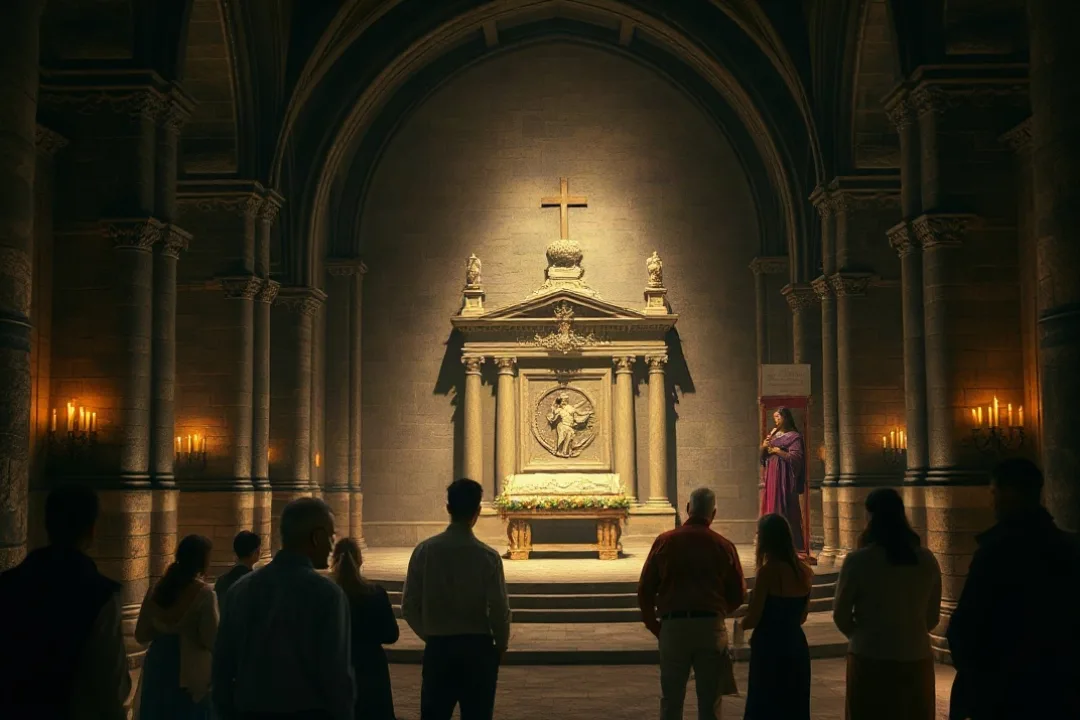
Her remains are said to rest in the crypt of Barcelona's cathedral, formally known as the Cathedral of the Holy Cross and Saint Eulalia, where a carved sarcophagus marks the traditional burial place beneath the main altar. The thirteen geese kept in the cathedral's cloister are popularly explained as a living reminder of her age and the number of her sufferings, although the practice of keeping geese there likely has older, more practical origins related to guarding the building.
Why Barcelona's cathedral is linked to her
Barcelona's Gothic cathedral did not start out dedicated to Eulalia alone. It grew on the site of earlier churches, and her relics were reportedly rediscovered and transferred into the building during the medieval period, cementing her status as a civic as well as religious figure.
The connection between the saint and the city deepened over the centuries as her feast became an occasion for public celebration, not just liturgical observance. Her association with the cathedral gave Barcelona a sense of sacred continuity, linking the medieval city back to the earliest centuries of Christian presence in the region.
Visitors to the cathedral today can see:
- The crypt beneath the main altar, where her sarcophagus is displayed
- The cloister, home to the thirteen geese associated with her legend
- Artwork and stained glass throughout the building referencing scenes from her martyrdom
- Processions and special Masses held around her February feast day
Feast days and how each St. Eulalia is celebrated
St. Eulalia of Mérida is commemorated on December 10, with local observances in Mérida that include special Masses and, in some years, cultural events tied to the city's Roman and early Christian heritage. Because her feast falls close to Advent, it tends to be a quieter, more liturgical observance compared to the Barcelona celebrations.
St. Eulalia of Barcelona's feast on February 12 is a major civic event in the city, often marked by several days of festivities that include:
- Processions through the old city featuring giant figures and traditional Catalan dances
- Performances by castellers, the human-tower builders associated with Catalan folk culture
- Concerts, markets, and family activities organized around the cathedral and surrounding squares
- Special illumination and decoration of public buildings in the historic quarter
These festivities reflect how a religious feast day can evolve into a broader expression of local identity, blending devotion with civic pride and seasonal community gathering.
Symbols and artistic depictions of St. Eulalia
Artists across centuries have depicted Eulalia with a consistent set of symbols drawn from her legend. She is frequently shown as a young girl, often holding a palm branch, which is the traditional symbol of martyrdom in Christian art.
Other recurring elements in depictions, particularly of the Barcelona tradition, include a cross on which she is sometimes shown bound, snow falling around her figure, and occasionally a dove, representing her soul departing at the moment of death. Medieval and Gothic representations tend to emphasize her youth and vulnerability contrasted with the violence of her ordeal, a visual choice meant to heighten the sense of her courage.
In Mérida, local art and church decoration draw more heavily on imagery tied to fire, reflecting the specific manner of her death described by Prudentius, along with references to the basilica and its long history as a pilgrimage site.
Practical tips for visiting sites connected to St. Eulalia
If you plan to visit places associated with either saint, a little preparation makes the experience more meaningful and helps you avoid common mix-ups.
- Confirm which Eulalia you're researching. Double-check whether a source is discussing the Mérida or Barcelona tradition, since details and feast dates differ.
- Visit the crypt in Barcelona's cathedral during quieter hours. Early mornings tend to be less crowded, giving you more time at the sarcophagus and surrounding chapels.
- Check festival dates in advance. The February celebrations in Barcelona can affect opening hours and transportation in the old city, so plan transportation and lodging accordingly.
- Pair a visit to Mérida's basilica with the nearby Roman ruins. The site's layered history, from Roman necropolis to Christian basilica, is easier to appreciate with some background on the city's archaeology.
- Look for the geese in Barcelona's cloister. They are a small but memorable detail connecting the cathedral's everyday life to the saint's legend.
A common mistake is assuming the two saints are simply duplicate versions of the same story told in different cities. While their legends share dramatic elements, each tradition developed its own local details, relics, and commemorations that are worth treating separately.
What her story has come to represent
Beyond the specific historical questions scholars continue to debate, Eulalia's story endures because it centers on a very young person choosing conviction over self-preservation. That theme has made her a recognizable figure well beyond strictly religious contexts, appearing in regional literature, local sayings, and civic symbolism tied to both Mérida and Barcelona.
For many residents of Barcelona in particular, St. Eulalia functions less as a distant historical figure and more as a thread connecting the modern city to its earliest recorded identity. The February festivities surrounding her feast keep that connection active for new generations, even among people who may not engage with the religious dimension of her story at all.
In Mérida, her memory is tied more closely to the physical continuity of a single sacred site that has been in use, in one form or another, for roughly seventeen centuries. That long, unbroken presence gives her cult there a different character: quieter, more rooted in place, and closely bound to the city's Roman past.
Frequently asked questions
Are St. Eulalia of Mérida and St. Eulalia of Barcelona the same person?
No, they are traditionally considered two separate martyrs. Both were young girls killed during Roman persecution of Christians in Spain, and their stories share similar details, but they come from distinct local traditions in Mérida and Barcelona with different feast days and relics.
When is St. Eulalia's feast day?
It depends on which saint. St. Eulalia of Mérida is celebrated on December 10, while St. Eulalia of Barcelona's feast falls on February 12, when the city holds several days of processions, music, and traditional Catalan celebrations.
Why are there geese in Barcelona Cathedral's cloister?
Popular tradition links the thirteen geese to St. Eulalia's legendary age and the number of torments she endured. The practice of keeping geese there may also have older practical roots, but it has become strongly associated with her story over time.
Where can you see St. Eulalia's relics today?
Tradition holds that St. Eulalia of Barcelona's remains rest in a carved sarcophagus in the crypt of Barcelona Cathedral, beneath the main altar. St. Eulalia of Mérida is honored at the basilica built over her traditional burial site in Mérida, Spain.
Leave a Reply