
Catholic calendar of saints and feast days explained
You flip to today's date hoping to find out whose feast it is, or maybe you noticed the priest wearing red instead of green and wondered why. The Catholic calendar of saints and feast days can look confusing at first glance, with its mix of solemnities, feasts, memorials, and seasons layered on top of the regular Gregorian calendar. Once you understand the basic structure, though, it becomes a surprisingly logical system that shapes the rhythm of Catholic worship all year long.
At its core, this calendar does two things at once. It walks through the life of Christ from Advent to the end of Ordinary Time, and it honors the saints whose lives are remembered on specific days, usually the date of their death, which the Church calls their "heavenly birthday."
What the liturgical calendar actually tracks
The liturgical calendar is not just a list of saints. It is built around two interlocking cycles: the temporal cycle, which follows the life of Jesus through seasons like Advent, Christmas, Lent, Easter, and Ordinary Time, and the sanctoral cycle, which assigns specific dates to individual saints and holy events.
When these two cycles overlap on the same date, there are rules for which one takes priority. A major solemnity like Christmas always outranks a saint's memorial. But on an ordinary Tuesday in July, a saint's day might be the main focus of that day's Mass readings and prayers.
Why some feasts move and others don't
Easter is a moveable feast, meaning its date changes every year based on the lunar calendar (the first Sunday after the first full moon following the spring equinox). Because so much of the calendar is built around Easter, including Lent, Ash Wednesday, Ascension, and Pentecost, those dates shift annually too.
Saints' feast days, by contrast, are usually fixed to a specific calendar date, like Saint Francis of Assisi on October 4 or Saint Patrick on March 17. A handful of exceptions exist, such as feasts that move to the nearest Sunday for pastoral reasons, but most saints keep the same date year after year.
The four ranks of celebrations in the Catholic calendar
Not every day on the calendar carries equal weight. The Church organizes celebrations into four tiers, each with its own level of liturgical importance.
- Solemnities are the highest rank, reserved for the most important mysteries of the faith and a few major saints. Examples include Christmas, Easter, the Immaculate Conception, and the feast of Saints Peter and Paul. These often come with vigil Masses and sometimes a holy day of obligation.
- Feasts rank below solemnities but still mark significant events or figures, such as the Transfiguration or the feast of an apostle.
- Memorials are the most common category, dedicated to individual saints on their assigned day. Most are "obligatory," meaning they're observed everywhere, while some are "optional," allowing priests to choose whether to highlight that saint or simply continue with the Ordinary Time readings.
- Commemorations are the lightest touch, a brief mention of a saint without changing the main liturgy of the day.
This ranking system explains why some feast days feel like major events with special Masses and traditions, while others pass almost unnoticed except for a line in the missal.
How saints get added to the calendar
A person doesn't appear on the calendar of saints automatically after death. The process, known as canonization, typically moves through several recognized stages before the Church formally declares someone a saint.
- The person is first named a Servant of God, opening an official investigation into their life and virtues.
- If their life is judged to reflect heroic virtue, they're declared Venerable.
- Beatification follows, usually requiring a verified miracle attributed to the person's intercession, after which they're called Blessed.
- A second miracle (in most cases) leads to full canonization, at which point the Church formally adds them to the universal calendar and assigns a feast day.
Martyrs sometimes follow a shorter path, since dying for the faith is itself considered a powerful witness. This whole process can take decades or even centuries, which is why new names still get added to the calendar regularly.
Good to know: Not every saint has a feast day observed worldwide. Many are celebrated only in specific countries, dioceses, or religious orders, reflecting local devotion rather than universal Church-wide observance.
How the universal calendar differs from local and national calendars
The Vatican maintains a universal calendar used throughout the entire Catholic Church, covering major solemnities and widely venerated saints. But individual countries, dioceses, and religious communities also maintain their own additions.
In the United States, for example, the national calendar includes feast days for saints with strong ties to American Catholic history, such as Saint Elizabeth Ann Seton and Saint Katharine Drexel, alongside the universal saints honored everywhere. A parish run by Franciscans might also observe extra feast days connected to Saint Francis or other figures from that religious order that wouldn't appear on a typical parish calendar elsewhere.
This layered system means two Catholics in different parts of the country, or different parts of the world, might notice slightly different saints highlighted on any given Sunday, even while sharing the same core liturgical structure.
What colors and seasons tell you about the calendar
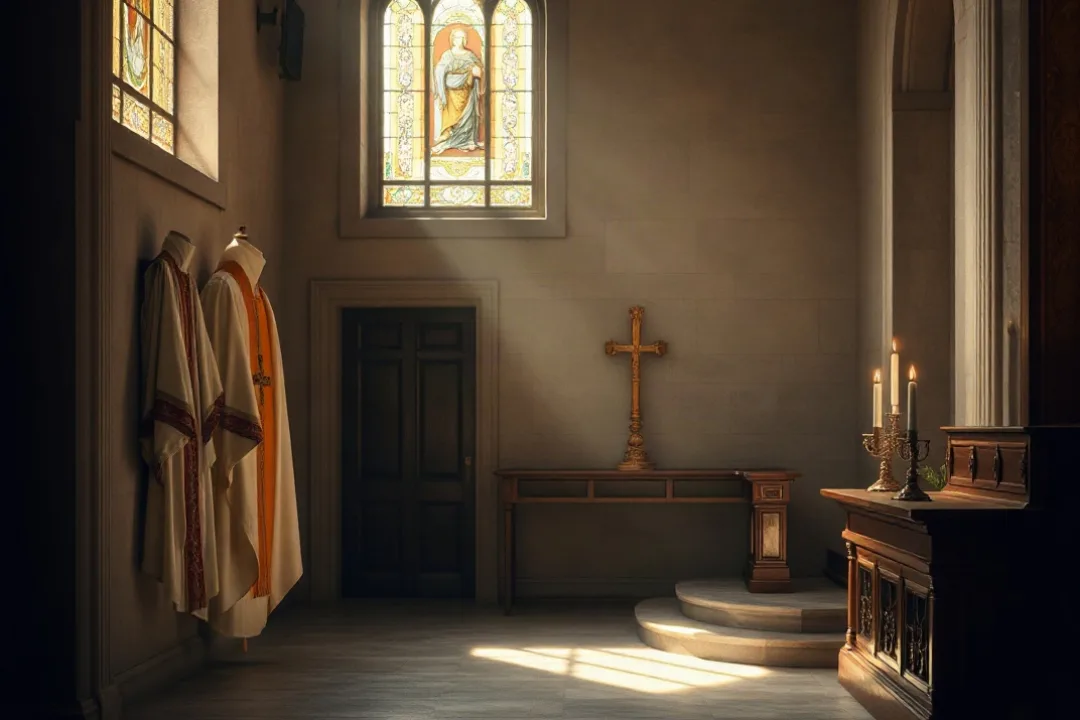
Liturgical colors are a quick visual cue for where you are in the calendar year. Priests' vestments and altar cloths change color to match the season or the type of feast being celebrated.
- Purple (or violet) marks penitential seasons like Advent and Lent, times of preparation and reflection.
- White or gold signals joy and celebration, used for Christmas, Easter, and feasts of saints who weren't martyred.
- Red appears for Pentecost, Palm Sunday, and feast days of martyrs, symbolizing the Holy Spirit or bloodshed for the faith.
- Green fills the long stretches of Ordinary Time, representing growth and hope between the major seasons.
- Rose shows up only twice a year, on Gaudete Sunday in Advent and Laetare Sunday in Lent, as a brief note of joy within a penitential season.
Noticing these colors is one of the simplest ways to follow along with the calendar even without memorizing every date.
How holy days of obligation fit into the picture
Within the broader calendar, a smaller set of dates carry a specific obligation for Catholics to attend Mass, separate from the usual Sunday requirement. In the United States, these typically include:
- Solemnity of Mary, Mother of God on January 1
- Ascension of the Lord, though in many U.S. dioceses this has been moved to the following Sunday
- Assumption of Mary on August 15
- All Saints' Day on November 1
- Immaculate Conception on December 8
- Christmas on December 25
Not every solemnity is a holy day of obligation, and the exact list can vary slightly by country depending on decisions made by local bishops' conferences.
Practical tips for following the calendar of saints day by day
Keeping track of feast days gets easier once you build a few habits around it. Here are some approaches that work well for individuals and families.
- Use a daily missal or app that lists the saint of the day along with the assigned Mass readings, so you don't have to look everything up separately.
- Pick a patron saint connected to your name, profession, or a personal interest, and mark their feast day to celebrate each year.
- Watch for color changes at Mass as a quick way to sense the liturgical season without needing a calendar in hand.
- Don't confuse optional memorials with required observances; many weekday saints are flexible, and a parish may honor a different saint than what's printed in a general calendar app.
- Check local and national calendars separately from the universal one, since a saint important in your region might not appear in a generic online list.
A common mistake is assuming every date has exactly one "correct" saint attached to it. In reality, several saints often share the same calendar day, and which one gets highlighted can depend on location, religious order, or even which edition of the missal is being used.
"We are not called to be successful, but to be faithful." This line, often associated with the spirit of Mother Teresa's work, captures why the calendar of saints exists in the first place: not to rank holiness, but to offer daily examples of lives lived with conviction.
How All Saints' Day and All Souls' Day relate to the calendar
Two dates near the start of November deserve special mention because they're often confused with each other. All Saints' Day, celebrated November 1, honors every saint in heaven, including the countless holy men and women who never received formal canonization or an individual feast day.
The very next day, All Souls' Day on November 2, shifts focus to praying for the souls of all the faithful departed, particularly those believed to still be undergoing purification before entering heaven. Together, these two days form a kind of bookend to the entire sanctoral cycle, reminding Catholics that the calendar of named saints represents only a fraction of those the Church believes are united with God.
Why the calendar still gets updated today
The list of saints is not frozen in time. Popes continue to canonize new saints regularly, and each addition eventually finds a place on the calendar, sometimes replacing or sharing a date with an existing observance.
Occasionally, the Vatican also revises how certain feasts are ranked or celebrated, as happened when liturgical reforms in the mid-twentieth century reorganized large portions of the sanctoral cycle. These changes explain why older missals or family prayer books sometimes list different dates or ranks than what's currently used in parishes.
Following the calendar of saints and feast days, in the end, is less about memorizing a fixed list and more about recognizing an evolving, living tradition that connects present-day worship to centuries of Christian witness.
Frequently asked questions
How is a saint's feast day usually chosen?
It's typically set on the date of the saint's death, viewed as their entrance into eternal life. When that date already honors another major feast, the Church sometimes assigns a nearby open date instead.
Can two saints share the same feast day?
Yes, this happens often. The universal calendar highlights one saint per day in most cases, but local, national, or religious order calendars may honor a different saint on that same date depending on regional devotion.
What's the difference between a memorial and a solemnity?
A solemnity marks the most significant mysteries of the faith or major saints, often with vigil Masses, while a memorial is a simpler, more common observance dedicated to an individual saint on an otherwise ordinary day.
Do Catholics have to attend Mass on every saint's feast day?
No. Mass attendance is only required on Sundays and on the specific holy days of obligation, such as Christmas or the Assumption. Most saints' feast days and memorials are optional observances, not obligations.
Leave a Reply