
What the Roman Missal is and how it shapes the Catholic Mass

If you have ever sat in a pew and watched the priest open a large, often red or gold-trimmed book at the altar, you have seen the Roman Missal in action. Many Catholics attend Mass for years without knowing its name or understanding why its exact wording matters so much. This guide explains what the Missal actually is, where it came from, and how it shapes everything from the opening greeting to the final blessing.
In short, the Roman Missal is the official liturgical book of the Roman Rite of the Catholic Church. It contains the prayers, instructions, and texts a priest needs to celebrate Mass throughout the liturgical year. It is not a Bible, a hymnal, or a prayer book for personal devotion, though it does contain some of the most carefully written prayers in the Catholic tradition.
What exactly is the Roman Missal
The Roman Missal is a liturgical book, meaning it is designed for use during the celebration of a sacrament rather than for private reading. It combines several elements that used to be found in separate medieval books: the prayers the priest says, the instructions (called rubrics, printed in red) telling him what to do and when, and the structure of the Mass from beginning to end.
Unlike a missal you might buy for personal use in the pew, which usually includes the Sunday readings as well, the official Roman Missal used at the altar focuses on the parts of the Mass that remain constant or that change according to the liturgical season, feast, or occasion. The Scripture readings themselves come from a separate book called the Lectionary.
Every parish priest relies on this book for:
- The opening rites, including the greeting and penitential act
- The Collect, or opening prayer, which changes daily
- The Eucharistic Prayer, including the words of consecration
- Prayers for specific feast days, saints, and special occasions like weddings or funerals
- Rubrics guiding posture, gestures, and the flow of the liturgy
Where the Roman Missal came from
The Missal did not appear overnight. Its roots go back to early Christian sacramentaries, handwritten collections of prayers used by bishops and priests as far back as the fourth and fifth centuries. Over the following centuries, these separate books for prayers, readings, and chants gradually merged into a single volume that a priest could use at the altar.
A major turning point came after the Council of Trent in the sixteenth century. In 1570, Pope Pius V issued a standardized Missal meant to unify liturgical practice across the Western Church, reducing the wide variation that had developed in different regions. This edition, often called the Tridentine Missal, remained largely unchanged for about four hundred years.
The next major shift came with the Second Vatican Council in the 1960s. The council called for a reform of the liturgy that would make the Mass more accessible, including the use of local languages instead of Latin exclusively. Pope Paul VI promulgated a revised Missal in 1969, commonly known as the Missal of Paul VI, which forms the basis of the Mass most Catholics attend today.
How many editions exist and why that matters
Since 1969, the Missal has gone through further revisions, known as typical editions, each one refining the Latin text used as the official reference point for all translations.
- The first typical edition (1970) implemented the initial post-Vatican II reforms
- The second typical edition (1975) made minor adjustments
- The third typical edition (2000, with a later printing in 2002) introduced new prayers, additional saints' feasts, and more precise rubrics
Each country's bishops' conference then works with the Vatican to produce an official translation of the Latin typical edition into the local language. This is why English-speaking Catholics experienced a noticeable change in the words of the Mass around 2011, when a new English translation of the third typical edition went into use.
Why the 2011 English translation changed familiar words
Many longtime Mass-goers remember the shift from saying "And also with you" to responding "And with your spirit" after the priest's greeting. This was not a random stylistic choice. The new translation aimed to follow the original Latin more closely, reflecting a principle called formal equivalence, which prioritizes fidelity to the source text's structure and theological nuance over smoother, looser English phrasing.
Good to know: the goal of the 2011 translation was not to change Catholic teaching but to express it with greater precision, restoring scriptural and theological richness that earlier translations had simplified.
Other noticeable changes included the Nicene Creed's phrase "consubstantial with the Father" replacing "one in Being with the Father," and the priest's invitation before Communion becoming closer to the biblical reference in the Gospel of Matthew, where a Roman centurion expresses unworthiness to receive Jesus under his roof.
What you will find inside the Missal, section by section
Opening the Roman Missal reveals a carefully organized structure built to guide a priest through the entire liturgical year without confusion.
- The Proper of Time, also called the Temporale, contains prayers tied to the seasons: Advent, Christmas, Lent, Easter, and Ordinary Time
- The Proper of Saints, or Sanctorale, provides prayers for specific saints' feast days throughout the year
- The Order of Mass (Ordo Missae) lays out the fixed structure and texts used at every Mass, including the Eucharistic Prayers
- Common prayers for categories like martyrs, virgins, or pastors, used when a particular saint does not have a unique set of prayers assigned
- Ritual Masses for occasions such as weddings, confirmations, or religious professions
- Votive Masses and Masses for Various Needs, which can be chosen for particular intentions like peace, the sick, or civil authorities
Understanding the role of rubrics
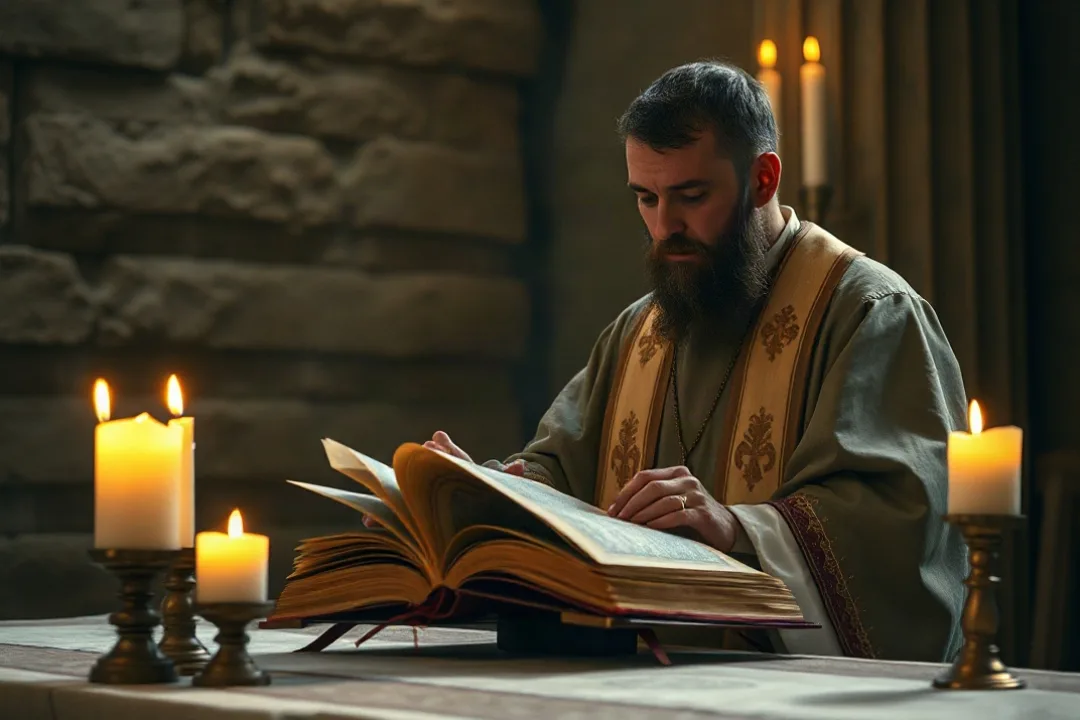
Scattered throughout the Missal are short instructions printed in red ink, a tradition that gives us the word "rubric" (from the Latin "ruber," meaning red). These tell the priest when to bow, when to extend his hands, when incense should be used, and how the Mass should flow from one part to the next. Rubrics exist to maintain consistency so that the Mass follows a recognizable pattern no matter where it is celebrated.
How the Missal is actually used during Mass
Watching a Mass with the Missal in mind makes the structure much easier to follow. Here is a simplified walk-through of how the book gets used from start to finish:
- The priest or deacon opens to the appropriate day's prayers, often marked with a ribbon placed in advance
- During the Introductory Rites, he reads the greeting, the penitential act, and the Collect, all taken directly from the Missal
- The Liturgy of the Word uses the separate Lectionary, so the Missal is set aside briefly except for short transitional prayers
- At the Liturgy of the Eucharist, the Missal returns to center stage for the Preparation of the Gifts, the Eucharistic Prayer, and the Communion Rite
- Closing prayers and the final blessing, again drawn from the Missal, bring the Mass to its conclusion
Because the prayers change daily according to the liturgical calendar, priests often prepare the Missal before Mass begins, placing ribbons or markers at the correct pages for the day's Collect, Prayer over the Offerings, and Prayer after Communion.
How the Roman Missal differs from other liturgical books
People sometimes confuse the Missal with other books used in church, so a quick comparison helps clarify the distinctions:
- The Lectionary contains the Scripture readings for Mass, organized on a three-year cycle for Sundays and a two-year cycle for weekdays
- The Book of the Gospels holds only the Gospel readings, often carried in procession and treated with special reverence
- The Liturgy of the Hours is a separate set of books for daily prayer at fixed times, distinct from the Mass itself
- Personal missals sold for pew use typically combine Mass prayers and daily readings into one portable volume for the congregation, unlike the large altar edition used by the priest
Why the exact wording of the Missal matters so much
Catholic theology holds that the way the Church prays reflects and shapes what it believes, summarized in the old Latin phrase lex orandi, lex credendi — the law of prayer is the law of belief. Because of this, even small wording choices in the Missal are debated carefully by scholars, translators, and bishops before approval.
The Second Vatican Council's Constitution on the Sacred Liturgy described the liturgy as "the summit toward which the activity of the Church is directed," underscoring why its texts receive such careful attention.
This explains why translation projects can take years and why revisions are not treated as mere style updates. A phrase that sounds slightly different in English can carry real theological weight, affecting how the faithful understand concepts like grace, sacrifice, or the nature of the Eucharist.
Common questions people have when they first notice the Missal
Several practical points come up repeatedly for Catholics who start paying closer attention to this book during Mass.
- Can laypeople own a Roman Missal? Yes, though most Catholics use a smaller "missal" or worship aid designed for the pew, which includes the daily readings alongside Mass prayers rather than the full altar edition
- Does every country use the same Missal? The Latin typical edition is the same worldwide, but each language has its own approved translation, and small regional adaptations are sometimes permitted
- Who approves changes to the Missal? The Vatican's Dicastery for Divine Worship works with national bishops' conferences, and any new translation needs papal approval (a process called "recognitio")
- Is the Missal the same as the Mass itself? No, the Missal is the script and instructions; the Mass is the liturgical celebration that uses it
Understanding these distinctions helps explain why a trip to a different country does not mean an unrecognizable Mass. The structure, prayers, and even the Latin originals remain the same, even when the spoken language changes from English to Spanish, French, or Tagalog.
What changes and what stays the same across the liturgical year
One of the more interesting aspects of the Missal is how it balances consistency with variation. The core structure of the Mass, the Order of Mass, never changes. What shifts are the specific prayers tied to the day.
During Advent and Christmas, the Collects emphasize waiting, hope, and the incarnation. In Lent, prayers turn toward repentance and fasting. Easter season prayers celebrate resurrection and new life, often using joyful language absent from the rest of the year. Feast days for individual saints bring their own unique prayers that highlight the particular virtues or history associated with that person.
Tip for following along: if you want to understand why the opening prayer sounds different week to week, it is tied directly to the liturgical season or the saint being honored that day, all drawn from the same Missal but different sections within it.
How priests and parishes obtain and care for the Missal
Parishes typically purchase the Roman Missal through Catholic publishers approved to print the officially sanctioned text, since unauthorized reproductions are not permitted for liturgical use. A full altar edition is a substantial, often leather-bound book meant to last many years of daily use.
Because the Missal receives heavy handling at every Mass, many parishes also use ribbon markers, stands, and protective covers to keep the book in good condition. Some older missals are retired and replaced only when a new typical edition or translation is formally introduced, which does not happen often, given how much coordination a revision requires.
Frequently asked questions
Is the Roman Missal the same thing as the Bible?
No. The Roman Missal contains the prayers and instructions used during Mass, while Scripture readings come from a separate book called the Lectionary. The Missal does quote and echo biblical language in many of its prayers, but it is not itself a book of Scripture.
Why did the words of the Mass change in 2011?
The English-speaking Church adopted a new translation of the Roman Missal's third typical edition, aiming for greater fidelity to the original Latin text. This produced changes like responding "And with your spirit" instead of the earlier wording, reflecting more precise theological language.
Can I buy a Roman Missal for personal use at home?
Yes, smaller missals designed for individual or pew use are widely available and typically combine the Mass prayers with the day's Scripture readings. These differ from the large altar edition priests use, which focuses mainly on prayers and rubrics rather than full readings.
Does the Roman Missal apply to all Catholics worldwide?
It applies specifically to the Roman Rite, the largest rite within the Catholic Church. Other Catholic rites, such as the Byzantine or Maronite rites, use their own distinct liturgical books with different structures and traditions, though they remain in full communion with Rome.
Leave a Reply