
What are Catholic churches? A clear guide to the basics
Maybe you drove past a stone building with a cross on top, stained glass windows, and statues near the entrance, and wondered whether it was Catholic. Or maybe a friend invited you to Mass and you want to know what you're walking into. Either way, the question "what are Catholic churches" usually has two layers: the physical buildings where Catholics worship, and the larger institution — the Catholic Church itself — that those buildings belong to.
Both answers matter, because a Catholic church building is never just a neutral meeting space. It's designed and arranged according to specific beliefs about worship, sacraments, and community, all connected to a global organization with its own leadership, history, and structure.
What makes a church "Catholic" in the first place
A Catholic church is a place of worship that belongs to the Catholic Church, a Christian body that traces its leadership back to the apostles and recognizes the Pope, the Bishop of Rome, as its earthly head. The word "catholic" itself comes from a Greek term meaning "universal," reflecting the Church's claim to be a worldwide community united in the same core beliefs and sacraments, even though it includes many cultures, languages, and local traditions.
Not every building with a steeple and stained glass is Catholic. Lutheran, Episcopal, and some Orthodox churches can look similar from the outside. What distinguishes a Catholic church is less about architecture and more about what happens inside: the celebration of the Mass, the presence of the tabernacle, and a structure of leadership connecting the local parish all the way up to Rome.
Quick way to tell: if a church has a small lamp burning near a box or niche on or near the main altar, that's usually the tabernacle, where consecrated bread is kept. Its presence is one of the clearest signs you're in a Catholic (or Eastern Catholic) church.
How a Catholic church building is typically arranged
Catholic churches vary enormously in size and style, from small rural chapels to massive cathedrals, but most share a recognizable layout shaped by centuries of tradition.
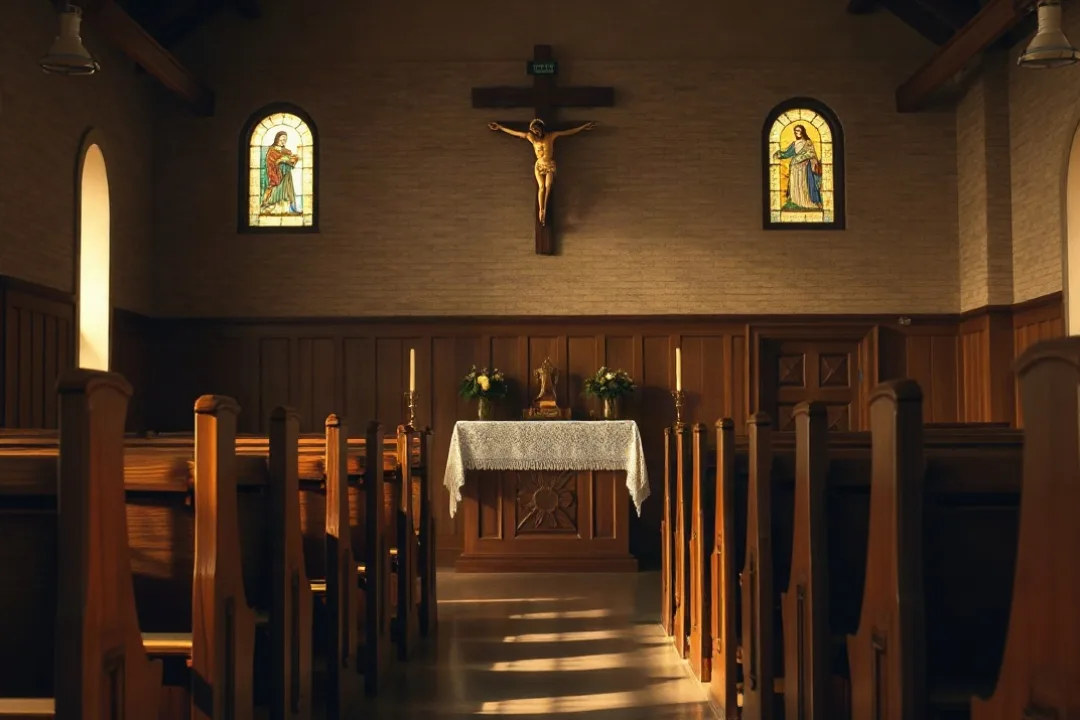
- The altar: a raised table at the front where the priest celebrates Mass; it's the visual and spiritual focal point of the building.
- The tabernacle: a locked box, often gold or ornate, where the consecrated host is reserved between Masses for adoration and for bringing communion to the sick.
- The sanctuary: the area around the altar, usually set apart by steps, a railing, or a change in flooring.
- Pews or seating: arranged facing the altar, often in long rows with kneelers attached.
- The crucifix: a cross showing the figure of Jesus, typically placed prominently above or near the altar, distinguishing Catholic churches from many Protestant ones that use a plain cross.
- Confessionals: small enclosed booths or rooms used for the sacrament of reconciliation, usually along the side walls.
- Statues and stained glass: images of Mary, saints, and biblical scenes, meant to teach and inspire devotion rather than to be worshipped themselves.
- Holy water fonts: small basins near the entrance where people dip their fingers and make the sign of the cross upon entering.
Some older or larger churches also have side chapels dedicated to particular saints, a baptismal font (sometimes near the entrance, sometimes near the altar), and a choir loft or music area.
What's the difference between the Catholic Church, a diocese, and a parish
People often use "the Catholic Church" loosely, but the organization actually works in layers, somewhat like a nested structure of responsibility.
- The worldwide Catholic Church is led by the Pope, currently based at the Vatican in Rome, and includes more than a billion members across nearly every country.
- A diocese is a regional division, usually covering a city or group of counties, overseen by a bishop. The United States, for example, is divided into roughly 190 dioceses and archdioceses.
- A parish is the local community most Catholics actually belong to — the specific church building where you'd go to Mass, have a baby baptized, or attend a funeral, usually led by a pastor (a priest) and sometimes assisted by associate priests or deacons.
This structure means that while beliefs and core practices are consistent worldwide, day-to-day decisions about parish life, schedules, and ministries are handled locally, within guidelines set by the diocese and ultimately by the universal Church.
Are all Catholic churches the same? Roman Catholic and Eastern Catholic churches
Most people picture the Roman Catholic Church when they think of Catholic churches, and it's by far the largest branch. But the Catholic Church is actually a communion of 24 individual churches, all united under the Pope but with different histories, languages, and liturgical styles.
- Roman Catholic (Latin Rite): the largest group by far, using the Mass format most Americans would recognize, typically in English or Latin.
- Eastern Catholic churches: smaller communities such as the Ukrainian Greek Catholic Church, Maronite Catholic Church, or Melkite Catholic Church, which share full communion with Rome but celebrate liturgies that look and sound closer to Eastern Orthodox worship — with incense, icons, chanted prayers, and married priests in some traditions.
Walking into an Eastern Catholic church can feel quite different from a typical American parish, with icons covering the walls and a different rhythm to the service, yet both are fully Catholic and recognize the same Pope.
What actually happens inside a Catholic church during worship
The central act of worship in any Catholic church is the Mass, celebrated daily in most parishes and especially on Sundays and holy days. A typical Sunday Mass runs about 45 minutes to an hour and follows a consistent structure.
- The Introductory Rites: an opening hymn, greeting, and a brief penitential prayer.
- The Liturgy of the Word: readings from the Old Testament, a psalm, a New Testament letter, and a Gospel reading, followed by a homily (a short reflection) from the priest.
- The Liturgy of the Eucharist: bread and wine are brought forward, blessed, and consecrated; Catholics believe this bread and wine truly become the body and blood of Christ.
- Communion: baptized Catholics in good standing with the Church come forward to receive the consecrated host.
- The Concluding Rites: a final blessing and dismissal.
Throughout the Mass there's a mix of standing, sitting, and kneeling, along with responses the congregation says together. First-time visitors aren't expected to know every cue, and it's completely acceptable to simply follow along or stay seated during parts you're unsure about.
What beliefs shape everything that happens in a Catholic church
Catholic worship and church design aren't arbitrary. They flow from specific beliefs that have been held consistently for centuries.
The Nicene Creed, recited at every Mass, describes the Church as
"one, holy, catholic, and apostolic."
That phrase summarizes four convictions: that the Church is unified in faith, set apart for a sacred purpose, universal in scope, and connected historically to the apostles through an unbroken line of leadership.
Catholics believe in seven sacraments — baptism, confirmation, Eucharist, reconciliation, anointing of the sick, holy orders, and matrimony — and a Catholic church is built, in large part, to support those sacraments. The baptismal font, confessionals, and altar aren't decoration; they're functional spaces for specific rites that Catholics consider essential to spiritual life.
Worth remembering: Catholics don't worship statues or images of Mary and the saints. These are understood as reminders and sources of inspiration, similar to looking at a photograph of someone you admire — the honor given to the image points beyond itself.
Who leads a Catholic church, from the parish up to Rome
Leadership in Catholic churches follows a chain that many newcomers find easier to understand as a ladder of responsibility rather than a single flat hierarchy.
- The Pope: the bishop of Rome and the visible head of the worldwide Church, elected by cardinals and serving until death or resignation.
- Cardinals: senior church leaders, often archbishops of major cities, who advise the Pope and elect his successor.
- Bishops: lead individual dioceses, ordain priests, and oversee parishes within their territory.
- Priests: lead individual parishes, celebrate Mass, hear confessions, and administer most sacraments.
- Deacons: ordained ministers who assist priests, can baptize and witness marriages, but cannot celebrate Mass or hear confessions.
- Religious sisters and brothers: members of religious orders (such as Franciscans or Dominicans) who may teach, run hospitals, or serve parishes, though they aren't ordained clergy.
This structure explains why a decision made in Rome, like a change to liturgical guidelines, eventually trickles down and affects what happens at a small parish thousands of miles away.
How Catholic churches differ from Protestant and Orthodox churches
Visitors sometimes assume all churches operate the same way, but there are real structural and theological differences worth knowing.
- Compared to most Protestant churches: Catholic churches emphasize the sacraments (especially the Eucharist) as central to worship, include devotion to Mary and the saints, and operate under a hierarchical leadership tied to the Pope rather than independent congregations or denominational boards.
- Compared to Eastern Orthodox churches: Catholic and Orthodox churches share much of the same sacramental theology, ancient liturgical roots, and reverence for Mary and the saints, but they differ on the authority of the Pope — Orthodox churches don't recognize his universal jurisdiction — and on a handful of theological and historical points that led to a formal split centuries ago.
- Compared to nondenominational churches: Catholic parishes follow a set liturgical calendar and readings used worldwide, rather than sermon series chosen locally, and they maintain practices like fasting during Lent and specific holy days of obligation.
Simple signs you can use to recognize a Catholic church from the outside
If you're trying to figure out whether a building you're looking at is Catholic, a few visual clues help, even before stepping inside.
- A crucifix (cross with the figure of Christ) rather than a bare cross on the exterior or above the entrance.
- A dedication name that often references a saint, Mary, or a title like "Our Lady of" or "Sacred Heart."
- A cornerstone or plaque listing a founding date and sometimes the name of the diocese.
- A rectory or parish office nearby, where the priest typically lives or works.
- A school or parish hall attached or adjacent, since many Catholic parishes run elementary schools.
None of these signs is absolute proof on its own, but together they're a reliable way to spot a Catholic parish in most American towns and cities.
Frequently asked questions
What is the difference between a Catholic church and a cathedral?
A cathedral is simply the main church of a diocese, where the bishop has his official seat (called a cathedra). It's still a Catholic church in every sense, just the headquarters church for that region, often larger and more ornate than a typical parish.
Can anyone attend Mass at a Catholic church?
Yes, Mass is open to the public regardless of religion or background. Visitors are welcome to observe, stand or sit as the congregation does, and participate in prayers if they feel comfortable, though receiving communion is reserved for baptized Catholics in good standing.
Why do Catholic churches have statues and images of Mary and saints?
These images serve as visual reminders of people considered models of faith, not objects of worship themselves. Catholics ask saints to pray on their behalf, similar to asking a friend for prayer support, while all worship is directed to God alone.
How many Catholic churches are there in the United States?
Estimates put the number at roughly 17,000 parishes across the country, organized into about 190 dioceses and archdioceses, making the Catholic Church one of the largest single religious organizations in the United States.
Leave a Reply