
What children's liturgies are and how they work in church
Children's liturgies (often called Children's Liturgy of the Word) are age-appropriate gatherings held during part of a church service, usually while the congregation listens to the Scripture readings and homily. Children, typically from preschool through elementary age, leave the main worship space with trained leaders to hear the same readings explained in simpler language, often through stories, discussion, or craft activities. They return to the congregation before the offertory or communion, having engaged with the same message as the adults in a way suited to their attention span and comprehension.
The practice is most common in Catholic parishes, but many Protestant congregations run similar programs under names like "children's church," "junior church," or "kids' worship." The underlying goal is the same everywhere: helping young children connect with the themes of the service without asking them to sit through an adult-length sermon they can't yet follow.
Why churches offer a separate liturgy for children
Anyone who has tried to keep a four-year-old quiet through a twenty-minute homily knows the challenge. Children's liturgies exist because young children process language and attention very differently from adults. A reading from Isaiah or a parable from Luke can be rich for grown-ups and nearly meaningless to a six-year-old without translation into concrete images and relatable situations.
Beyond simply managing restlessness, the practice reflects a belief that children deserve their own encounter with the same Word proclaimed to the rest of the community. Rather than being sidelined with coloring sheets unrelated to the service, they hear the same Gospel story, just told at their level.
There's also a formation goal. Regular participation introduces children to the rhythm of the liturgical year, familiar prayers, and biblical vocabulary long before they're ready for catechism classes in the traditional classroom sense.
How a typical children's liturgy session is structured
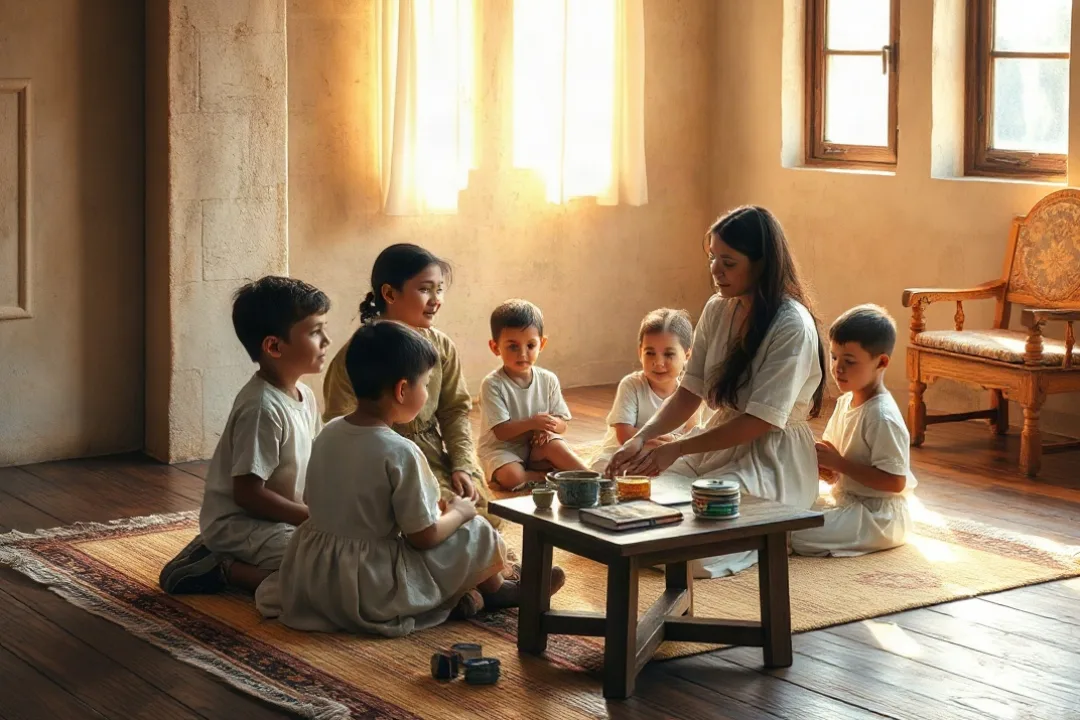
Most sessions follow a simple arc that mirrors the main service, scaled down:
- Gathering and greeting: a leader welcomes the children, sometimes with a short opening prayer or song.
- Proclamation of the Word: one or more readings are shared, often in a simplified version written for children rather than the full adult lectionary text.
- Reflection or discussion: the leader asks open-ended questions, tells a related story, or uses props to unpack the meaning.
- Response activity: drawing, a short craft, acting out the story, or a simple written reflection tied directly to the reading.
- Closing prayer: often a spontaneous prayer led by a child or a familiar memorized prayer.
- Return to the congregation: children rejoin their families, sometimes carrying their artwork or a card summarizing the lesson.
The whole thing usually lasts between fifteen and twenty-five minutes, timed to match the length of the adult readings and homily.
How content is adapted by age group
Many parishes split children into at least two groups because a three-year-old and a ten-year-old need very different approaches.
Preschool and early elementary (roughly ages 3-7)
At this age, sessions rely heavily on visual storytelling, repetition, and movement. Leaders might use felt boards, puppets, or simple picture books rather than reading a text aloud word for word. Songs with hand motions help hold attention and reinforce the lesson's core idea, such as sharing, forgiveness, or gratitude.
Upper elementary (roughly ages 8-11)
Older children can handle more of the actual Scripture text and benefit from discussion questions that connect the reading to situations in their own lives, like dealing with a disagreement with a sibling or feeling left out at school. Journaling, short skits, and small-group conversation work well here.
Some parishes also run a separate track for middle schoolers, though by that age many congregations shift toward youth group models rather than a children's-liturgy format.
Who leads children's liturgies and what training they need
Leaders are usually volunteers: parents, catechists, retired teachers, or older teens working under adult supervision. Parishes generally require some combination of the following before someone leads a session unsupervised:
- A background check, since the role involves regular, unsupervised contact with minors.
- Basic safe-environment training covering supervision ratios, appropriate physical contact, and reporting procedures.
- Familiarity with the lectionary cycle or curriculum the parish uses, so the children's session actually lines up with what's being read in the main service.
- A second adult present at all times, both for safety and so no single volunteer is ever alone with a group of children.
Good leaders don't need theology degrees, but they do need patience, comfort speaking in front of a group, and the flexibility to adjust on the fly when a story isn't landing or a child is having a rough morning.
A quick note on consistency: children's liturgy works best when it happens every week, not just on special occasions. Irregular scheduling confuses kids and makes it harder for leaders to build on themes from one week to the next.
Common mistakes and practical tips for running a strong session
Even well-meaning volunteers can run into the same handful of pitfalls. Keeping these in mind helps sessions stay engaging and age-appropriate:
- Don't read the adult text unchanged. A reading written for adult ears, full of long sentences and abstract theology, will lose most children within a minute. Use a children's lectionary resource or paraphrase the story in your own words.
- Avoid sessions that run too long. If the main service's readings and homily take fifteen minutes, don't keep children away for thirty. Watch the clock and have the group back in their seats before the congregation starts looking for them.
- Don't skip the discussion step. Jumping straight from story to craft without any conversation means children miss the chance to actually process what they heard.
- Match the activity to the lesson. A coloring page of a rainbow doesn't help much if the reading was about the Good Samaritan. Pick crafts and questions that reinforce the specific theme of the day.
- Keep group sizes manageable. One adult can realistically handle attention and safety for maybe eight to twelve young children; beyond that, recruit a second or third volunteer.
- Plan for latecomers and criers. Have a simple routine for children who arrive mid-session or who need a quiet moment, rather than letting disruptions derail the whole group.
- Rotate leaders occasionally. Relying on the same one or two volunteers every week leads to burnout; a rotating roster keeps the program sustainable.
What materials and resources parishes typically use
Running a children's liturgy program doesn't require an elaborate budget, but a few basic resources make a real difference:
- A children's lectionary or adapted Scripture resource that follows the same three-year or one-year cycle as the main service.
- A simple supply kit: crayons, paper, scissors, glue, and printable activity sheets tied to the weekly theme.
- A dedicated, child-safe space away from the main worship area, ideally with a door for noise control but still easily supervised.
- A short planning guide or lesson outline so volunteers aren't improvising from scratch each week.
- A simple sign-in and sign-out system so parents know exactly who picked up their child and when.
Many dioceses and publishers produce ready-made curricula that map directly onto the liturgical calendar, which saves volunteer leaders from having to write their own lesson plans every week.
How children's liturgy differs across denominations and traditions
While the Catholic model of Children's Liturgy of the Word is probably the most formally structured version, similar practices exist well beyond Catholic parishes.
Episcopal and Lutheran congregations often run comparable programs, sometimes called "Godly Play," which uses storytelling with simple wooden figures and open-ended wondering questions rather than direct explanation. Many evangelical and nondenominational churches offer "children's church" that looks more like a scaled-down worship service, complete with songs, a short talk, and games, rather than a strict mirror of the adult lectionary.
What ties these approaches together is the conviction that children shouldn't simply be minded until the "real" service ends. As one widely cited catechetical principle puts it:
Children are not the Church of tomorrow; they are the Church of today.
That idea, often attributed to reflections from the Second Vatican Council era, underlies why so many congregations invest real effort into making the Word accessible to their youngest members rather than treating their presence as an afterthought.
How parents can support what happens in children's liturgy
Parents play a bigger role than they might realize, even if they're sitting in the main service while their child is elsewhere.
- Ask open questions afterward rather than yes-or-no ones. "What was the story about today?" works better than "Was it good?"
- Keep the take-home material visible for a few days, whether that's a craft, a coloring sheet, or a printed reflection card, so the lesson has a chance to come up again during the week.
- Volunteer occasionally, even just once a month. Programs run on rotating volunteers tend to be far more sustainable than ones depending on two or three overworked regulars.
- Talk with the leader directly if a child seems anxious about leaving the main service or struggles with transitions; a small adjustment, like sitting near the door or having a familiar face nearby, often solves it.
Consistency at home reinforces consistency at church. A child who hears the same biblical themes echoed in both places tends to retain far more than one who only encounters them for twenty minutes on Sunday.
Frequently asked questions
What age range is children's liturgy usually designed for?
Most programs serve children roughly ages 3 through 11, often split into a younger group (preschool to early elementary) and an older group (upper elementary). Toddlers under 3 and children in middle school typically move into separate nursery care or youth group programs instead.
Do children miss anything important by leaving the main service?
They miss the homily and adult-level readings, but they hear the same Scripture passages in a simplified form during their own session and rejoin the congregation before the offertory or communion, so they're present for the central parts of the service.
Do volunteers need special training to lead a children's liturgy session?
Most parishes require a background check and basic safe-environment training before anyone works with children, plus some familiarity with the lectionary or curriculum being used. A second adult is usually required to be present for safety and supervision.
How is children's liturgy different from Sunday school?
Children's liturgy happens during the service itself and directly mirrors that day's readings in simplified form, while Sunday school usually happens at a separate time and follows its own broader curriculum not necessarily tied to that week's lectionary.
Leave a Reply