
Understanding the requiem mass order of service

A requiem mass follows the same basic structure as every Catholic funeral liturgy, moving through an opening rite, readings, the eucharistic prayer, and a final farewell before burial. The order rarely changes from parish to parish because it comes directly from the Order of Christian Funerals, the official liturgical book priests use. Knowing this structure in advance makes it easier for families to plan a service and for guests to follow along without feeling lost.
The word "requiem" comes from the opening line of the traditional Latin entrance chant, Requiem aeternam dona eis, Domine — "Grant them eternal rest, O Lord." Today the term is used loosely for any funeral Mass, whether it includes that specific chant or not. What matters most to families planning one is understanding each part of the service and the choices available within it.
What happens during the opening rites
The service usually begins at the entrance of the church, where the priest greets the casket or urn and sprinkles it with holy water as a reminder of baptism. A white pall, symbolizing the garment of baptism, is often placed over the casket at this point by family members or friends.
The procession then moves up the aisle, typically accompanied by an opening hymn or the traditional Latin chant mentioned above. Once everyone reaches their seats, the priest offers a brief greeting and opening prayer that sets the tone for the liturgy, asking for comfort for the mourners and mercy for the person who has died.
- Entrance procession: casket, family, and ministers walk in together
- Sprinkling with holy water: a sign of the deceased's baptism
- Placing of the pall: an optional but meaningful gesture for family members
- Opening prayer: spoken by the priest, naming the deceased
How the liturgy of the word is structured
This section includes scripture readings, usually three in total, chosen by the family in consultation with the priest. A first reading from the Old Testament, a second from the New Testament epistles, and a Gospel reading form the backbone of this part of the service.
Common choices include passages that speak to comfort and hope, such as Isaiah 25:6-9, which describes a banquet where mourning is wiped away, or John 11, the account of Lazarus being raised, which speaks to belief in resurrection. A responsorial psalm, often Psalm 23 or Psalm 130, is sung or recited between the first and second readings.
After the Gospel, the priest delivers a homily. In a Catholic funeral Mass this is meant to reflect on the readings and on the hope of resurrection rather than function as a personal eulogy, which is why many parishes reserve personal tributes for the wake, the reception, or a brief moment at the end of Mass before the final commendation.
Good to know: Most dioceses discourage a full eulogy during Mass itself. Families who want to share personal memories are usually invited to do so at the vigil service the night before or during the reception afterward.
What takes place during the liturgy of the eucharist
This central portion of the Mass mirrors a regular Sunday liturgy. It begins with the Prayers of the Faithful, a set of petitions that typically ask for mercy on the deceased, comfort for the grieving family, and peace for all who mourn.
Family members or close friends are often invited to read these petitions aloud. After this, the presentation of the gifts takes place, where bread and wine are brought forward, sometimes along with symbols connected to the deceased's life, such as a Bible, a photograph, or an object tied to their work or faith.
The eucharistic prayer follows, the same consecration prayer used at every Mass, during which the priest specifically remembers the deceased by name. Communion is then distributed to those who are prepared to receive it according to Catholic practice.
- Prayers of the Faithful
- Presentation of the gifts
- Eucharistic prayer and consecration
- The Lord's Prayer
- Sign of peace
- Communion
- Prayer after communion
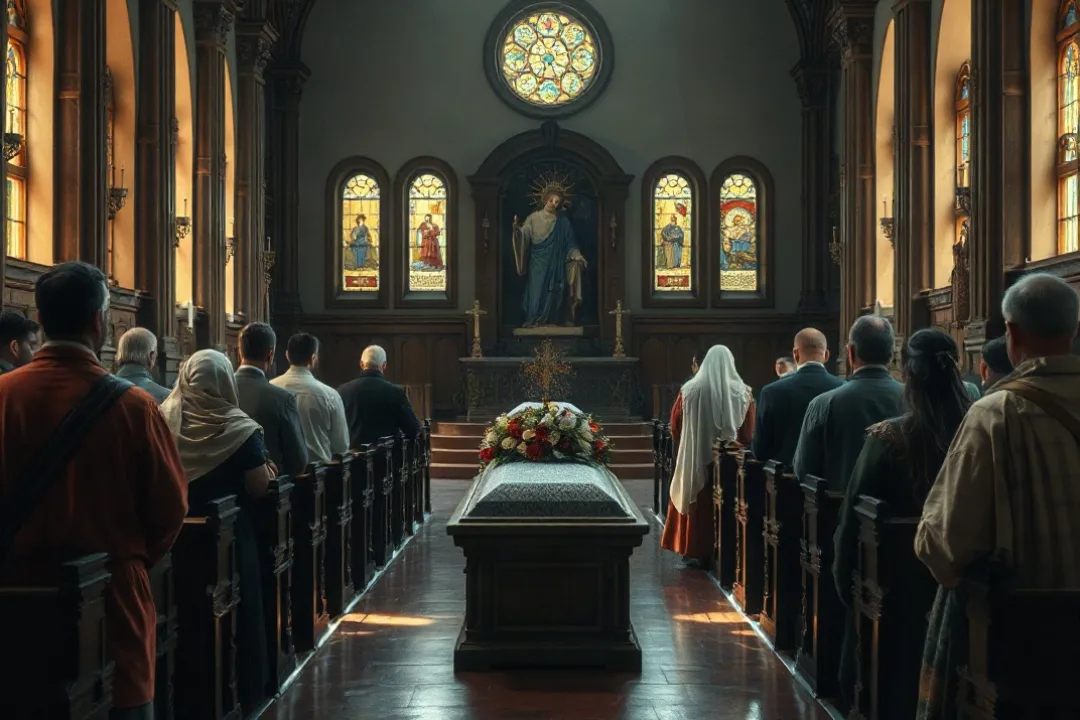
What happens during the final commendation and farewell
Once communion concludes, the Mass moves into its most emotionally significant section: the final commendation. This is the Church's formal farewell to the deceased before the body leaves for the cemetery or crematorium.
The priest incenses the casket as a sign of honor, and a final song of farewell is often sung, frequently the traditional In Paradisum or a contemporary hymn chosen by the family. This moment is brief but deliberate, giving mourners one last structured opportunity to say goodbye within the liturgy itself.
Grant them eternal rest, O Lord, and let perpetual light shine upon them.
The recessional follows, with the casket carried back down the aisle, usually to another hymn, as family and guests follow behind. From here, most families proceed directly to the cemetery for the rite of committal, a shorter graveside service with its own brief prayers.
How music and hymn choices shape the service
Music plays a defining role in how a requiem mass feels. Families typically work with the parish music director to select hymns appropriate for each part of the service, keeping in mind that most parishes have guidelines about which songs are considered suitable for liturgical use.
Common choices include:
- Entrance hymn: "On Eagle's Wings" or "Be Not Afraid"
- Responsorial psalm: Psalm 23, "The Lord Is My Shepherd"
- Communion hymn: "Ave Maria" or "How Great Thou Art"
- Final song of farewell: "In Paradisum" or "Song of Farewell"
- Recessional: "How Great Thou Art" or an instrumental piece
Secular songs are generally not permitted during the Mass itself, though many families play a favorite song during the visitation, the reception, or at the cemetery, where the rules are less strict.
How to put together a printed order of service
Many families choose to print a simple booklet or single sheet so guests can follow the service and have something to keep as a remembrance. A well-organized program typically includes the deceased's full name and dates, a brief welcome, and the sequence of the Mass with hymn titles and reading citations.
A practical approach is to list each section in the order it occurs, rather than including every word of every prayer, since the priest and missalette already provide the full text for responses.
- Cover page with name, birth and death dates, and a photo
- Order of the procession and opening rite
- List of readings with the names of those reading them
- Hymn titles for entrance, offertory, communion, and recessional
- Names of pallbearers and officiants
- A short note of thanks from the family
It helps to confirm final hymn and reading selections with the priest or music director at least a week before the service, since last-minute changes can create confusion for the funeral home printing the programs.
How a requiem mass differs from other funeral services
Not every funeral includes a full Mass. A funeral Mass, sometimes called a requiem mass, includes the celebration of the Eucharist, while a funeral liturgy outside Mass follows a similar structure of readings and prayers but omits the eucharistic portion, often used when a priest is unavailable or when many attendees are not Catholic.
A memorial Mass follows the same order but takes place without the body present, sometimes weeks or months after the death. Protestant and nondenominational funeral services are typically shorter, more flexible in structure, and built around a eulogy and personal tributes rather than a fixed liturgical sequence.
Keep in mind: Catholic funeral norms can vary slightly by diocese, so it's worth asking the parish office directly about local customs regarding eulogies, music, and printed programs before finalizing any plans.
Frequently asked questions
How long does a typical requiem mass last?
Most Catholic funeral Masses run between 45 minutes and an hour, depending on how many readings and hymns are included and whether communion is distributed to a large number of attendees. A funeral liturgy without a full Mass tends to run shorter, closer to 30 minutes.
Can a eulogy be given during the mass itself?
Church guidelines generally discourage a full personal eulogy during the Mass, reserving that space for reflection on scripture instead. Many parishes allow a brief remembrance at the end of Mass before the final commendation, or encourage families to share memories at the wake or reception.
Who typically chooses the readings and hymns?
The family usually selects readings and hymns in consultation with the parish priest or music director, who can confirm which selections fit liturgical guidelines. It helps to bring a short list of preferred scripture passages and songs to that planning meeting.
Is it necessary to print a formal order of service booklet?
It isn't required, but a printed program helps guests follow along, especially those unfamiliar with Catholic liturgy, and it becomes a keepsake for the family. A simple one-page sheet listing hymns, readings, and participants is usually enough.
Leave a Reply