
St. Benedict: his life, the Rule, and the medal explained
St. Benedict of Nursia was a sixth-century Italian monk who founded Western monasticism and wrote the Rule of St. Benedict, a guide for communal religious life built on prayer, work, and stability. He is honored as the patron saint of Europe, of students, and of a well-known protective medal that bears his name. His influence shaped monastery life across the continent for more than a thousand years.
Most people encounter his name today through the St. Benedict medal, a small sacramental covered in Latin letters that Catholics wear or hang in their homes. Understanding the man behind the medal helps explain why it carries the meaning it does, and why his Rule still gets quoted by people who have never set foot in a monastery.
Who was St. Benedict of Nursia
Benedict was born around 480 in Nursia, a town in central Italy, into a family with enough means to send him to Rome for his education. According to the earliest biography of him, written by Pope Gregory the Great roughly fifty years after his death, Benedict grew troubled by the moral laxity he saw among his fellow students and left the city to live as a hermit.
He settled in a cave near Subiaco, east of Rome, where he spent about three years in solitude, prayer, and penance. Word of his holiness spread, and nearby monks eventually asked him to become their abbot. The arrangement did not last; some of the monks reportedly resented his strict discipline and are said to have tried to poison him, which is one reason he later became associated with protection against poisoning.
Benedict went on to found a series of monasteries in the region, the most famous being Monte Cassino, established around 529. It was there that he wrote the document for which he is best remembered. His twin sister, St. Scholastica, founded a community of nuns nearby and followed a similar way of life. Benedict died at Monte Cassino around 547, reportedly standing in prayer, supported by his brothers, after receiving the Eucharist.
What the Rule of St. Benedict actually teaches
The Rule of St. Benedict is a practical handbook for monks, not a theological treatise. It covers everything from how much sleep monks should get to how guests should be welcomed, how an abbot should be chosen, and how often the community should pray together. Its genius lies in its balance: it is strict enough to form real discipline but humane enough to be livable over a lifetime.
The Rule opens with a line that monks have repeated for fifteen centuries: a call to listen with the ear of your heart. That single phrase captures the spirit of the whole document — attentiveness, humility, and a willingness to be shaped by something larger than personal preference.
Several themes run through the Rule and explain why it still gets studied outside religious life:
- Ora et labora ("pray and work") — the idea that manual labor and prayer are not opposites but partners in a balanced day.
- Stability — monks commit to one community rather than wandering, which Benedict saw as essential to real spiritual growth.
- Obedience — not blind submission, but a trust that following a rule and a leader can free a person from the exhausting tyranny of constantly deciding everything alone.
- Hospitality — the Rule famously instructs that every guest be received as if they were Christ himself.
- Humility — Benedict devotes an entire chapter to a step-by-step path toward humility, treating it as the foundation of every other virtue.
Why it still matters: Business consultants, therapists, and writers on habit-building have borrowed from the Rule's emphasis on routine, moderation, and community because it offers a tested framework for sustainable discipline, not a harsh regime of deprivation.
What the symbols on the St. Benedict medal mean
The medal most people picture when they hear his name shows Benedict on one side, usually holding a book (the Rule) and a staff. Around him are the Latin words Eius in obitu nostro praesentia muniamur, roughly translated as "May we be strengthened by his presence in the hour of our death."
The back of the medal is where the famous abbreviations appear, arranged around a cross. These letters stand for a Latin prayer of protection:
- C S S M L — Crux Sacra Sit Mihi Lux ("May the holy cross be my light")
- N D S M D — Non Draco Sit Mihi Dux ("Let not the dragon be my guide")
- V R S — Vade Retro Satana ("Step back, Satan")
- N S M V — Non Suade Mihi Vana ("Do not tempt me with vanities")
- S M Q L — Sunt Mala Quae Libas ("The things you offer me are evil")
- I V B — Ipse Venena Bibas ("Drink the poison yourself")
The letters C S P B, often found near the top or along the vertical bar of the cross, stand for Crux Sancti Patris Benedicti — "The cross of our holy father Benedict." At the very top, the letters P A X (Latin for "peace") sometimes appear, reflecting the Benedictine motto still used by monasteries today.
How Catholics use the St. Benedict medal and cross
The medal is classified as a sacramental, not a sacrament. That distinction matters: a sacramental has no automatic power of its own. It works, in Catholic teaching, as a reminder and a point of prayer, drawing its meaning from the faith and intention of the person using it rather than from the object itself.
Typical ways people use it include:
- Wearing it on a necklace or attaching it to a rosary as a reminder of Benedict's call to resist temptation.
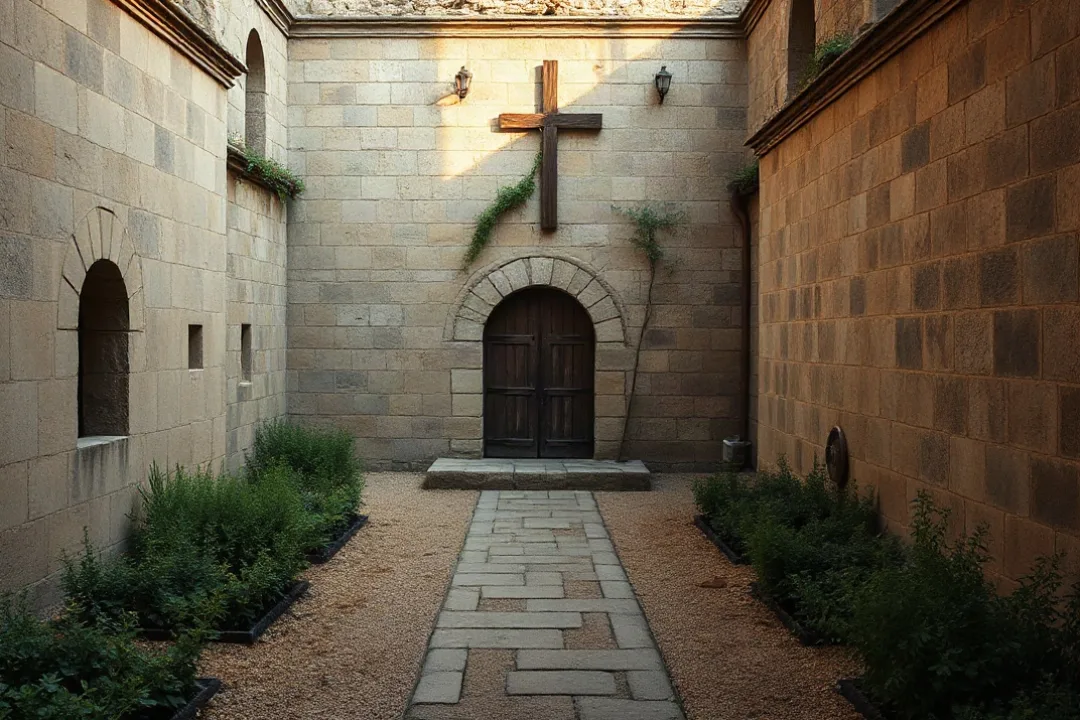
- Hanging a larger version, sometimes called a St. Benedict cross, near the entrance of a home.
- Placing it in a car, a hospital room, or a new house as a sign that the space is entrusted to God's protection.
- Giving it to someone going through illness, addiction recovery, or a difficult spiritual struggle.
- Having the medal blessed by a priest before using it, which many Catholics consider an important step.
A word of caution: Treating the medal as a magic charm that works regardless of faith or intention misreads its purpose. The Church presents it as an aid to prayer and a visible reminder of spiritual realities, not a substitute for them.
What St. Benedict is the patron saint of
Over centuries of devotion, Benedict picked up a long list of patronages, many tied directly to episodes from his life or to the themes of his Rule. People commonly turn to him as patron of:
- Europe, a title given formally by Pope Paul VI in 1964 in recognition of how Benedictine monasteries helped preserve learning and civic order after the fall of Rome.
- Students and schoolchildren, since monastery schools founded on his Rule became centers of education throughout the Middle Ages.
- Farmers and agricultural workers, reflecting the manual labor built into monastic daily life.
- Those at risk of poisoning, connected to the attempt on his life by resentful monks.
- People facing temptation, nightmares, or spiritual attack, drawing on the protective prayer inscribed on his medal.
- Monks, abbots, and religious communities generally, as the founder of Western monastic life.
When is the feast day of St. Benedict
The Catholic Church currently celebrates St. Benedict's feast on July 11, a date set after the liturgical reforms following the Second Vatican Council. Before that reform, his feast had long been kept on March 21, traditionally regarded as the date of his death. Some traditional communities and the Eastern Orthodox Church still observe the March date.
On the feast day, Benedictine monasteries and parishes with a Benedictine connection often hold special Masses, readings from the Rule, and blessings of medals. It is also a common day for people to renew personal commitments to a simpler, more disciplined rhythm of prayer and work.
How the Rule of St. Benedict applies to everyday life today
Few readers of the Rule today are planning to enter a monastery, yet the text keeps finding new audiences because its core insight is not exclusively religious: a life without structure tends to drift, and a life with too rigid a structure tends to break. Benedict aimed for something in between, which he called discretion.
Writer and Benedictine oblate Kathleen Norris once described the Rule's appeal this way:
The genius of Benedict's Rule is that it is not a system for the extraordinary but a way of making ordinary life, day after day, into something holy.
That idea shows up in small, practical habits that anyone can borrow, whether or not they share Benedict's faith:
- Fixed times for work and rest, rather than letting one bleed endlessly into the other.
- Regular pauses for reflection throughout the day instead of saving all self-examination for a crisis.
- Hospitality as a discipline, treating interruptions from other people as worthy of attention rather than as nuisances.
- Moderation over extremes, since the Rule repeatedly warns abbots against demanding more than monks can reasonably bear.
- Commitment to one place or community, resisting the urge to constantly start over somewhere new when things get difficult.
For a modern reader, the Rule works almost like a design document for a sustainable life: it assumes people will fail, get tired, and need correction, and it builds in mechanisms for all three rather than pretending perfection is the starting point.
How the St. Benedict medal differs from other Catholic medals
Catholic tradition includes many medals tied to specific saints, but the St. Benedict medal stands out for being built around an explicit prayer of exorcism and protection rather than simply an image of a saint. The Miraculous Medal, by comparison, centers on an apparition of Mary and a promise of grace; the St. Christopher medal centers on safe travel.
The St. Benedict medal's text directly names spiritual opposition — the "dragon," "Satan," offered "poison" — which is why it has long been associated with deliverance prayers and with blessing homes thought to be troubled. Priests sometimes recommend it specifically in the context of spiritual struggle, alongside confession, regular prayer, and sacramental life, rather than as a stand-alone remedy.
Simple ways to learn more about St. Benedict's life and Rule
Readers curious to go deeper have several accessible starting points:
- Read Pope Gregory the Great's account of Benedict's life, found in Book Two of his Dialogues, for the original stories behind his reputation.
- Pick up any modern translation of the Rule of St. Benedict; most editions run under a hundred pages and include helpful introductions.
- Visit or read about Monte Cassino, rebuilt after heavy damage in World War II, which still functions as an active Benedictine abbey.
- Look into Benedictine oblates, lay men and women who commit to living by a modified version of the Rule while remaining outside formal religious life.
Whether approached as history, spirituality, or practical wisdom about structuring a day, Benedict's legacy rests less on dramatic miracles and more on a quiet insistence that ordinary routines, held with care and humility, can become the foundation of a meaningful life.
Frequently asked questions
What does the St. Benedict medal protect against?
Tradition associates it with protection against poisoning, temptation, and spiritual attack, based on the Latin prayer inscribed on its back. Catholics view it as an aid to prayer rather than a guaranteed shield, and its effectiveness is understood as tied to faith, not to the object itself.
Why is St. Benedict called the patron saint of Europe?
Pope Paul VI gave him this title in 1964 because Benedictine monasteries preserved learning, agriculture, and social order across the continent during the centuries following the fall of the Roman Empire, helping lay groundwork for later European civilization.
What is the difference between the St. Benedict medal and the St. Benedict cross?
They carry the same symbols and prayer, but the cross is usually a larger crucifix-shaped sacramental meant for hanging on a wall, while the medal is smaller and typically worn or carried. Both serve the same protective and devotional purpose.
Do you need to be Catholic to wear a St. Benedict medal?
No formal restriction exists, though its meaning is rooted in Catholic sacramental theology. Many non-Catholics wear it out of respect for Benedict's historical legacy or personal devotion, but Catholics generally recommend having it blessed by a priest for its full intended use.
Leave a Reply