
The cross of St. Benedict: meaning, symbols, and history
The cross of St. Benedict is a Christian sacramental medal covered in symbols and Latin abbreviations, traditionally used by Catholics as a sign of protection against evil and a reminder of Christian faith. It is not a magic charm, but a devotional object rooted in the life and teachings of a sixth-century monk whose influence shaped Western monasticism for centuries.
Many people encounter the medal without knowing its background: a small coin-like cross, often worn on a chain or attached to a rosary, covered in tiny letters that look almost like a code. Understanding what those letters mean, and why the medal looks the way it does, helps explain why it has remained popular for well over a thousand years.
Who was St. Benedict of Nursia
Benedict of Nursia was born around the year 480 in central Italy. As a young man, he left behind formal studies in Rome and withdrew to a solitary life of prayer, eventually settling in a cave near Subiaco. Over time, disciples gathered around him, and he went on to found the monastery of Monte Cassino, which became one of the most influential religious communities in Western history.
Benedict is best known for writing the Rule of St. Benedict, a short but detailed guide for monastic life built on balance: prayer, manual labor, study, and community life in fixed proportion. This rule became the foundation for countless monasteries across Europe and earned him the title of patron of Europe and, more broadly, of a stable and ordered spiritual life.
Stories from his life, recorded by Pope Gregory the Great, describe several attempts on his life, including poisoned bread and wine offered by jealous rivals. According to these accounts, Benedict made the sign of the cross over the poisoned items, and the danger was averted. This tradition is part of why the cross bearing his name became associated with protection from harm, both physical and spiritual.
What the front of the medal shows
The medal usually has two sides, each dense with imagery. On the front, you typically find an image of St. Benedict himself, often holding a book in one hand, representing his Rule, and a staff or cross in the other, symbolizing his authority as abbot and his trust in Christ.
Around this central image, two smaller objects commonly appear: a cup, sometimes with a serpent coming out of it, and a raven carrying away a piece of bread. These refer directly to the stories of attempted poisoning mentioned earlier. The cup recalls the poisoned wine that is said to have shattered when he blessed it, and the raven recalls another account in which a bird is said to have carried away poisoned bread meant for him.
Beneath or around the image, there is usually an inscription that reads, in abbreviated Latin, something to the effect of “Cross of our Holy Father Benedict.” This phrase simply identifies the medal and ties it directly back to his name and legacy.
How to read the letters on the back of the medal
The back of the medal is where most people get curious, since it is covered in a cross shape made up of letters rather than images. At the center of the cross, four letters usually appear in the four quadrants: C S P B, standing for Crux Sancti Patris Benedicti, meaning “Cross of the Holy Father Benedict.”
Running along the vertical and horizontal arms of the cross, there is typically a longer sequence of letters. These stand for a Latin prayer asking for protection, often rendered in English along these lines:
- C S S M L — “May the Holy Cross be my light”
- N D S M D — “Let not the dragon be my guide”
- V R S N S M V — “Begone, Satan, never tempt me with your vanities”
- S M Q L I V B — “What you offer me is evil, drink it yourself”
Around the edge of the medal, four more letters are commonly found: P A X, meaning “peace,” along with other letters that complete a final line asking for the saint’s blessing. The exact arrangement can vary slightly depending on where and when a particular medal was made, but the core message stays the same: a prayer for protection and a rejection of temptation.
Keep in mind: the medal itself has no power on its own. In Catholic teaching, a sacramental like this draws its meaning from the faith of the person using it and from the blessing of the Church, not from the object as such.
How the medal came to be used as a sacramental
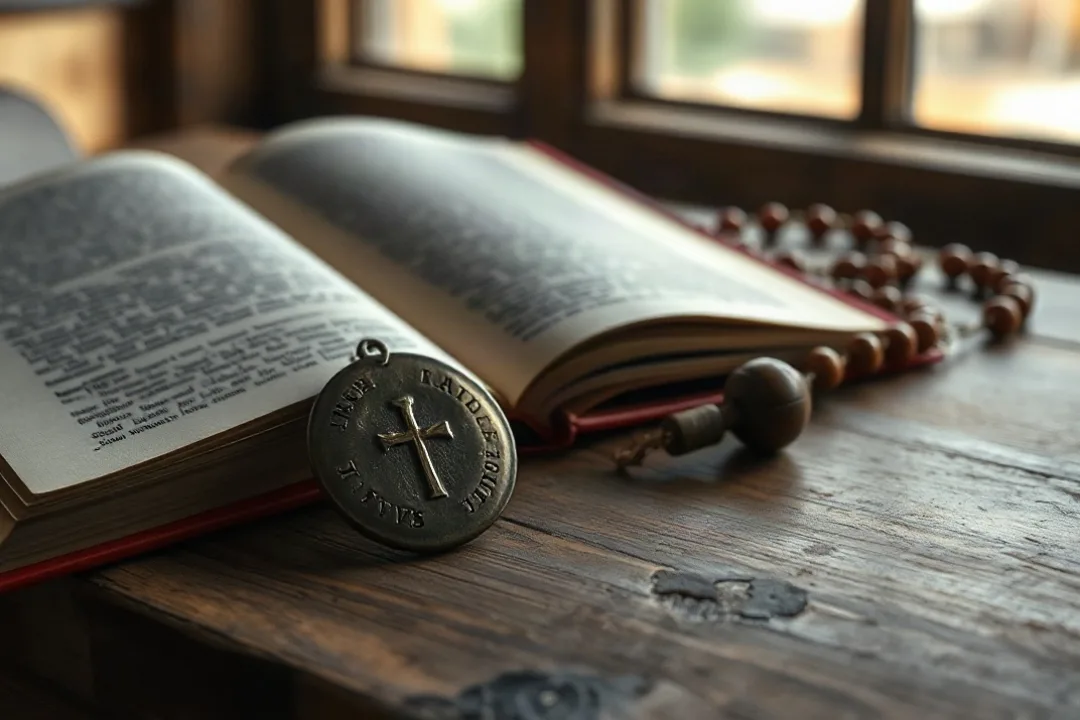
The exact origin of the medal as a physical object is harder to trace than Benedict’s own life. Historical records suggest that a version of the cross with these specific letters existed by at least the 1600s, found carved on a wall at a monastery connected to Benedictine tradition, though the symbols themselves likely developed gradually from earlier monastic practices of invoking the cross for protection.
Over the following centuries, the design was refined and formally approved for use by the Church, with a well-known version struck in the 1800s to mark an anniversary connected to Benedict’s birth. This version, sometimes called the jubilee medal, became the standard pattern still used today, combining the earlier letter prayer with the images of the cup, the raven, and Benedict himself.
The medal gained particular popularity as a response to difficult circumstances: outbreaks of illness, periods of social unrest, and personal struggles with temptation or fear. People wore it, placed it in their homes, or buried it in foundations as an expression of trust that Christ’s cross, invoked through Benedict’s example, offered real spiritual protection.
Common ways people use the St. Benedict medal today
Practices around the medal vary, but a few uses are especially common among Catholics and some other Christians who have adopted the devotion:
- Wearing it on a necklace or attaching it to a keychain as a personal reminder of faith and a request for protection.
- Placing it at entrances of a home, sometimes embedded near a doorway or cornerstone, as a blessing over the household.
- Including it on a rosary, where it often replaces or accompanies the standard crucifix.
- Giving it as a gift at moments such as baptism, confirmation, a new home, or recovery from illness.
- Using it during prayer, holding it while reciting the prayer connected to its inscriptions, particularly in moments of fear, temptation, or spiritual struggle.
Many Catholics also have the medal blessed by a priest before using it, since a blessing is traditionally understood as part of what makes a sacramental meaningful within the practice of the faith.
Practical tips and common mistakes to avoid
People new to the devotion sometimes misunderstand how the medal is meant to work. A few points can help clarify its proper use:
- It is not a lucky charm. Treating it as something that magically wards off bad luck misses the point; it is meant as an aid to prayer and trust in God, not a substitute for faith.
- Have it blessed if possible. While not strictly required to carry one, a blessing connects the object to its intended purpose within Catholic practice.
- Don’t ignore the prayer behind the letters. The abbreviations are not decoration; learning what they mean turns the medal into an actual prayer rather than a piece of jewelry.
- Avoid confusing it with other medals. Several saints have medals with similar coin-like shapes; checking for the distinctive cup, raven, and letter cross helps confirm it is genuinely the Benedictine medal.
- Remember its historical roots. Knowing the stories of Benedict’s life, including the poisoning accounts, gives the symbols on the medal their proper context rather than treating them as abstract decoration.
Why the medal is still relevant for modern believers
Benedict’s own writings emphasize balance, humility, and steady perseverance in ordinary life, values that remain appealing regardless of era. The Rule of St. Benedict famously describes the monastery as a “school for the Lord’s service,” a phrase that captures its practical, patient approach to spiritual growth rather than dramatic gestures.
“Listen carefully, my child, to the instructions of your master, and incline the ear of your heart.”
This opening line from his Rule reflects the same spirit found in the medal: a call to attentiveness, discipline, and trust, applied to daily struggles rather than extraordinary events. For many believers today, the medal serves as a small, tangible reminder of that same steady commitment, worn or carried as a quiet statement of where their trust lies during ordinary days and difficult ones alike.
Whether displayed in a home, worn as jewelry, or kept in a wallet or car, the cross of St. Benedict continues to function the way it always has: as a visual prayer, summarizing centuries of tradition in a single small object anyone can carry.
Frequently asked questions
What does the St. Benedict medal actually protect against?
In Catholic tradition, it is used as a sacramental asking for protection against evil influences, temptation, and spiritual danger, drawing on the stories of St. Benedict surviving attempts at poisoning. It works as an aid to prayer and faith, not as an independent magical object.
Do I need a priest to bless my St. Benedict medal?
It is not strictly required to own or wear one, but many Catholics have it blessed because a priest's blessing is traditionally seen as connecting the medal to its intended spiritual purpose, making it a fuller expression of the devotion rather than just a piece of jewelry.
What do the letters C S P B stand for on the medal?
These four letters, found in the center of the cross on the back of the medal, abbreviate the Latin phrase Crux Sancti Patris Benedicti, meaning "Cross of the Holy Father Benedict," directly identifying the medal and linking it to his name.
Can non-Catholics wear or use the St. Benedict medal?
Many people outside the Catholic Church, including some Protestants and those simply drawn to its history, wear the medal as a symbol of protection and faith. Its meaning is rooted in Catholic tradition, but nothing prevents others from appreciating its symbolism and history.
Leave a Reply