
What the pope actually does and how one is chosen
When news breaks that a pope has died or resigned, most people have the same string of questions: who decides the next one, what does this person actually do all day, and why does the whole process seem to involve smoke signals from a chimney? The papacy is one of the oldest continuously held offices in the world, and understanding how it works clears up a lot of confusion fast.
The short version: the pope is the Bishop of Rome and, according to Catholic tradition, the spiritual successor of the apostle Peter. He leads the worldwide Roman Catholic Church, which counts more than a billion members across nearly every country on earth, and he also serves as the head of state of Vatican City, the smallest sovereign nation in the world.
What the pope actually is and whom he represents
In Catholic belief, Jesus gave the apostle Peter a special role of leadership among the disciples, often described using the image of "keys" to the kingdom, drawn from Matthew 16:18-19. Catholic tradition holds that Peter later became the first bishop of Rome, and every pope since has been considered his spiritual successor in that office.
That means the pope isn't simply a global religious celebrity or a figurehead. He holds real teaching and governing authority within the Church. He can issue formal documents called encyclicals or apostolic exhortations that shape Catholic teaching on everything from economic justice to family life. He also has final say over major decisions involving bishops, religious orders, and Church doctrine worldwide.
At the same time, the pope is a head of state. Vatican City has its own government, and the pope sits at the top of it, much like a president or monarch would in any other country, except his authority flows from a religious office rather than an election by citizens.
How a new pope gets chosen: inside the conclave
When the papacy becomes vacant, either through death or resignation, the Church doesn't hold a public vote. Instead, a group called the College of Cardinals gathers in Rome for a closed-door process known as a conclave, held inside the Sistine Chapel.
Not every cardinal gets to vote. Cardinals who have already turned 80 are excluded from the actual balloting, though younger cardinals, typically numbering around 120 or so depending on who has been appointed in recent years, serve as the electors. They are literally locked in, cut off from phones, newspapers, and outside contact, until a decision is made.
Who can actually be elected pope
Technically, canon law allows any baptized Catholic male to be elected pope. In practice, this hasn't happened in centuries. Every pope for roughly the last several hundred years has been chosen from among the cardinals themselves, since they are already senior Church leaders who know the candidates and the issues facing the Church.
- Baptized Catholic male: the only formal requirement under canon law
- Cardinal in practice: every modern pope has come from this group
- No campaigning: there are no official candidates or platforms, though cardinals discuss possibilities informally before the conclave begins
- Two-thirds majority: a candidate needs this threshold of votes to be elected, not a simple majority
What the smoke signals mean
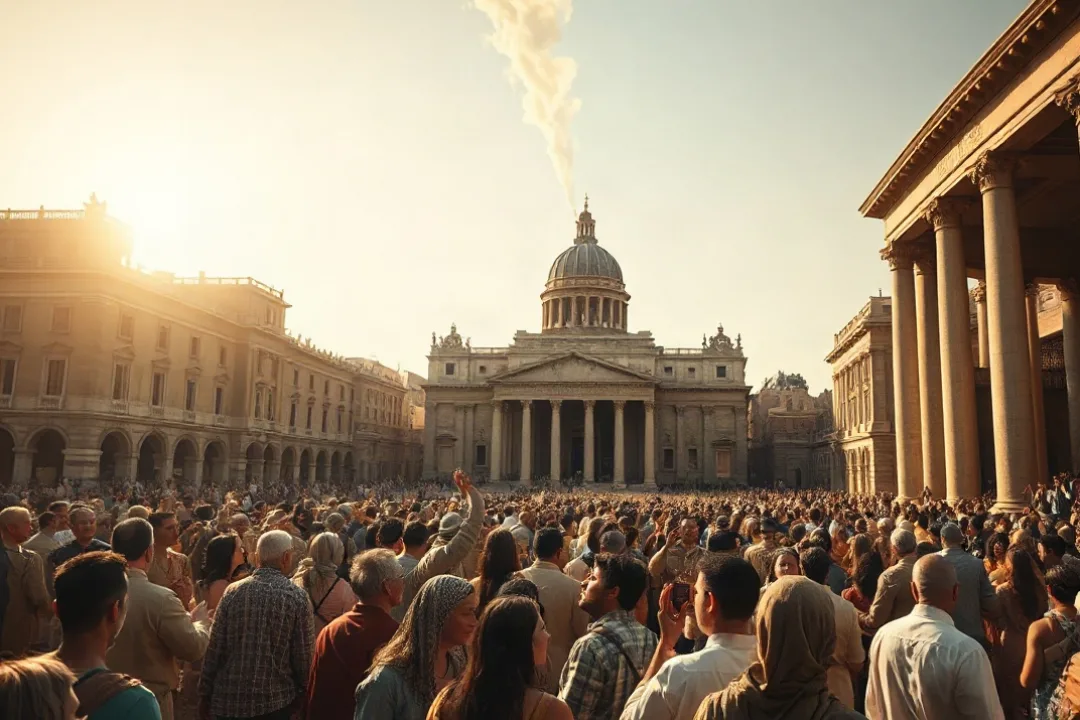
After each round of voting, the ballots are burned in a stove inside the chapel. Chemical additives are used so the smoke that rises from the chimney on the roof sends a clear signal to the crowd waiting outside in St. Peter's Square.
- Black smoke means no candidate reached the required majority
- White smoke means a new pope has been chosen
Once white smoke appears, a senior cardinal steps onto the balcony of St. Peter's Basilica and announces "Habemus Papam" — "We have a pope" — followed by the new pope's chosen name.
Good to know: conclaves can move quickly or drag on for days. Some recent ones were resolved within a couple of days, while historical conclaves have occasionally stretched on for weeks when cardinals were deeply divided.
What fills a pope's typical day and year
Despite being well into their seventies or eighties when elected, most modern popes keep a demanding schedule. A pope's responsibilities generally fall into a few categories.
- Teaching and writing: drafting encyclicals, giving homilies, and addressing theological or moral questions facing Catholics around the world
- Governing the Church: overseeing the Roman Curia, the Vatican's administrative bodies, and appointing bishops and cardinals across the globe
- Public audiences: holding a General Audience most Wednesdays in St. Peter's Square or an indoor hall, and delivering the Angelus prayer and brief reflection from his window most Sundays at noon
- International travel: making apostolic visits to other countries, meeting with heads of state, bishops, and local Catholic communities
- Diplomacy: receiving ambassadors and foreign leaders, since the Vatican maintains diplomatic relations with most countries in the world
Popes also meet privately with countless individuals and groups, from victims of tragedy to scientists and artists. Pope Francis became known for informal, off-the-cuff remarks during these encounters, including his widely quoted response in 2013 when asked about a priest's past:
"Who am I to judge?"
That one line, said aboard a flight back from Brazil, captured a more pastoral tone that marked much of his papacy and showed how closely the world watches even casual papal remarks.
Titles, symbols, and the name a pope chooses
The pope holds several formal titles beyond "pope" itself, including Bishop of Rome, Vicar of Jesus Christ, and Servant of the servants of God, a title meant to emphasize humility rather than power. He's also referred to as the Supreme Pontiff.
One of the first things a newly elected pope does is choose a papal name, different from the name he was baptized with. This tradition goes back centuries and usually signals something about the direction he hopes to take or a predecessor he admires. Recent examples include:
- Pope Francis, who chose his name in honor of Saint Francis of Assisi and his focus on simplicity and care for the poor
- Pope Benedict XVI, whose name echoed Saint Benedict and earlier popes associated with peace efforts
- Pope John Paul II, who combined the names of his two immediate predecessors
Visually, the pope is instantly recognizable by his white cassock, white skullcap called a zucchetto, and the Fisherman's Ring, a symbol referencing Peter's original profession. Historically the ring was used to seal official documents; today it's largely ceremonial and is formally altered or destroyed after a pope dies or resigns, so it can't be misused.
Vatican City: the world's smallest state and the pope's home
Vatican City became an independent sovereign state in 1929 under the Lateran Treaty, signed between the Holy See and the Italian government. Before that, the pope's temporal authority had been a contested political issue for decades following Italian unification.
Today Vatican City covers roughly a few tenths of a square mile, entirely surrounded by the city of Rome. Small as it is, it functions as a genuine country, with its own:
- Postal service and stamps
- Radio station and newspaper, L'Osservatore Romano
- Security force, the colorfully uniformed Swiss Guard, which has protected popes since the early 1500s
- Museums and the Vatican Library, home to an enormous collection of historical manuscripts and art
The pope's official residence is the Apostolic Palace, though Pope Francis chose instead to live in a simpler guesthouse on the Vatican grounds, a decision that reflected his broader emphasis on modest living.
What happens when a pope resigns or dies
For most of modern history, popes served until death. Resignation is allowed under canon law but had been exceptionally rare until Pope Benedict XVI stepped down in 2013, citing declining health and the physical demands of the office. That decision marked the first voluntary papal resignation in several centuries and opened public conversation about whether future popes might follow a similar path.
Whether a pope dies in office or resigns, the period before a successor is elected is called sede vacante, meaning "the seat being vacant." During this time:
- A senior cardinal known as the Camerlengo temporarily manages Vatican administrative affairs
- Major decisions and appointments are generally put on hold until a new pope is elected
- Funeral rites are held if the pope has died, typically drawing world leaders and massive crowds to Rome
- The conclave is convened, usually within a couple of weeks, to begin the election process described earlier
Worth remembering: a retired pope, as Benedict XVI demonstrated, doesn't retain governing authority over the Church. He steps back entirely, leaving the active leadership role to his successor.
Once a new pope is elected and accepts the office, he's installed in a formal ceremony, and the cycle of teaching, traveling, and governing begins again, continuing an office that traces its roots back nearly two thousand years.
Frequently asked questions
Does the pope get a salary?
No. The pope doesn't receive a formal paycheck. His living expenses, housing, travel, and personal needs are covered directly by the Vatican, since the role is treated as a lifelong religious vocation rather than a paid job.
Can a pope be removed from office against his will?
There's no established formal process for removing a pope involuntarily under current canon law. Historically, popes have left office only through death or voluntary resignation, which remains an extremely rare choice.
How long does a papal conclave usually take?
It varies widely. Some recent conclaves concluded within one to three days once cardinals reached consensus quickly, while historical conclaves have occasionally lasted weeks when the College of Cardinals was deeply divided over candidates.
Why does the pope pick a new name after being elected?
The tradition dates back centuries and lets a new pope signal priorities or honor a predecessor. For example, choosing the name Francis reflected an intended focus on humility and care for the poor, inspired by Saint Francis of Assisi.
Leave a Reply