
What Jesus Called the Bleeding Woman Changed Her Life
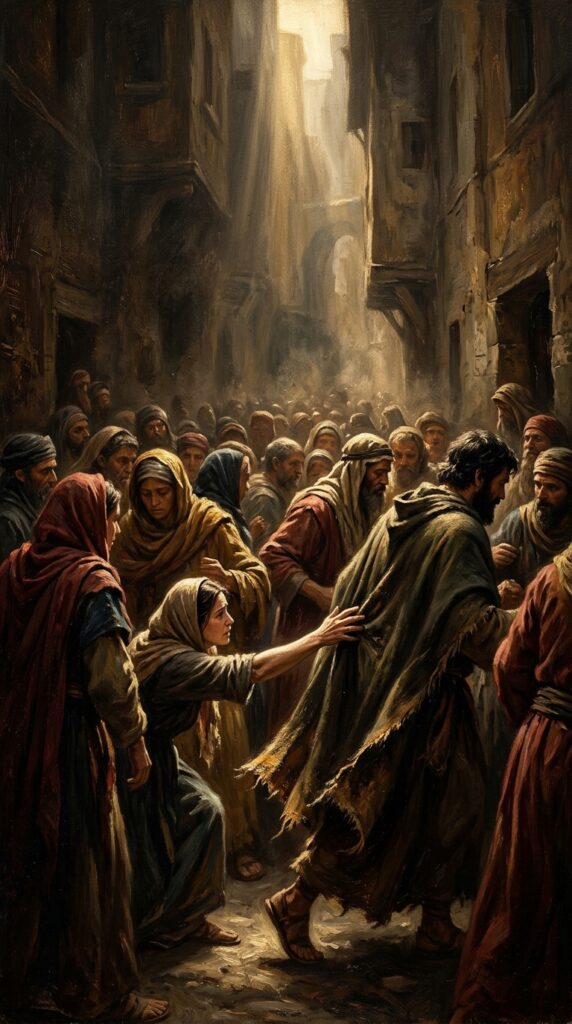
If you arrived here from our video wondering what happened after Jesus stopped in that crushing crowd, you are about to discover one of the most tender encounters recorded in Scripture. For twelve long years, a nameless woman had suffered from chronic bleeding, empty pockets, and complete social rejection. With trembling faith, she reached through the mob, touched the fringe of His garment, and felt an instant physical transformation. Yet Jesus immediately halted the entire procession and asked, “Who touched my garments?” The disciples were bewildered, but Jesus refused to keep walking. What He called her when she fell at His feet did not merely confirm her healing—it rewrote her entire identity.
Twelve Years of Silent Suffering and Isolation
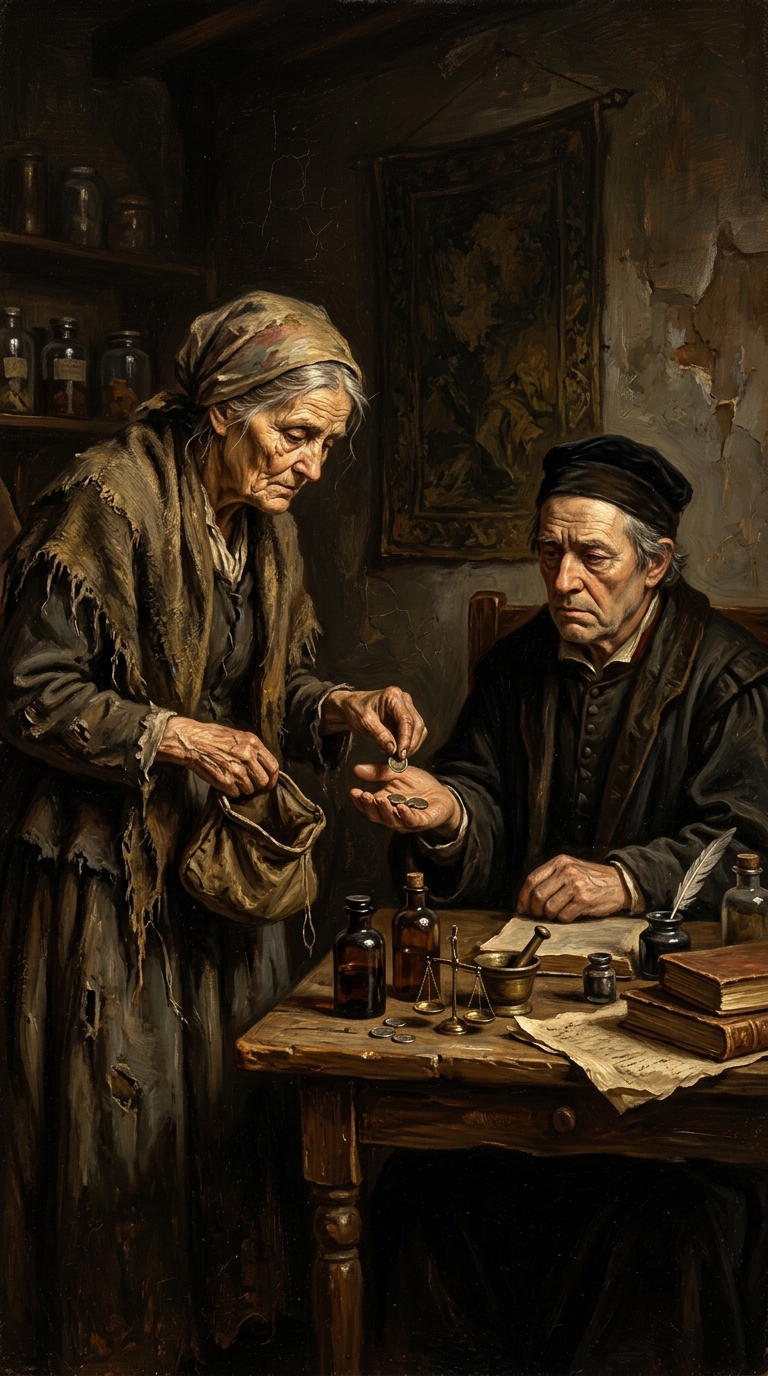
To understand why this moment moved Jesus so deeply, we must first look at the reality this woman endured every single day. The Gospel of Mark records her plight with heartbreaking clarity: “And there was a woman who had had a discharge of blood for twelve years, and who had suffered much under many physicians, and had spent all that she had, and was no better but rather grew worse” (Mark 5:25–26).
Her struggle was not merely medical or financial; it was religious and social. According to the Law of Moses in Leviticus 15:25–27, a prolonged issue of blood rendered a person ceremonially unclean. Everything she touched, every chair she sat upon, and anyone who brushed against her became unclean as well. For over four thousand consecutive days, she had been cut off from normal human connection.
She could not enter the temple courts to pray. She could not embrace her family or share an ordinary meal without placing a burden of ceremonial uncleanness on everyone around her. Ancient medical practices were often agonizing, yet she poured every penny she possessed into remedies that only left her weaker. By the time Jesus entered her region, she was penniless, exhausted, and invisible to society.
A Daring Reach in a Swarming Crowd
When this desperate woman heard that Jesus was passing through, something sparked within her weary heart. Mark 5:28 captures her quiet conviction: “For she said, ‘If I touch even his garments, I will be made well.’”
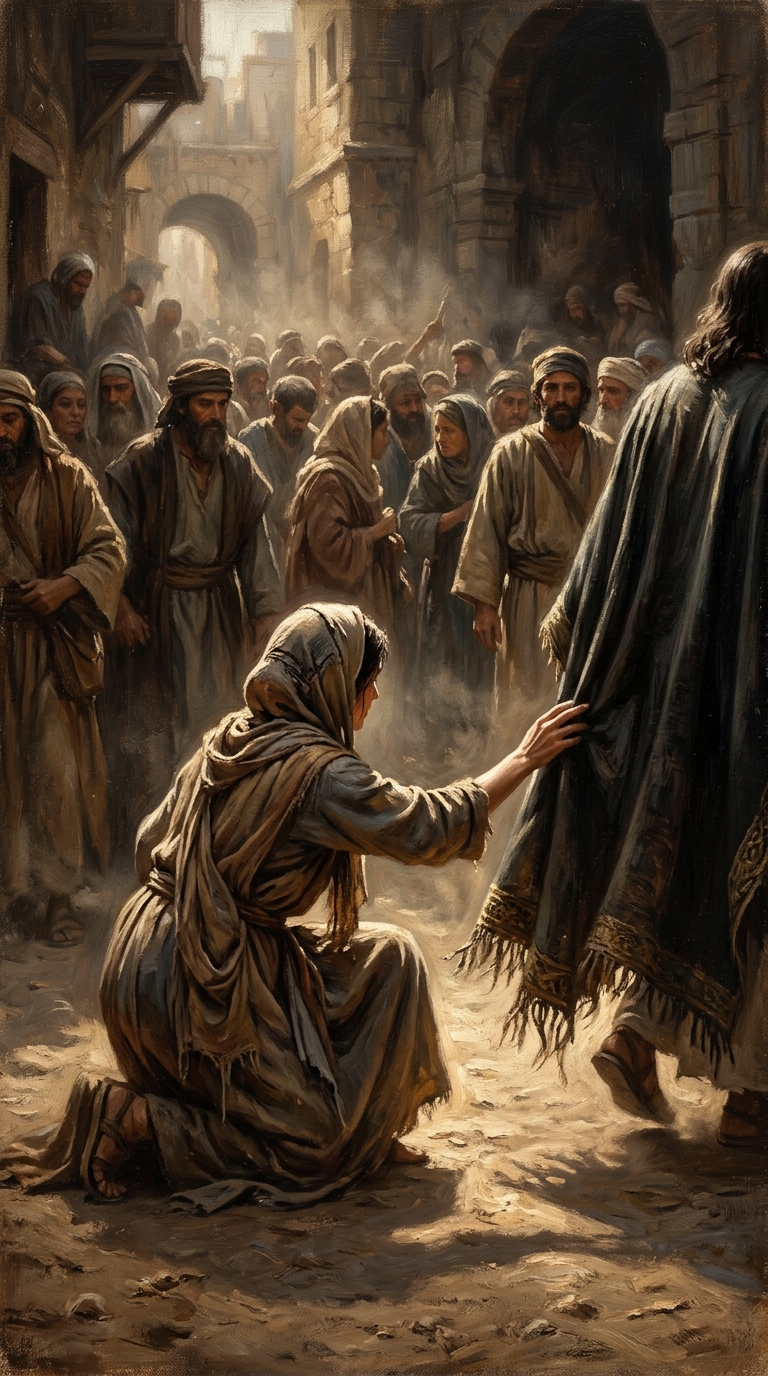
Her action was exceptionally bold. Under Jewish law, pushing into a tightly packed public gathering was strictly forbidden for someone in her condition. Had the crowd recognized her, she risked severe public humiliation and outrage. Yet she did not ask for a private audience, nor did she cry out aloud. She simply dropped low, pushed through the dust, and brushed the edge of His outer robe.
The reaction was instantaneous. Mark 5:29 tells us that “immediately the flow of blood dried up, and she felt in her body that she was healed of her disease.” After twelve years of agony, the hemorrhage vanished in a single heartbeat. Her plan had worked: she had received her cure, and she could now slip back into the shadows unnoticed—or so she thought.
Why Jesus Stopped When Everyone Was in a Hurry
Jesus was not strolling casually that afternoon. He was actually rushing to an emergency. Jairus, an influential synagogue leader, had just fallen at Jesus’ feet, begging Him to come quickly because his twelve-year-old daughter was dying (Mark 5:22–23). Every second counted. Yet in the middle of this urgent mission, Jesus stopped abruptly.
Mark 5:30 records: “And Jesus, perceiving in himself that power had gone out from him, immediately turned about in the crowd and said, ‘Who touched my garments?’”
The disciples were completely baffled. Peter and the others replied in disbelief: “You see the crowd pressing around you, and yet you say, ‘Who touched me?’” (Mark 5:31; Luke 8:45). Scores of people were bumping into Jesus on every side. But Jesus distinguished between the casual jostling of the curious crowd and the deliberate touch of trusting faith.
Why did Jesus stop? He certainly knew who had touched Him. He did not ask to gain information; He asked in order to create a sacred encounter. Had Jesus allowed her to slip away quietly, she would have possessed physical health, but she would have walked away feeling like a thief who stole a blessing. Worse, the community would still view her as unclean. Jesus stopped because He refused to treat her as an anonymous transaction.
The Name That Changed Everything: “Daughter”
Terrified that her identity had been discovered, the woman stepped forward. Mark 5:33 describes her reaction: “But the woman, knowing what had happened to her, came in fear and trembling and fell down before him and told him the whole truth.”
She knelt in the dust, fully expecting public condemnation for having touched a rabbi while ceremonially unclean. Instead, Jesus looked down upon her with divine compassion and spoke words that shattered twelve years of shame:
“Daughter, your faith has made you well; go in peace, and be healed of your disease.” (Mark 5:34)
Consider the profound power of that single opening word: Daughter. Across all four Gospels, this is the only recorded time Jesus directly addresses an individual woman with this family title. He did not address her as “woman,” nor did He refer to her condition. With one tender word, He adopted her into the family of God.
Furthermore, Jesus used the Greek verb sozo when saying “your faith has made you well.” In the New Testament, sozo frequently extends far beyond physical relief; it speaks of total deliverance, salvation, and holistic restoration. By calling her forward publicly, Jesus accomplished three vital purposes:
- He restored her community standing: In the presence of religious onlookers, the highest authority declared her completely clean and whole.
- He removed her shame: She was no longer a castaway hiding in fear; she was affirmed as a woman of profound faith.
- He gave her enduring peace: His blessing, “go in peace” (shalom), guaranteed that her suffering was permanently behind her.
A Tale of Two Daughters
Scripture reveals a breathtaking detail when we examine the surrounding narrative. Jesus had stopped on His way to heal Jairus’ daughter, who was twelve years of age (Mark 5:42). For the exact length of time that Jairus had enjoyed the laughter and joy of his growing girl, this suffering woman had known only isolation, poverty, and sorrow.
In a single afternoon, Jesus ministered to two daughters from opposite ends of society. One belonged to a prominent, wealthy religious ruler; the other was an impoverished outcast whose name history never recorded. Yet both were equally precious to the Savior. Jesus demonstrated that no matter how crowded the world feels or how urgent life seems, He never overlooks the quiet cry of faith.
Jesus did not just heal her body; He restored her soul, her dignity, and her place in the family of God. If you have ever felt overlooked, unworthy, or defined by past pain, remember that Christ looks upon humble faith and offers the very same welcome.
What stands out to you most about Jesus calling this woman “Daughter”? Share your thoughts and reflections in the comments below!
Leave a Reply