
What are rosaries? A clear guide to the prayer and the beads
A rosary is both a physical string of beads and a repeated prayer practice built around that string, most closely associated with the Catholic Church. The word refers to two things at once: the object you hold in your hand, and the sequence of prayers you say while moving your fingers along it. Understanding one helps you understand the other, because the beads exist purely to support the prayer, counting out repetitions so the person praying doesn't have to keep a mental tally.
At its simplest, praying the rosary means repeating the Hail Mary many times, grouped into sets of ten called decades, interspersed with the Lord's Prayer and other short prayers. Each decade is paired with a short meditation on an event from the life of Jesus or Mary, called a mystery. The physical repetition becomes a kind of rhythm that frees the mind to focus on those events rather than on counting.
What makes up a rosary's physical structure
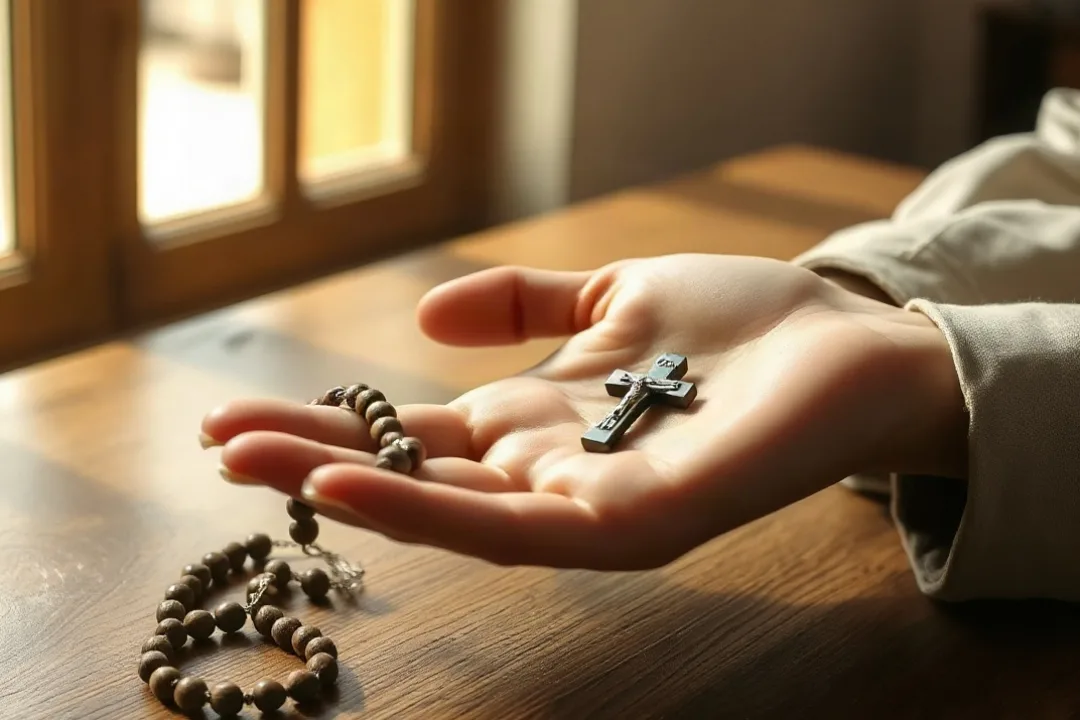
A standard five-decade rosary has a recognizable, consistent layout. Once you know the pattern, you can pick up almost any rosary in the world and know exactly where you are in the prayer sequence just by feel.
- A crucifix at one end, where the prayer traditionally begins with the Sign of the Cross and the Apostles' Creed.
- A single large bead right after the crucifix, used for the Lord's Prayer.
- Three small beads in a row, each used for a Hail Mary, often prayed for an increase in faith, hope, and love.
- A centerpiece medal, frequently showing an image of Mary, marking the transition into the main body of the rosary.
- Five decades, each made up of ten small beads for Hail Marys, separated by one larger bead for the Lord's Prayer.
After finishing all five decades, the prayer typically closes with the Hail Holy Queen and sometimes a closing prayer to the crucifix again. Some rosaries include a small additional medal or a ring of extra beads for other devotions, but the five-decade design is the one most people picture when they hear the word.
Smaller and larger variations
Not every rosary has the full structure. A chaplet is a shorter string of beads built around a different devotion entirely, sometimes mistaken for a rosary because it looks similar. A full fifteen-decade rosary, sometimes called a Dominican rosary, loops through all three traditional sets of mysteries in one sitting and is far longer than the everyday five-decade version most people carry in a pocket or hang from a car mirror.
Where the rosary came from historically
The practice of counting repeated prayers on a string predates the rosary as we know it today. Medieval monks and laypeople used knotted cords or strings of pebbles to keep track of repeated psalms or prayers, since not everyone could read the full Book of Psalms. Over the twelfth and thirteenth centuries, this habit of counting gradually attached itself to repeated Hail Marys rather than Psalms, giving ordinary people who couldn't read Latin a way to participate in a rhythm of prayer similar to what monks practiced.
Tradition closely links the rosary's development to the Dominican order, and popular devotion credits Saint Dominic with receiving the rosary directly from a vision of Mary, though historians note the prayer's structure actually developed gradually over generations rather than appearing all at once. By the late Middle Ages, the basic pattern of beads, Hail Marys, and meditative themes had settled into something close to the form still used today, and it spread widely through preaching orders and popular devotion across Europe.
Key point: the rosary wasn't invented by one person on one day. It grew slowly out of older monastic prayer habits, shaped over centuries into the form most people recognize now.
How the mysteries organize the prayer's meaning
Each decade of the rosary is tied to a specific scene, known as a mystery, meant to be held in the mind while the beads move through the fingers. These scenes are grouped into four sets, each reflecting on a different stage of the Christian story.
- Joyful Mysteries — scenes around Jesus's birth and early life, including the Annunciation and the Nativity.
- Sorrowful Mysteries — events connected to Jesus's suffering, such as his agony before his arrest and his crucifixion.
- Glorious Mysteries — his resurrection and the events the Church sees as following it, including his Ascension.
- Luminous Mysteries — a set added in the modern era, focused on moments from Jesus's public ministry, such as his baptism and the Wedding at Cana.
Traditionally, different sets of mysteries are assigned to different days of the week, so that someone praying the rosary daily moves through all four sets over the course of a week rather than repeating the same meditations every time. This rotation keeps the practice from becoming purely mechanical, since the mental focus changes even though the physical motion of the beads stays the same.
How someone actually prays a rosary step by step
For a newcomer, the sequence can look intimidating written out, but it becomes automatic quickly once the pattern is felt rather than read. A simplified walk-through looks like this:
- Hold the crucifix and make the Sign of the Cross, then say the Apostles' Creed.
- On the large bead that follows, say the Lord's Prayer.
- On each of the next three small beads, say a Hail Mary.
- Pause at the centerpiece and announce the first mystery for the day.
- Move onto the large bead for that decade and say the Lord's Prayer.
- Move through the ten small beads of the decade, saying a Hail Mary on each while holding the mystery in mind.
- Repeat the process for the remaining four decades, announcing a new mystery before each one.
- Close with the Hail Holy Queen once all five decades are complete.
Some people add the Glory Be after each decade, and many finish with a short closing prayer tied to a specific intention, such as praying for a sick relative or for peace. None of these additions are mandatory; the core structure is flexible enough to absorb personal habits built up over years of use.
The Rosary is my favorite prayer.
That line, widely attributed to Pope John Paul II, captures why so many Catholics return to the rosary again and again: it doesn't require reading, doesn't demand a quiet room, and can be prayed in a car, on a walk, or lying in bed at night.
What rosaries are made of and why materials vary so much
Rosary beads come in an enormous range of materials, and the choice often reflects practicality, cost, or personal meaning rather than any strict rule. A rosary blessed by a priest carries spiritual significance for the person who owns it, but the Church does not require any particular material for that blessing to apply.
- Wood beads, often olive wood, common for everyday use and travel rosaries because they are light and durable.
- Glass or crystal beads, popular for their appearance and sometimes given as gifts for occasions like baptisms or First Communion.
- Metal chain-link rosaries, sturdy and long-lasting, frequently carried in pockets or bags.
- Cord or knotted rosaries, made from rope rather than beads, favored for outdoor use since they survive water and rough handling better than glass.
- Gemstone rosaries, made from materials like rose quartz or amethyst, often chosen for their color or as keepsakes from a particular place, such as a pilgrimage site.
Some rosaries are made from materials tied to a specific saint or shrine, such as beads crafted from rose petals associated with devotions to certain apparitions of Mary. These items often carry sentimental or devotional weight beyond their physical function, especially when they come from a place the owner visited or a relative who has passed away.
Who uses rosaries and how practices differ
The rosary is most strongly associated with Catholic practice, but related bead-based prayer traditions exist well beyond that single context. Orthodox Christians use a knotted prayer rope, sometimes called a komboskini, for repeating the Jesus Prayer rather than the Hail Mary. Anglican and some Protestant traditions have developed their own prayer bead sets with different structures and meanings, often adapted from the Catholic model but built around different prayers or themes.
Within Catholic practice itself, there's considerable variation in how people actually use a rosary day to day:
- Some pray a full five-decade rosary every day as a fixed habit, often at the same time, such as before bed.
- Others carry a rosary as a comfort object, touching the beads during stressful moments without necessarily completing the full prayer sequence.
- Many parishes organize group rosary prayer, especially during specific months traditionally associated with Marian devotion.
- Some people pray only a single decade at a time when pressed for time, rather than skipping the practice entirely.
This flexibility is part of why the rosary has remained a durable practice across such a long span of history. It doesn't require a church building, a priest, or even much free time, which makes it accessible to people in a huge range of circumstances, from hospital waiting rooms to long commutes.
Choosing or caring for a rosary of your own
If you're picking up a rosary for the first time, there's no need to overthink the material or style. A simple wood or plastic rosary works exactly as well for prayer as an expensive gemstone one; the value lies in the practice, not the price of the object.
Tip: if a rosary breaks, most Catholic gift shops or parish offices can repair it rather than requiring you to discard it, since many people prefer to keep a rosary that holds personal or family significance.
Basic care is minimal. Keep beads away from extreme heat, which can warp wood or certain plastics, and store the rosary somewhere it won't get tangled or crushed, such as a small pouch or a dedicated pocket in a bag. Many people keep one rosary for daily use and another, often an heirloom, reserved for special occasions or kept at home rather than carried around.
Frequently asked questions
Do you have to be Catholic to use a rosary?
No. While the rosary is strongly tied to Catholic tradition, anyone can use the beads as a tool for repeated prayer or quiet reflection. Some people from other Christian traditions, or even outside Christianity, use similar bead-counting methods adapted to their own prayers or meditations.
How long does it take to pray a full rosary?
A standard five-decade rosary typically takes about 15 to 20 minutes to pray at a normal pace, depending on whether you add extra prayers like the Glory Be after each decade or pause for longer reflection on each mystery.
What's the difference between a rosary and a chaplet?
A rosary generally refers to the specific five-decade devotion centered on the Hail Mary and the mysteries of Jesus's life. A chaplet is a broader term for any shorter string of prayer beads built around a different devotion, saint, or theme.
Why does a rosary have exactly five decades?
The five-decade structure became standard because it allows someone to pray through one full set of mysteries, such as the Joyful or Sorrowful Mysteries, in a single sitting. A fifteen-decade version exists for praying through all three traditional sets at once.
Leave a Reply