
May for Mary: understanding this Catholic tradition
If you have ever walked into a Catholic church in early May and noticed a statue of the Virgin Mary surrounded by fresh flowers, you have seen the start of a tradition that goes back centuries. Many people wonder why an entire month gets set aside for Mary, and what, exactly, they are supposed to do about it. The short answer: May is traditionally known as the month of Mary, a time when Catholics around the world honor the mother of Jesus through prayer, flowers, and small daily devotions.
This custom is not a formal obligation like attending Mass on Sunday. It is a devotional practice, meaning it grew out of the lived faith of ordinary Catholics over time rather than being handed down as a strict rule. That makes it flexible enough to look different from one family or parish to the next, while still sharing the same heart.
Why May became known as Mary's month
The connection between May and Mary did not appear overnight. Historians trace it back to a mix of older seasonal customs and later Church writings that blended together over several centuries.
Long before Christianity spread across Europe, many cultures already treated spring as a season for honoring fertility goddesses and the renewal of nature. As Christianity took root, some of these older spring customs were reshaped around Christian figures instead. Mary, often associated with new life and growth because of her role in the birth of Jesus, became a natural fit for a season already tied to blossoming fields and warmer weather.
The more formal, written tradition is usually credited to a series of devotional books that spread through Italy in the 1700s. A Jesuit priest is commonly cited as one of the early promoters of dedicating the month specifically to Mary, encouraging the faithful to set aside daily time in May for prayer and reflection on her life. From there, the practice spread through religious orders, parish missions, and eventually into Catholic schools and homes across Europe and, later, the Americas.
By the 1800s, popes had begun writing letters encouraging Catholics to observe the month with special devotion, and the custom became firmly woven into parish life, especially through the practice known as May crowning.
What a May crowning ceremony actually involves
If you grew up in a Catholic parish or attended a Catholic school, you may remember a specific springtime ceremony: children in white dresses or shirts, a procession, and someone placing a crown of flowers on a statue of Mary. This is the May crowning, and it is probably the most recognizable public expression of the month-long devotion.
A typical May crowning includes:
- A procession, often with students or parish members walking in, sometimes carrying flowers or singing a hymn.
- The crowning itself, where a young person, often chosen as an honor, places a floral crown on the statue's head.
- Prayers, usually including the Hail Mary, sometimes a full decade of the Rosary, or a litany to Mary.
- A closing hymn, frequently a traditional Marian song.
The symbolism is straightforward: crowning Mary with flowers is a way of honoring her as, in Catholic belief, the Queen of Heaven, while the fresh blooms tie the ceremony to the renewal of spring itself.
Simple ways to observe May for Mary at home
Not every family has access to a parish ceremony, and not everyone wants something elaborate. The devotion works just as well on a small, personal scale.
Here are practical ways people commonly observe the month:
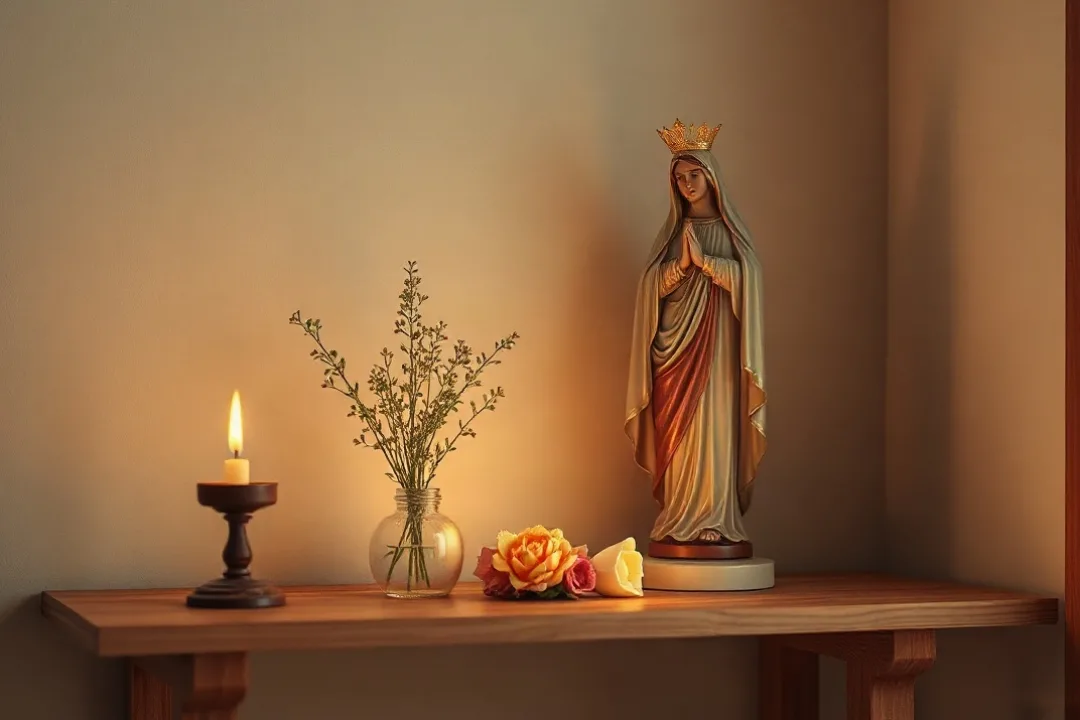
- Set up a small May altar. A shelf, a corner table, or even a windowsill works. A statue or image of Mary, a candle, and fresh or paper flowers are enough.
- Pray a daily decade of the Rosary. Even five minutes, said consistently through the month, becomes a meaningful rhythm.
- Read a short reflection on Mary's life each day. Many Catholic publishers and parish bulletins offer brief daily readings specifically for May.
- Add fresh flowers regularly. Swapping out wilted blooms for new ones becomes its own small act of care and attention.
- Attend a May crowning if your parish offers one, even if you are not part of the group being crowned. Watching the ceremony as a family is its own quiet tradition.
Tip: If daily prayer feels like too much to start, pick one specific day each week in May and commit to a slightly longer devotion that day instead. Consistency matters more than length.
How May devotions connect to the Rosary and other Marian prayers
Many of the prayers used during May for Mary are not unique to the month. They are prayers Catholics use year-round, simply given extra attention during this time.
The most common include:
- The Hail Mary, a short prayer asking for Mary's intercession, drawn from the greeting given to her in Luke 1:28 and the words of her relative Elizabeth in Luke 1:42.
- The Rosary, a set of prayers organized around meditations on key events in the lives of Jesus and Mary, often called the mysteries.
- The Litany of the Blessed Virgin Mary, a long list of titles for Mary, each followed by a short response, traditionally prayed aloud in groups.
- The Memorare, a shorter prayer asking Mary to remember her role as a protector and to intercede on behalf of the person praying.
None of these require special training to pray. Many parishes print the words in the bulletin during May specifically so newcomers can follow along without needing to memorize anything in advance.
What the Church actually teaches about honoring Mary
Some people, especially those less familiar with Catholic practice, wonder whether devotion to Mary competes with worship of God. Catholic teaching draws a clear line here. Mary is honored, not worshipped; the technical term used is veneration, which is a form of deep respect and honor, distinct from the worship reserved for God alone.
The reasoning behind Marian devotion usually comes down to Mary's unique role in Christian belief: she is understood as the mother of Jesus, who Catholics believe is both fully human and fully divine. Honoring her is seen as a way of honoring her son, similar to how respecting someone's mother is also a sign of respect for that person.
Devotion to Mary does not take anything away from devotion to Christ; it points toward him.
This idea shows up repeatedly in how the Church describes Mary's purpose within the faith: not as a replacement for Jesus, but as someone who consistently directs attention back to him.
How schools and parishes typically organize May devotions
Catholic schools often build an entire month of small rituals around this tradition, partly because it lines up with the end of the academic year and partly because children respond well to visual, participatory customs.
Common school and parish practices include:
- A daily classroom prayer dedicated to Mary, often recited at the start of the school day throughout May.
- A rotating flower offering, where different students or families bring fresh flowers for the statue each day.
- A May procession, sometimes combined with a First Communion celebration since both tend to happen in spring.
- Art or writing projects focused on Marian themes, giving children a creative way to engage with the tradition.
Parishes, meanwhile, often schedule a special evening Rosary group during May, sometimes moving the prayer outdoors if weather allows, which ties the devotion back to its seasonal, springtime roots.
Common questions about starting this tradition yourself
People new to the custom sometimes worry they need special permission, specific objects, or formal training before they can take part. None of that is true. The tradition was built by ordinary households, and it still works best that way.
A few starting points that tend to work well for beginners:
- Start small. One prayer a day is enough; you do not need a full Rosary or an elaborate altar right away.
- Use what you already have. A holy card, a small figurine, or even a printed image can stand in for a statue.
- Involve children at their own pace. Letting a child pick flowers or light a candle gives them ownership of the practice without pressure.
- Ask your parish office. Many parishes are glad to share the specific prayers or schedule they use, especially around crowning ceremonies.
The month ends, traditionally, without any formal closing ritual beyond the last day's prayer. Some families simply let the flowers on their altar stay until they naturally fade, treating the slow end of the devotion as fitting for a practice rooted in the rhythms of spring itself.
Frequently asked questions
Why is May specifically chosen as the month of Mary?
The custom grew from older European spring celebrations tied to fertility and renewal, which Christians later reshaped around Mary. Formal Catholic writings promoting the practice spread widely in the 1700s, and popes later encouraged it, cementing May as her month alongside its seasonal association with blooming flowers.
Is May crowning only for Catholic schools, or can any family do it?
May crowning ceremonies are common in Catholic schools and parishes, but any family can hold a simple version at home. Placing a small flower crown or fresh bouquet near an image of Mary while saying a short prayer captures the same spirit without needing an organized group.
Do I have to pray the whole Rosary every day during May?
No. The full Rosary is traditional but not required. Many people pray just one decade, a single Hail Mary, or a short daily reflection instead. Consistency through the month matters more than the length of any single prayer.
Does honoring Mary during May conflict with worshiping God?
No. Catholic teaching distinguishes between worship, reserved for God alone, and veneration, the honor given to Mary and other saints. Devotion to Mary is understood as pointing toward her son, Jesus, rather than replacing worship of him.
Leave a Reply