
Thursday rosary mystery: the Luminous Mysteries explained

On Thursdays, Catholics around the world pray the Luminous Mysteries of the Rosary, a set of five meditations on the public ministry of Jesus Christ. These mysteries were formally added to the traditional Rosary by Pope John Paul II in 2002, filling a gap between the childhood of Jesus and the beginning of his Passion.
Unlike the Joyful, Sorrowful, and Glorious Mysteries, which had been prayed for centuries, the Luminous Mysteries focus specifically on moments when Christ's divine identity was revealed through light, teaching, and miracle. That is why they are also called the Mysteries of Light.
What makes Thursday the day for the Luminous Mysteries
The Rosary is traditionally divided across the week so that over seven days, a person prays through all twenty mysteries of Christ's life. The standard weekly schedule assigns:
- Monday and Saturday: Joyful Mysteries
- Tuesday and Friday: Sorrowful Mysteries
- Wednesday and Sunday: Glorious Mysteries
- Thursday: Luminous Mysteries
This arrangement was suggested by Pope John Paul II himself when he introduced the new set of mysteries in his apostolic letter Rosarium Virginis Mariae. He placed them on Thursday, the day before the Church traditionally recalls the Passion on Friday, so the public ministry of Jesus naturally leads into his suffering and death.
The five Luminous Mysteries prayed on Thursday
Each decade of the Thursday Rosary corresponds to one of these moments from the Gospels:
- The Baptism of Jesus in the Jordan (Matthew 3:13-17)
- The Wedding at Cana (John 2:1-11)
- The Proclamation of the Kingdom of God (Mark 1:14-15)
- The Transfiguration (Matthew 17:1-8)
- The Institution of the Eucharist (Matthew 26:26-28)
Praying through these five mysteries means meditating on how Jesus revealed who he truly was, not through abstract teaching alone, but through concrete events witnessed by real people.
The Baptism of Jesus: a voice from heaven confirms his identity
When Jesus steps into the Jordan River to be baptized by John, something extraordinary happens. The sky opens, the Holy Spirit descends like a dove, and a voice declares him as the beloved Son. This moment matters because it is the first public sign of the Trinity acting together, and it marks the formal beginning of Jesus's mission.
Meditating on this mystery often centers on spiritual rebirth. Many who pray this decade reflect on their own baptism and what it means to live as a son or daughter of God rather than simply reciting the moment as history.
The Wedding at Cana: the first public miracle and Mary's role
At a wedding feast, the wine runs out. Mary notices the problem before anyone else and brings it to her son, telling the servants simply to do whatever he tells them. Jesus turns water into wine, and John's Gospel notes this was the first sign that revealed his glory to his disciples.
This mystery is often tied to intercession. Mary doesn't demand a miracle; she quietly points out the need and trusts her son's response. Many people meditating on this decade ask for help with ordinary, practical problems, following Mary's example of simple, confident request.
The Proclamation of the Kingdom: a call to change direction
Jesus begins preaching that the kingdom of God is near and that people should repent and believe the good news. This mystery doesn't point to one single episode but to the overall pattern of his teaching, parables, and calls to conversion throughout the Gospels.
Reflecting on this decade usually brings up questions about personal change. It asks what needs to shift in daily habits, priorities, or relationships to live more in line with what Jesus taught.
The Transfiguration: a glimpse of glory before the cross
On a mountain, in front of Peter, James, and John, Jesus is transformed. His face shines, his clothes become dazzling white, and Moses and Elijah appear beside him. A cloud covers them, and the same voice heard at the Baptism returns, confirming again that this is the beloved Son.
This mystery often brings comfort during hard seasons. It shows that suffering and glory are connected, since this vision comes shortly before Jesus turns toward Jerusalem and the events of his Passion.
The Institution of the Eucharist: the Last Supper and lasting presence
At the Last Supper, Jesus takes bread and wine, blesses them, and tells his disciples this is his body and blood, given for them. He instructs them to do this in memory of him, establishing what Catholics believe continues at every Mass.
This final Luminous Mystery is frequently described as the summit of the whole set. It connects Christ's public ministry directly to the sacrifice that follows, and to the ongoing presence many believers encounter in the Eucharist today.
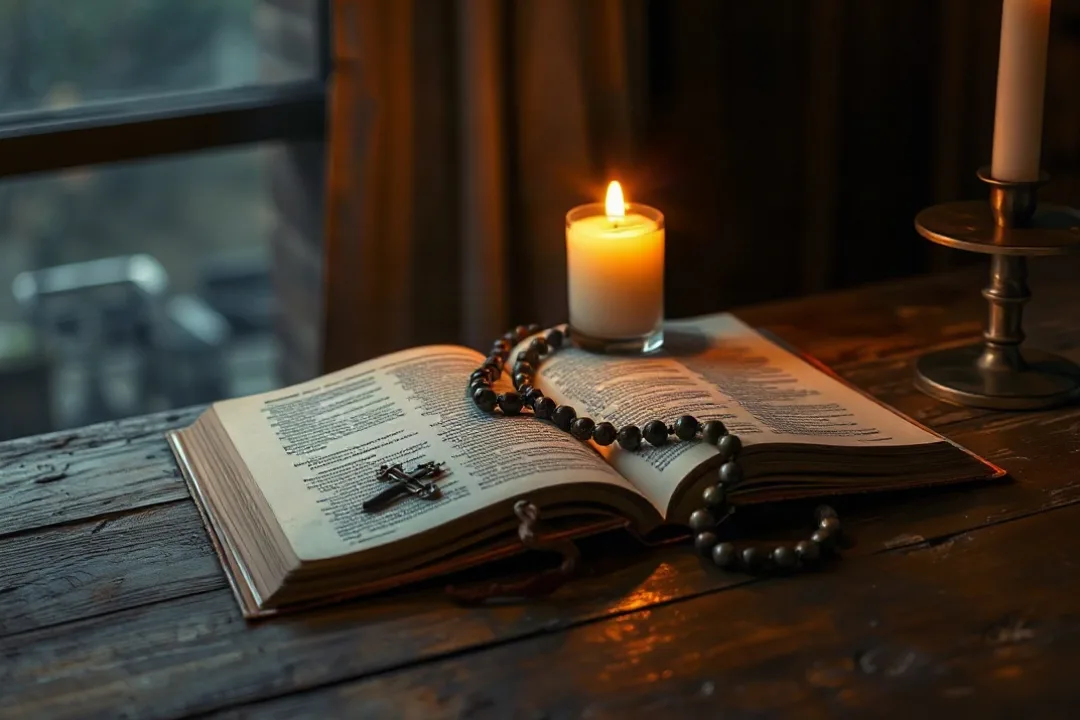
How to pray the Thursday Rosary step by step
The structure follows the same pattern as any Rosary, only the five mysteries meditated on during the decades change. A typical sequence looks like this:
- Begin with the Sign of the Cross and the Apostles' Creed
- Pray one Our Father
- Pray three Hail Marys, often for an increase in faith, hope, and charity
- Pray the Glory Be
- Announce the first Luminous Mystery (the Baptism of Jesus) and pray one decade: an Our Father, ten Hail Marys, and a Glory Be
- Repeat this pattern for each of the remaining four mysteries
- Close with the Hail Holy Queen or another closing prayer, such as the Fatima Prayer added after each decade by some groups
Many people pause briefly before each decade to read the related Gospel passage or picture the scene before beginning the Hail Marys. This small habit keeps the prayer from becoming mechanical and helps the mind stay anchored to the specific mystery being prayed.
Tip: If a full Rosary feels long on a busy Thursday, praying even one decade of the Luminous Mysteries with full attention is more valuable than rushing through all five distracted.
Why these mysteries were added later than the others
For centuries, the Rosary only included the Joyful, Sorrowful, and Glorious Mysteries. Devotional writers and theologians had long noted a gap: the mysteries moved from Jesus's childhood almost directly to his suffering, skipping over the years of his adult ministry, teaching, and miracles.
Pope John Paul II addressed this directly in 2002, explaining that the new mysteries would help the faithful contemplate Christ's public life more fully. He described this set as helping believers grasp the mystery of light that Christ himself is, referencing John's Gospel where Jesus calls himself the light of the world.
"Each of these mysteries is a revelation of the Kingdom now present in the very person of Jesus."
This addition did not replace or diminish the older mysteries; it simply gave Rosary prayer a more complete rhythm, covering birth, ministry, death, and resurrection across the full week.
Common questions about praying the Luminous Mysteries
People new to this devotion often wonder whether the order or wording needs to be exact, or whether small variations matter. Some practical clarifications help:
- The order of the five mysteries follows the Gospel chronology and is not meant to be rearranged
- Scriptural references can be read aloud before each decade, though this is optional and more common in group settings
- Personal intentions can be attached to any decade; there's no requirement to pray for something specific tied to each mystery
- Missing Thursday and praying the Luminous Mysteries on another day is acceptable if that fits someone's schedule better
Praying the Luminous Mysteries in a group or family setting
Many parishes and families pray the Thursday Rosary together, often taking turns leading each decade. This shared structure makes it easier for children or newcomers to follow along, since the repetition of prayers stays the same even as the mystery changes.
Some families use short printed cards with an image for each Luminous Mystery, placing the relevant card in the center of the table or prayer space as that decade begins. This visual anchor helps younger children connect the words being prayed to the actual Gospel scene.
Bringing the Thursday mysteries into daily life
Beyond the prayer itself, the five Luminous Mysteries offer a framework for everyday reflection. The Baptism invites a sense of identity rooted beyond daily roles and achievements. Cana encourages noticing small needs around us, rather than waiting for dramatic crises. The call to the Kingdom pushes toward ongoing change rather than settling into routine. The Transfiguration offers perspective when life feels heavy, a reminder that difficult chapters are not the whole story. The Institution of the Eucharist, for those who practice it, points toward a sense of ongoing nourishment and connection that doesn't depend on feeling spiritually strong every day.
Praying through these mysteries regularly on Thursdays builds familiarity with the arc of Christ's public life in a way that reading the Gospels straight through sometimes doesn't, since the Rosary's repetitive structure allows each scene time to settle rather than moving quickly to the next.
Frequently asked questions
Why are the Luminous Mysteries prayed on Thursday instead of another day?
Pope John Paul II suggested Thursday when he introduced these mysteries in 2002, since it fits naturally before Friday, the day traditionally associated with Christ's Passion and the Sorrowful Mysteries. This placement lets the public ministry of Jesus lead directly into his suffering within the weekly cycle.
Can I pray the Luminous Mysteries on a day other than Thursday?
Yes. The weekly schedule is a traditional suggestion, not a strict rule. If Thursday doesn't fit your schedule, praying the Luminous Mysteries on another day, or even daily for a period, is perfectly acceptable and still meaningful.
What is the difference between the Luminous Mysteries and the other three sets?
The Joyful, Sorrowful, and Glorious Mysteries focus on Christ's birth, death, and resurrection. The Luminous Mysteries fill the gap between them, focusing specifically on his adult public ministry: his baptism, miracles, teaching, transfiguration, and the Last Supper.
Do I need to read Scripture before each decade of the Thursday Rosary?
It's not required but many people find it helpful. Reading the short Gospel passage connected to each Luminous Mystery before praying that decade keeps the mind focused on the specific scene rather than reciting prayers on autopilot.
Leave a Reply