
The Angelus prayer: meaning, history, and how to pray it
The Angelus is a short Catholic devotion prayed three times a day, traditionally at 6 a.m., noon, and 6 p.m., recalling the moment the angel Gabriel announced to Mary that she would conceive Jesus. It takes its name from the first word of its opening line in Latin, Angelus Domini nuntiavit Mariae — "The angel of the Lord declared unto Mary."
Where the Angelus prayer comes from
The Angelus did not appear all at once. It grew over several centuries out of simpler bell-ringing customs in medieval Europe, where church bells called people to pause and recite a Hail Mary or two at set hours. Franciscan communities are often credited with popularizing an evening bell and prayer in honor of the Incarnation sometime in the thirteenth century.
Over the following hundreds of years, a midday prayer and a morning prayer were gradually added, and the three moments merged into the pattern still used today. By the time the devotion reached its familiar form, it combined three short biblical scenes with three Hail Marys and a closing prayer, all framed by the ringing of bells.
The practice spread widely because it required no books, no special training, and no particular setting. A farmer in a field, a baker closing a shop, or a student walking home could all stop for a minute or two and pray it from memory.
How to pray the Angelus step by step
The structure is simple enough to learn in one sitting, even though the full text uses older, formal language. Here is the basic sequence:
- First versicle and response: a line announcing that the angel appeared to Mary, followed by a Hail Mary.
- Second versicle and response: Mary's reply of acceptance, followed by another Hail Mary.
- Third versicle and response: the statement that the Word became flesh, followed by a third Hail Mary.
- A short versicle and response asking for the prayers of the Mother of God, often phrased as a request to be made worthy of the promises of Christ.
- The closing collect, a brief prayer asking God to pour grace into the hearts of the faithful.
Many people make the Sign of the Cross at the beginning and end, and some pause briefly after each Hail Mary to reflect on the scene just announced. The whole devotion typically takes two to three minutes.
Tip: If you are new to the Angelus, start by praying just the first line and one Hail Mary at noon for a week. Add the second and third sections once the opening feels natural rather than memorizing the whole thing at once.
What each part of the Angelus actually means
The three main sections correspond to three moments described in the opening chapter of the Gospel of Luke and the beginning of John's Gospel. Understanding what each line points to makes the repetition of Hail Marys feel less mechanical.
- The announcement: the first section recalls Luke 1:26-28, where the angel Gabriel is sent to a young woman in Nazareth and greets her as one who has found favor with God.
- The consent: the second section recalls Luke 1:38, where Mary responds to the angel's message by agreeing to what is asked of her, describing herself as the servant of the Lord.
- The Incarnation: the third section draws on John 1:14, which describes the eternal Word taking on human flesh and dwelling among people.
Each Hail Mary that follows is not just a repeated formula; it is meant to let the pray-er sit for a moment with that particular scene before moving to the next one. The closing collect then turns the focus from Mary's role to the broader mystery of the Incarnation itself, asking that the grace revealed in that event take root in the person praying.
Pour forth, we beseech thee, O Lord, thy grace into our hearts; that as we have known the Incarnation of thy Son Jesus Christ by the message of an angel, so by his Passion and Cross we may be brought to the glory of his Resurrection.
Why the Angelus is tied to bells and set times of day
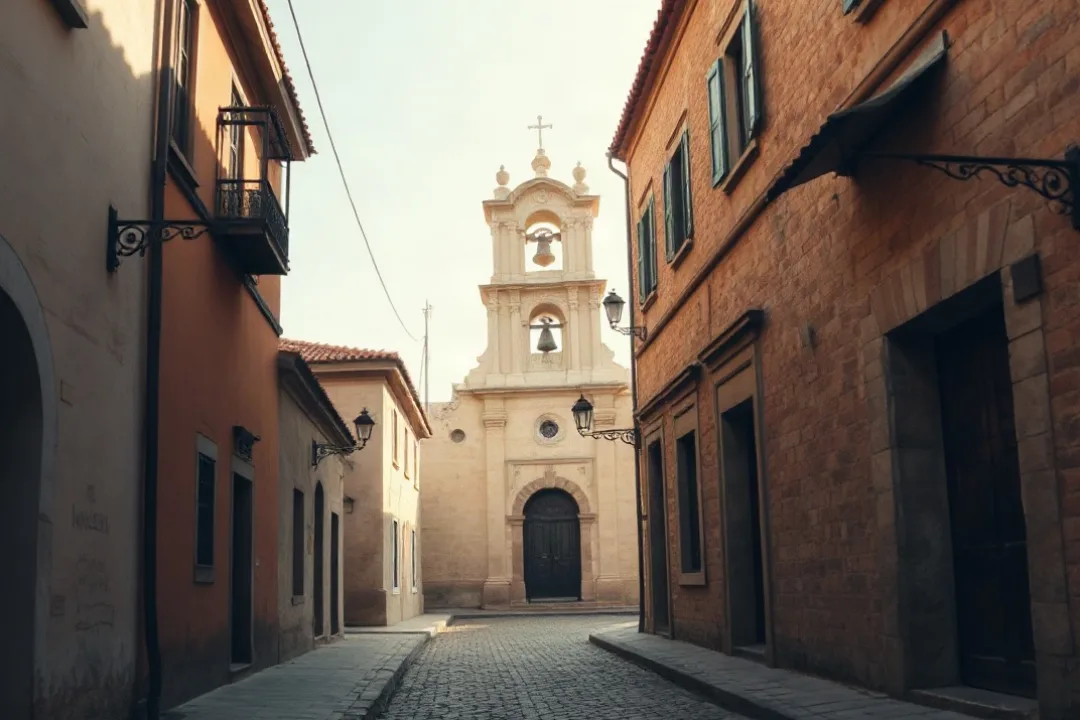
The link between the Angelus and church bells is not incidental; it is part of how the devotion was designed to work. Because few people in earlier centuries owned clocks, the ringing of a bell three times a day served as both a timekeeping signal and an invitation to pray.
The morning bell marked the start of the working day, the noon bell interrupted the busiest stretch of labor, and the evening bell signaled the close of work. Stopping at each of these points turned ordinary transitions into small moments of reflection on the Incarnation, rather than leaving prayer only for church services or bedtime.
Many parishes, monasteries, and some town halls still ring bells at these hours, and in communities where this custom survives, people often recognize the pattern of the ringing even if they do not pray the words themselves.
The Regina Caeli: how the Angelus changes during Easter season
From Easter Sunday through Pentecost, Catholics typically replace the Angelus with a different prayer called the Regina Caeli, Latin for "Queen of Heaven." This shorter prayer is structured as four short verses and responses rather than three, and it centers on the Resurrection instead of the Annunciation.
The reasoning behind the switch is straightforward: the Angelus focuses on the beginning of Christ's earthly life, while the Easter season celebrates the end of his earthly suffering and his rising from the dead. Rather than praying about the Incarnation during a season dedicated to the Resurrection, the Church offers a prayer matched to the liturgical moment.
Once the Easter season ends, communities and individuals return to the regular Angelus for the rest of the year.
The Angelus and the pope's Sunday noon address
One of the most visible modern expressions of this devotion happens each Sunday at noon in St. Peter's Square, where the pope appears at a window to lead the Angelus with the crowd gathered below. Before the prayer itself, he usually offers brief reflections on the day's Gospel reading or on current events affecting the Church and the world.
This weekly appearance has made the Angelus familiar even to people with little background in Catholic devotional practice, since footage of it is often broadcast or shared widely. It also reinforces the original idea behind the prayer: that it is meant to be prayed in community, at a fixed hour, rather than only in private.
Keep in mind: the Angelus is a devotional practice, not an obligatory part of Mass or official liturgy. You can pray it at any hour that works for your schedule; the traditional three times are a helpful pattern, not a strict rule.
How people fit the Angelus into daily life today
Few households today hear church bells marking the hours, so praying the Angelus usually requires a personal reminder rather than relying on an external signal. People have found several practical ways to keep the habit:
- Phone alarms set for 6 a.m., noon, and 6 p.m., labeled simply "Angelus."
- Pairing it with an existing routine, such as praying it right before lunch or right after arriving home from work.
- Praying it with family at the dinner table, which also helps children memorize the responses by hearing them repeated.
- Using a printed card or app that includes the full text until the words are memorized.
Because the prayer is short, missing one of the three traditional times does not mean skipping it for the day. Many people simply pray it once, whenever they remember, and treat the three-times-a-day pattern as an ideal to grow into rather than a requirement to meet perfectly.
How the Angelus differs from the Rosary
The Angelus is sometimes confused with the Rosary because both involve repeated Hail Marys and both honor Mary's role in the Incarnation. The two are different in scope and purpose, though:
- Length: the Angelus takes two or three minutes; a full Rosary takes closer to twenty minutes.
- Structure: the Angelus has three fixed Hail Marys tied to specific verses; the Rosary has fifty or more Hail Marys organized into decades, each attached to a different mystery from the life of Christ.
- Focus: the Angelus concentrates entirely on the Annunciation and Incarnation; the Rosary moves through a wider range of events, depending on which set of mysteries is being prayed that day.
- Typical timing: the Angelus is prayed at set hours throughout the day; the Rosary is more often prayed once, at whatever time is convenient.
Many Catholics pray both, using the Angelus as a brief daily anchor and the Rosary as a longer, separate devotion.
Why this short prayer has lasted so long
Part of the Angelus's staying power comes from how little it demands. It does not require a church building, a group of people, or any special object, which made it accessible to laborers, travelers, and households without much formal religious instruction across many centuries.
It also works as a recurring reminder of a single idea rather than a broad survey of doctrine: that God became human in a specific moment, through a specific person's free consent. Returning to that idea three times a day, in the middle of ordinary tasks, was understood as a way of keeping that belief present rather than confined to Sunday worship.
For readers encountering the Angelus for the first time, the easiest entry point is simply pausing at noon, reading the three versicles and three Hail Marys slowly, and letting the closing prayer be the last thing said before returning to whatever came before.
Frequently asked questions
What does the word Angelus mean?
Angelus is Latin for "angel" and comes from the prayer's opening line, Angelus Domini nuntiavit Mariae, meaning "The angel of the Lord declared unto Mary." The name refers to the angel Gabriel's announcement to Mary described in Luke's Gospel.
Do you need a rosary or any object to pray the Angelus?
No. The Angelus only requires the words themselves, which can be prayed from memory, a printed card, or an app. It does not use rosary beads, since it has just three Hail Marys rather than the longer decades used in the Rosary.
Can non-Catholics pray the Angelus?
Yes, anyone can pray it. It is a traditional Catholic devotion, but its focus on the Annunciation and Incarnation is drawn from Gospel passages shared across Christian traditions, so people outside the Catholic Church sometimes pray it as well.
Is it wrong to pray the Angelus at a different time than 6 a.m., noon, and 6 p.m.?
No. Those three hours are a traditional pattern tied to the historical custom of bell-ringing, not a strict requirement. You can pray the Angelus at any time that fits your day, whether once or multiple times.
Leave a Reply