
Planning a meaningful pilgrimage to Rome: what to know before you go
Rome has drawn pilgrims for nearly two thousand years, and it remains one of the few cities on earth where faith, history, and daily life sit on top of each other in the same square mile. Walking its streets means tracing the footsteps of apostles, martyrs, and ordinary believers who came seeking forgiveness, healing, or simply a closer sense of the sacred. A pilgrimage to Rome is not the same as a vacation, even if it includes the same flights and hotel rooms; the purpose shapes everything from the route you take to the pace you keep.
There is an old saying, omnes viae Romam ducunt — all roads lead to Rome — and for centuries that was literally true for anyone walking from northern Europe toward the tombs of Peter and Paul. Today most pilgrims arrive by plane, but the sense of convergence remains. People come from every continent, speaking dozens of languages, to stand in the same basilicas and pass through the same ancient doors.
Why Rome became the center of Christian pilgrimage
Rome's importance as a pilgrimage destination rests on two historical facts: it is the place where Saint Peter and Saint Paul were martyred and buried, and it has been the seat of the papacy for most of Christian history. Unlike Jerusalem, which draws pilgrims to the sites of Christ's life, death, and resurrection, Rome draws them to the foundations of the institutional Church itself.
By the fourth century, after Constantine legalized Christianity, construction began on basilicas marking the burial sites of martyrs. Pilgrims started arriving in organized numbers, and by the medieval period, Rome ranked alongside Jerusalem and Santiago de Compostela as one of the three great pilgrimage destinations of Christendom. Earning indulgences, seeking healing, or fulfilling a vow were common motivations, and many of those same reasons still bring people to the city.
The tradition of the Holy Year, or Jubilee, reinforced Rome's pilgrimage identity. First proclaimed in 1300, Jubilee years invite the faithful to travel to Rome, pass through designated Holy Doors, and seek a plenary indulgence. These years happen on a roughly 25-year cycle, with additional special Jubilees declared at other times, and they tend to draw especially large crowds of pilgrims to the city.
Choosing when to travel and how long to stay
Timing affects almost everything about a pilgrimage to Rome, from crowd levels to the weather you'll walk through. Spring (April and May) and fall (late September through October) offer the most comfortable temperatures and moderate crowds. Summer brings intense heat, often above 90°F, along with the thickest tourist crowds of the year.
Holy Week, the days leading up to Easter, is a powerful but demanding time to visit. Masses, processions, and the Easter Sunday blessing from St. Peter's Square draw enormous numbers of people, so anyone attending should plan for long lines, limited seating, and the need to arrive hours early for major events.
- Three to four days allows time to visit the four major basilicas and a few key sites without rushing.
- A full week gives room for the catacombs, smaller churches tied to specific saints, and a day trip to Assisi or Orvieto.
- Ten days or more suits those walking part of a pilgrim route into the city, since the final stretches alone can take several days on foot.
Booking accommodations near the historic center, rather than near the main train station, makes early morning visits to basilicas far easier, since many open before 7 a.m. and are quietest right after opening.
The sites every pilgrim should know
The four papal basilicas
Rome's pilgrimage tradition centers on four major basilicas, and visiting all four, ideally on foot, is considered a complete pilgrimage circuit by many Catholic traditions.
- St. Peter's Basilica, built over the traditional burial site of the apostle Peter, inside Vatican City.
- St. John Lateran, the cathedral of Rome and the pope's own church as bishop of the city, often overlooked by first-time visitors despite its official rank.
- St. Paul Outside the Walls, marking the burial place of Saint Paul, set apart from the historic center and often quieter because of its distance.
- St. Mary Major, the largest church dedicated to Mary in Rome, known for its ancient mosaics and a relic believed to be from the manger in Bethlehem.
Each of these basilicas has a Holy Door, opened during Jubilee years, and each remains open to pilgrims for prayer and Mass throughout the regular calendar as well.
Catacombs and places of martyrdom
The catacombs along the Appian Way, including those of San Callisto and San Sebastiano, hold the underground burial chambers where early Christians laid their dead and, during periods of persecution, sometimes gathered secretly for worship. Guided tours are required, both for safety and to preserve the fragile tunnels, and they offer a direct physical connection to the earliest generations of the faith.
Other sites worth including are the Mamertine Prison, traditionally linked to the imprisonment of Peter and Paul, and the Scala Santa, a staircase pilgrims traditionally climb on their knees, believed to be the steps Christ walked before his trial.
Tip: Reserve catacomb tours and Vatican Museum entry online several weeks ahead. Walk-up lines, especially in spring and fall, can mean waiting two or more hours outside in the sun.
Walking an ancient route into the city
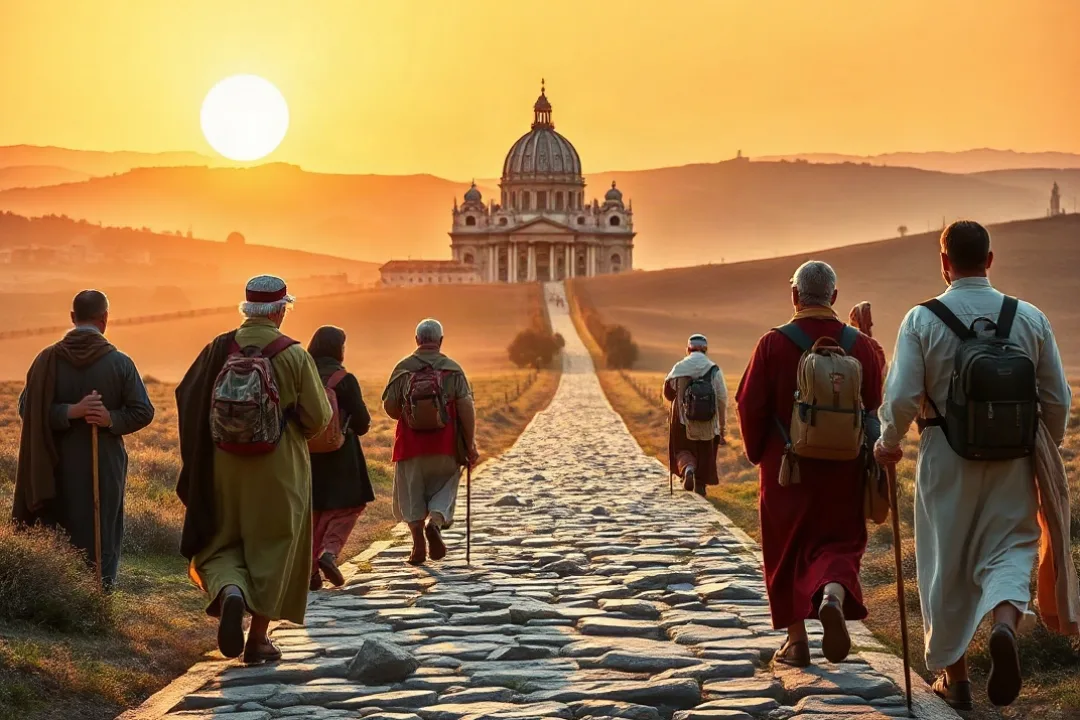
For pilgrims who want the physical experience of arrival, not just the destination, the Via Francigena offers a historic walking route stretching from Canterbury, England, through France and Switzerland, down into Italy and finally to Rome. Few modern pilgrims walk the entire length, but many choose to complete the final stages, often starting from Siena or another town in Tuscany, which can be covered in one to two weeks.
Walking into Rome on foot, arriving at St. Peter's Square after days of travel, produces an entirely different feeling than stepping off a tour bus. The approach builds anticipation gradually, and many pilgrims describe the final view of the dome from a distance as the emotional high point of the entire trip.
Those considering this route should plan for:
- Physical preparation, since daily walking distances often run between 12 and 20 miles.
- A pilgrim credential, a small passport-style booklet stamped at churches, hostels, and refuges along the way, which also grants access to discounted pilgrim lodging.
- Lighter packing than a typical trip, since everything is carried on your back for days at a time.
Pilgrim hostels along the route, run by parishes or religious communities, offer basic but affordable beds, usually for a modest donation rather than a fixed price.
Practical preparation before you leave
A successful pilgrimage depends as much on logistics as on devotion. Visitors from the United States need a valid passport, and most stays under 90 days do not require a visa, though travelers should confirm current entry requirements before booking flights, since rules can change.
Modest dress is required inside all churches and basilicas, including St. Peter's. Shoulders and knees must be covered for both men and women, and guards at the entrances do turn people away for shorts or sleeveless tops, so it helps to carry a light scarf or shawl even on hot days.
- Comfortable, broken-in walking shoes matter more than anything else you pack, given the uneven cobblestones throughout the historic center.
- A reusable water bottle is practical, since Rome's public drinking fountains, called nasoni, provide free, cold, potable water throughout the city.
- Carrying a small amount of cash helps for donation boxes, candles, and smaller churches that do not accept cards.
- A basic daily Mass schedule, available at most parish offices or online, lets you plan visits around times when churches are open and active rather than closed for private prayer or events.
Travelers hoping to attend a papal audience, held most Wednesdays when the pope is in Rome, can request free tickets in advance through the Prefecture of the Papal Household, either by mail, fax, or through a local parish connection. Tickets are free, but arriving early is essential, since seating in St. Peter's Square fills quickly.
Making the spiritual purpose central to the trip
It is easy for a pilgrimage to Rome to drift into ordinary sightseeing, given how much art, architecture, and history surrounds every basilica. Keeping the spiritual focus intact takes some intention.
Many pilgrims find it helpful to set a specific intention before departure, whether that is prayer for a family member, gratitude for a particular grace, or simply the desire to deepen their faith. Writing that intention down, and returning to it at each major site, keeps the trip anchored even amid crowds and tour groups.
Pope Francis has spoken of pilgrimage as a reminder that faith is not a static possession but a journey, something lived step by step rather than held all at once.
Attending Mass at each of the major basilicas, rather than simply photographing them, transforms the visit from a checklist into an act of devotion. Many churches also offer confession in multiple languages, including English, and dedicating even one morning to the sacrament can anchor the entire trip.
Journaling each evening, noting what moved you or surprised you that day, gives the pilgrimage a lasting shape once you return home. Some travelers also bring small items, like rosaries or holy cards, to be blessed at a basilica and later given to family members who could not make the trip themselves.
Reminder: Rome rewards slowness. Trying to see everything in a single rushed day often leaves pilgrims exhausted and disconnected from the very experience they traveled so far to have.
Choosing one or two sites per day, rather than cramming in a dozen, allows time to actually pray, sit quietly, or simply notice details that a hurried pace would miss, such as the worn stone steps at a side chapel or the quiet corner where locals still light candles each morning before work.
Frequently asked questions
How many days do I need for a pilgrimage to Rome?
Three to four days covers the four major basilicas and a few key sites comfortably. A full week allows time for the catacombs, smaller churches, and day trips, while walking part of an ancient route like the Via Francigena before arriving can add another week or more.
Do I need to book anything in advance for a pilgrimage to Rome?
Yes, especially the Vatican Museums, catacomb tours, and papal audience tickets, which should be reserved weeks ahead. Many churches and Masses don't require booking, but popular sites fill up quickly, particularly during Jubilee years and Holy Week.
What should I wear to visit Rome's basilicas?
Shoulders and knees must be covered for both men and women at all major churches, including St. Peter's. A light scarf or shawl is useful for quick coverage on hot days, since guards consistently enforce this rule, even for brief visits.
What is a Jubilee year and why does it matter for Rome pilgrims?
A Jubilee, or Holy Year, is a special period, proclaimed roughly every 25 years, when pilgrims can pass through designated Holy Doors at Rome's basilicas and seek a plenary indulgence. Jubilee years bring significantly larger crowds and additional liturgical events throughout the city.
Leave a Reply