
St. Lucia Day: history, traditions, and how it's celebrated
St. Lucia Day is a festival of light celebrated on December 13 throughout Sweden, Norway, Finland, and Danish communities, marking one of the darkest points of the Scandinavian winter with candles, white gowns, and saffron-scented buns. The holiday honors Saint Lucia of Syracuse, a young Christian martyr from the fourth century, and centers on a young woman chosen to play "Lucia," who wears a crown of candles and leads a procession of singers through homes, schools, and churches. The day blends Christian martyrdom legend with older Nordic midwinter customs tied to light overcoming darkness.
Unlike many winter holidays that arrived in the United States through mass commercialization, St. Lucia Day remains largely a cultural and community tradition, kept alive mainly by Scandinavian-American families, churches, and heritage organizations. Understanding where it came from and how it's observed helps explain why candles, buns, and processions still matter to people who mark it every year.
Who was Saint Lucia and why December 13 matters
Saint Lucia was a young woman from Syracuse, Sicily, who lived in the late third and early fourth century. According to tradition, she was a Christian who devoted herself to charity, giving away her dowry to the poor instead of marrying as her family wished. She was eventually martyred during a period of persecution of Christians under Roman rule, and she became venerated as a saint associated with sight and light, partly because her name comes from the Latin word for light, lux.
The connection to Scandinavia seems unlikely at first, since Lucia never set foot in the Nordic countries. Her feast day spread through the medieval Christian calendar across Europe, and in Sweden it merged with older pre-Christian midwinter beliefs about the winter solstice. Before calendar reforms shifted the dates, December 13 was close to the shortest day of the year, a time when Scandinavians marked the turning point between deepening darkness and the slow return of light.
That overlap gave Lucia's story unusual staying power in the north. A saint linked to light arriving on one of the darkest days of the year became a natural symbol for communities enduring long, nearly sunless winters.
How the modern Lucia tradition took shape
The Lucia celebration familiar today, with a young woman wearing a crown of candles, didn't become widespread in Sweden until the 1700s and 1800s, and it grew into a nationwide custom mainly in the twentieth century. Newspapers, schools, and local organizations helped standardize the image of Lucia as a white-robed figure with a candle crown, accompanied by attendants called tärnor who also wear white and carry candles.
Radio and later television broadcasts of Lucia processions in Sweden during the 1900s turned a regional custom into a shared national event. Schools began choosing a student to serve as that year's Lucia, towns held public processions, and companies and churches adopted the tradition as part of their December calendar. Norway, Finland, and Danish communities adopted versions of the celebration as well, often through cultural exchange with Sweden or through Lutheran church traditions.
Good to know: St. Lucia Day isn't an official public holiday with a day off work in Sweden, Norway, or Finland. It's a cultural and often religious observance layered into the normal December calendar.
What a traditional St. Lucia Day celebration includes
Celebrations vary by country, town, and setting, but certain elements appear consistently across Scandinavian communities and the diaspora groups that keep the tradition in the United States.
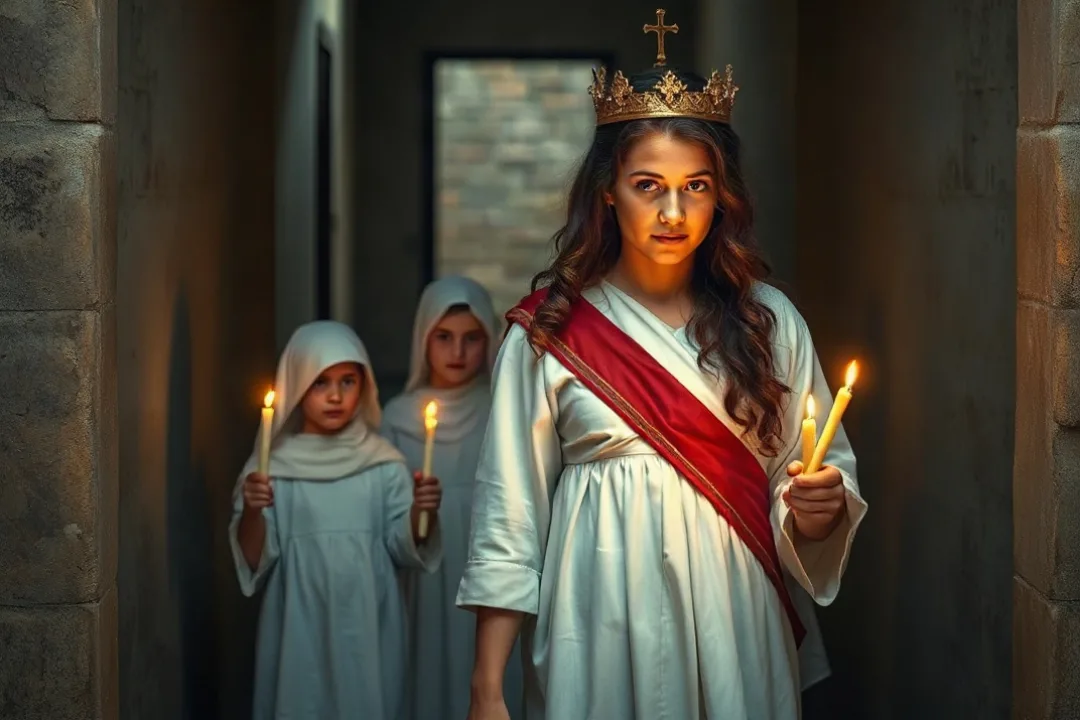
- The Lucia figure: a girl or young woman wears a white gown, often with a red sash, and a crown fitted with lit candles (real or battery-powered today for safety).
- Attendants in white: other participants, sometimes called tärnor, carry single candles and walk alongside Lucia in the procession.
- Star boys: in some versions, boys dressed in white robes and pointed hats, carrying star-topped wands, join the procession representing the Three Wise Men or older midwinter figures.
- Singing: the group sings traditional songs, most notably "Sankta Lucia," based on a Neapolitan melody, as they walk through homes, schools, offices, or churches.
- Saffron buns: known as lussekatter or "Lucia cats," these golden, saffron-spiced buns shaped with curled ends and studded with raisins are served alongside coffee or glögg (mulled wine).
- Gingerbread cookies: pepparkakor, thin spiced cookies, often accompany the buns on the breakfast or coffee table.
In many Swedish households, the celebration begins early in the morning, sometimes before sunrise, when a family member dressed as Lucia brings coffee and buns to still-sleeping relatives, singing as she enters the room. Schools typically hold a Lucia procession where one student is chosen to wear the crown while classmates serve as attendants and star boys.
Step-by-step: how a typical Lucia Day morning unfolds
- Early rising: Because the tradition is tied to bringing light into darkness, celebrations often start before dawn, sometimes as early as 6 or 7 a.m.
- Dressing as Lucia: The chosen person puts on a white gown, a red sash, and a candle crown, assisted by family or classmates.
- Preparing the tray: Coffee, lussekatter, and sometimes gingerbread are arranged on a tray to be carried in during the procession.
- The procession: Lucia leads attendants and star boys through the house, school hallway, or church aisle while everyone sings "Sankta Lucia" or other seasonal songs.
- Serving and sharing: Once the song ends, the group shares the buns and coffee with family, classmates, or congregation members.
- Community events: Many towns also hold a larger public Lucia procession later in the day or evening, often ending with a concert or market.
Why saffron buns and candles are central to the day
The saffron buns known as lussekatter get their golden color and distinctive aroma from saffron, a spice that was historically expensive and associated with special occasions. Their shape, often described as resembling curled cat tails or figure eights, ties into old folklore about cats and the devil tempting people during the dark winter nights, though the exact origin of the shape is debated among food historians.
Candles serve a more direct symbolic purpose. In a region where December days offer only a few hours of weak daylight, lighting candles isn't decorative flourish, it's a literal counterweight to the darkness. The candle crown worn by Lucia represents this idea in its most visible form, turning a single person into a walking source of light for the household or community.
Safety note: Many schools and families now use battery-powered LED candles for the crown instead of real flames, especially for younger children, to avoid the fire risk of an open flame near hair and fabric.
How St. Lucia Day differs across Sweden, Norway, and Finland
While the core imagery, white gown, candle crown, saffron buns, stays consistent, each country has shaped the holiday slightly differently.
- Sweden: Treats the day as the most widely recognized version of the holiday, with national television broadcasts, large public processions in cities like Stockholm, and school celebrations nearly everywhere.
- Norway: Observes similar school and church processions, though the holiday is somewhat less universally embedded in national identity than in Sweden.
- Finland: Also celebrates Lucia Day, particularly within the Swedish-speaking Finnish community, with processions, songs, and a nationally selected Lucia in some regions.
- Danish communities: Observe Lucia Day mainly through churches, often as a candlelit service rather than a full school-based procession.
In all these places, the holiday sits firmly within the Advent season leading up to Christmas, functioning almost as a midpoint marker between the start of Advent and Christmas Eve itself.
How Scandinavian-American communities keep the tradition alive
In the United States, St. Lucia Day survives mainly through Scandinavian heritage organizations, Lutheran churches with Nordic roots, cultural centers, and families who immigrated from Sweden, Norway, or Finland and passed the custom down. Cities with strong Scandinavian immigrant history, including parts of Minnesota, Illinois, and the Pacific Northwest, often host public Lucia processions, craft fairs, and bakery events built around the day.
Swedish-American churches sometimes select a Lucia from the congregation each year, much like schools do in Sweden, and hold a candlelit service followed by a coffee hour with lussekatter. Museums and cultural heritage centers dedicated to Scandinavian history frequently schedule their biggest December event around December 13, drawing visitors who may not have Nordic ancestry but enjoy the tradition's warmth and simplicity.
Simple ways to mark St. Lucia Day at home
You don't need Scandinavian heritage or a formal procession to bring the spirit of the day into your own household. A few manageable steps can capture the holiday's core idea of bringing light and warmth into a dark winter morning.
- Bake lussekatter: Saffron buns are the most accessible entry point; recipes typically call for saffron threads, yeast dough, milk, butter, and raisins.
- Light candles at breakfast: Even without a full candle crown, setting a few lit candles on the breakfast table echoes the day's symbolism.
- Play or sing "Sankta Lucia": The melody is simple and widely available online, making it easy to learn even without fluency in Swedish.
- Serve coffee or glögg: Warm drinks fit naturally with the cold, early-morning feel of the tradition.
- Involve kids with costumes: A simple white robe and a battery-powered candle crown can turn the morning into a memorable family activity, especially for children drawn to the story of a girl crowned with light.
Families who want to go further sometimes organize a small neighborhood or extended-family procession, with children taking turns wearing the crown or carrying star wands, keeping the focus on song and shared food rather than elaborate staging.
Common misconceptions about St. Lucia Day
Because the name overlaps with the Caribbean island nation of Saint Lucia, some people searching for information about the holiday initially expect content about that country rather than the Scandinavian festival. The two share a namesake saint but otherwise have no connection in terms of customs or geography.
Another common mix-up involves timing. St. Lucia Day isn't Christmas Eve or Christmas Day, nor is it a substitute for either. It falls firmly within Advent, about two weeks before Christmas, and functions as its own distinct observance rather than a warm-up event for the main holiday.
"She comes, she comes, bright in her radiant crown," goes one common English rendering of the traditional song's opening lines, reflecting the central image of Lucia arriving as a bringer of light during the darkest stretch of the year.
Some also assume the holiday is strictly religious. While it has Christian roots tied to a martyred saint, much of its modern observance, especially in schools and public events, treats it as a cultural and seasonal tradition rather than a formal religious service, even though churches continue to hold Lucia-themed services as well.
Frequently asked questions
What is the meaning behind St. Lucia Day?
St. Lucia Day honors Saint Lucia of Syracuse, a Christian martyr associated with light, and marks the turning point toward longer days during the darkest part of the Scandinavian winter. It blends her legend with older midwinter customs celebrating the return of light.
Why does the Lucia figure wear candles on her head?
The candle crown symbolizes bringing light into darkness, reflecting the holiday's core theme during one of the shortest-daylight periods of the year. Many families and schools now use battery-powered candles instead of open flames for safety.
What foods are traditionally eaten on St. Lucia Day?
The signature food is lussekatter, saffron-spiced buns shaped with curled ends and studded with raisins, usually served with coffee or mulled wine called glögg. Gingerbread cookies known as pepparkakor often accompany them.
Is St. Lucia Day the same as Saint Lucia the Caribbean country?
No. St. Lucia Day is a Scandinavian winter festival named after Saint Lucia of Syracuse, while Saint Lucia the country is an independent Caribbean island nation named after the same saint but with no shared traditions or customs.
Leave a Reply