
The Glorious Mysteries of the Rosary explained simply
The Glorious Mysteries are the fifth and final set of events that Catholics contemplate while praying the Rosary, traditionally meditated on Sundays and Wednesdays. They trace the story of Christ's triumph over death and Mary's own glorification, moving from the empty tomb to her crowning as Queen of Heaven.
Unlike the Joyful or Sorrowful Mysteries, which focus on Christ's birth and suffering, the Glorious Mysteries look toward victory and hope. They remind the person praying that struggle is not the end of the story, and that both Jesus and Mary now share in a life beyond suffering.
What the Glorious Mysteries are and where they fit in the Rosary
The Rosary is built around four sets of mysteries, each made up of five events from the life of Jesus and Mary. These are the Joyful Mysteries (His birth and childhood), the Luminous Mysteries (His public ministry), the Sorrowful Mysteries (His Passion), and the Glorious Mysteries (His Resurrection and what follows).
Each set is traditionally assigned to specific days of the week so that someone praying the Rosary daily moves through the entire life of Christ over time. The Glorious Mysteries are usually prayed on Sunday and Wednesday, though some people pray all five sets on Sunday alone, especially during the Easter season when the Church emphasizes the Resurrection.
What ties the five Glorious Mysteries together is the theme of new life after struggle. Each mystery shows a moment where something that seemed finished — a life, a presence, a waiting — opens into something greater.
The five Glorious Mysteries and what each one means
Praying the Rosary means holding a scene in mind while reciting the Hail Mary ten times (a decade), after an Our Father and before a closing Glory Be. Here is what each of the five Glorious Mysteries represents:
- The Resurrection of Jesus — Jesus rises from the dead on the third day after His crucifixion, as described in passages like Matthew 28 and John 20. This mystery is meditated on for the grace of faith, since the Resurrection is the foundation of Christian belief that death does not have the final word.
- The Ascension of Jesus into Heaven — Forty days after rising, Jesus ascends bodily into Heaven in the presence of His disciples, as recounted in Acts 1. This mystery is often linked to the grace of hope, since it points to a destiny beyond earthly life.
- The Descent of the Holy Spirit at Pentecost — Ten days after the Ascension, the Holy Spirit comes upon the apostles and Mary gathered in Jerusalem, described in Acts 2. This event marks the birth of the early Christian community and is meditated on for the grace of wisdom and courage.
- The Assumption of Mary into Heaven — Catholic tradition holds that Mary, at the end of her earthly life, was taken body and soul into Heaven. This mystery is tied to the grace of a holy death and trust in God's care beyond this life.
- The Coronation of Mary as Queen of Heaven — Mary is honored as Queen of Heaven and Earth, a role rooted in her unique closeness to Christ. This mystery is meditated on for the grace of perseverance and devotion to Mary.
Each mystery is not simply a historical fact to recall but a scene meant to be entered imaginatively, as if the person praying were present at the empty tomb or in the upper room at Pentecost.
How to actually pray the Glorious Mysteries step by step
The structure of each decade stays the same no matter which mystery is being prayed. Here is the basic sequence for someone praying all five Glorious Mysteries:
- Begin with the Sign of the Cross and the Apostles' Creed.
- Pray one Our Father.
- Pray three Hail Marys, traditionally for an increase in faith, hope, and charity.
- Pray one Glory Be.
- Announce the first Glorious Mystery, the Resurrection, and briefly picture the scene.
- Pray one Our Father, ten Hail Marys, and one Glory Be while holding that scene in mind.
- Move to the second mystery, the Ascension, and repeat the same pattern.
- Continue through Pentecost, the Assumption, and finally the Coronation of Mary.
- Close with the Hail Holy Queen and, if desired, the Sign of the Cross.
Many people also add a short meditation sentence before each decade, such as pausing to think about what courage the apostles must have felt at Pentecost, or what it might mean for Mary to be welcomed into glory after a life marked by quiet faithfulness.
Tip: If your mind wanders during the Hail Marys, that is normal. Gently return to the image of the mystery rather than judging yourself for losing focus — the repetition is part of what allows deeper reflection to happen.
Why these five mysteries are called glorious
The word glorious refers to events that reveal triumph, honor, or exaltation rather than suffering. After the heaviness of the Sorrowful Mysteries, which end with Christ's death, the Glorious Mysteries shift the focus entirely toward what comes after.
This shift matters theologically. The Resurrection is treated in Christian teaching as the event that gives meaning to everything that came before it, including the suffering of the Passion. Without it, the Sorrowful Mysteries would end in defeat rather than hope.
The remaining four mysteries extend that same logic outward: Christ's Ascension shows where human life is ultimately headed, Pentecost shows how that hope is shared with ordinary people through the Holy Spirit, and Mary's Assumption and Coronation show what that destiny looks like for someone who followed God faithfully through an entire life.
"The Rosary is the 'weapon' for these times." — Saint Padre Pio
That saying is often repeated because the Rosary, and the Glorious Mysteries in particular, were traditionally seen as a source of strength during difficult periods, precisely because they point beyond present difficulty toward final victory.
The spiritual fruit connected to each Glorious Mystery
Catholic tradition often pairs each mystery with a specific grace or virtue to ask for while meditating on it. These pairings are not fixed doctrine, but they are widely used as a guide for prayer:
- Resurrection — faith, especially the ability to trust in God's power even when circumstances look hopeless.
- Ascension — hope and a longing for Heaven rather than excessive attachment to earthly concerns.
- Pentecost — wisdom, courage, and openness to the gifts of the Holy Spirit in daily decisions.
- Assumption — a peaceful trust in God at the end of life and freedom from excessive fear of death.
- Coronation — perseverance in small, faithful acts, following Mary's example of quiet devotion rewarded with honor.
Praying with these intentions in mind turns the Rosary from a repeated formula into a conversation about specific struggles a person may be facing, such as fear, grief, or discouragement.
When the Glorious Mysteries are traditionally prayed
The standard weekly schedule assigns the Glorious Mysteries to Sunday and Wednesday. Sunday's placement makes sense given that it is the day the Church associates with the Resurrection, celebrated weekly as a kind of small Easter.
During the Easter season, which runs from Easter Sunday through Pentecost, many Catholics pray the Glorious Mysteries every day, since the liturgical calendar itself is focused on resurrection and new life during that stretch of the year. Some parishes and prayer groups adjust their public Rosary schedules accordingly.
Outside of liturgical rules, there is nothing preventing someone from praying the Glorious Mysteries on any day that feels right. Many people choose them specifically during moments of grief, illness, or uncertainty, precisely because the mysteries speak directly to hope beyond present hardship.
Common questions about meditating on these mysteries well
A frequent difficulty is treating the Hail Marys as background noise while the mind drifts elsewhere. A few practical habits can help with this:
- Use a short phrase before each decade, such as "Jesus, risen and alive" for the first mystery, to anchor attention.
- Picture a single image rather than trying to recall an entire narrative — the empty tomb, the cloud at the Ascension, the flames at Pentecost, Mary rising, Mary crowned.
- Pray slowly rather than rushing through the words, since speed often correlates with distraction.
- Connect each mystery to something current, like praying the Pentecost mystery while asking for guidance on a real decision.
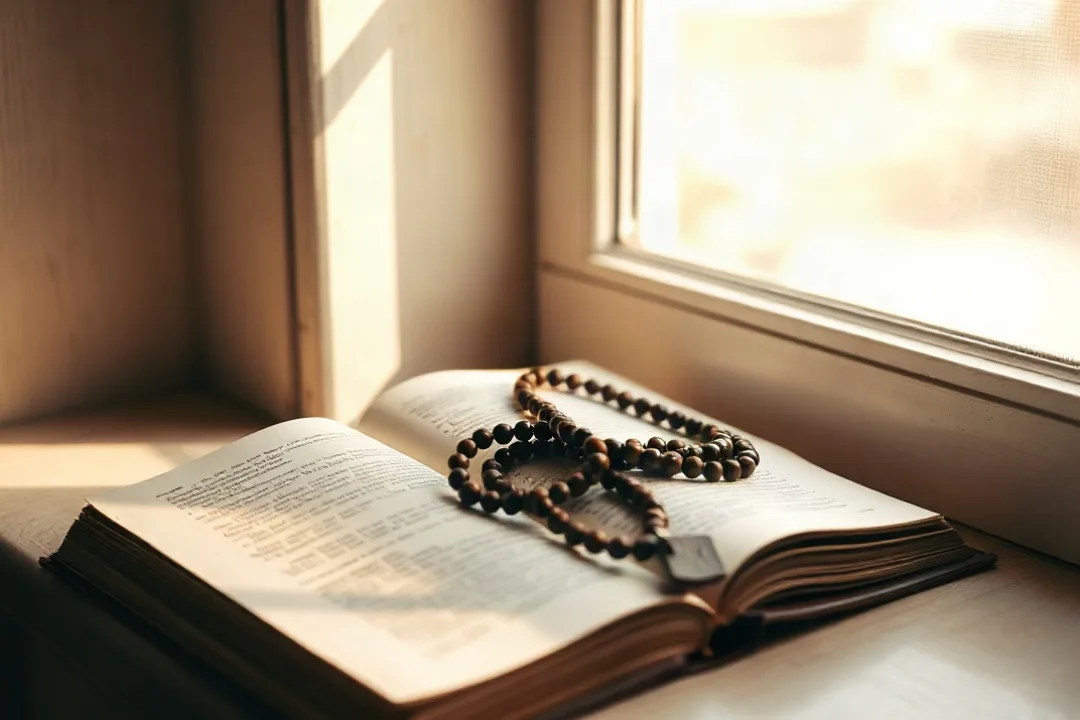
Praying with a physical rosary, rather than counting on fingers or an app, also helps many people stay present, since the repeated motion of the beads gives the hands something to do while the mind focuses on the mystery.
Reminder: There is no single correct way to feel while praying the Rosary. Some days the words flow with attention; other days they are said almost mechanically. Both are considered valid forms of prayer within Catholic tradition.
How the Glorious Mysteries connect to everyday life
The five scenes described in the Glorious Mysteries are not only distant historical or theological events. They map onto experiences many people recognize: moments that seemed final but opened into something new, periods of waiting followed by sudden clarity or courage, and the hope that a life of quiet faithfulness eventually matters.
Someone grieving a loss might find the Resurrection mystery speaks directly to their situation, offering a framework for believing that loss is not absolute. Someone facing a major transition, like a move or a career change, might connect with the Ascension, a moment of leaving one stage of life to enter another.
The Pentecost mystery often resonates with people facing a task that feels beyond their abilities, since it describes ordinary individuals receiving the courage and clarity needed for a mission larger than themselves. The Assumption and Coronation, meanwhile, speak to questions about what ultimately happens at the end of a faithful life, offering reassurance rather than fear.
Praying through these five mysteries regularly, whether on Sundays, Wednesdays, or during the Easter season, gives a structured way to sit with both the historical claims of Christian faith and the personal hopes that those claims are meant to support.
Frequently asked questions
On which days of the week are the Glorious Mysteries prayed?
Traditionally, the Glorious Mysteries are prayed on Sundays and Wednesdays. Many Catholics also pray them every day during the Easter season, since that period of the liturgical year centers on the Resurrection and Pentecost, both of which are part of this set of five mysteries.
What are the five Glorious Mysteries in order?
In order, they are the Resurrection of Jesus, the Ascension of Jesus into Heaven, the Descent of the Holy Spirit at Pentecost, the Assumption of Mary into Heaven, and the Coronation of Mary as Queen of Heaven. Each one is meditated on during a separate decade of the Rosary.
How long does it take to pray the Glorious Mysteries?
Praying all five Glorious Mysteries, including the opening prayers and closing Hail Holy Queen, typically takes between fifteen and twenty minutes at a steady, unhurried pace. The exact time varies depending on how much silent meditation is added between decades.
Why are these mysteries called glorious instead of joyful or sorrowful?
The term glorious refers to triumph and exaltation rather than birth or suffering. These five events happen after Christ's death, showing resurrection, ascension into Heaven, the coming of the Holy Spirit, and Mary's own glorification, which is why they are grouped separately from the Joyful and Sorrowful Mysteries.
Leave a Reply