
The Fatima miracle: what really happened in 1917
On October 13, 1917, somewhere between 30,000 and 100,000 people gathered in a muddy field near Fatima, Portugal, and reported watching the sun spin, change colors, and seem to plunge toward the earth. This event, known as the Miracle of the Sun, remains one of the most widely witnessed claimed supernatural occurrences of the twentieth century, documented not only by religious pilgrims but by secular journalists who had gone to the site expecting to mock the whole affair.
The phenomenon capped off six months of reported apparitions to three shepherd children in the Portuguese countryside. What started as a local curiosity involving a handful of villagers grew into an event that drew people from across the country, including newspaper reporters, skeptics, and government officials who wanted to see for themselves whether anything unusual would actually happen.
How the apparitions at Fatima began
The story starts with three children: Lucia dos Santos, who was ten years old, and her younger cousins Francisco and Jacinta Marto, ages nine and seven. They were tending sheep in a field called the Cova da Iria, outside the small town of Fatima, when they reported seeing a bright figure they described as a lady dressed in white, brighter than the sun.
According to their accounts, the lady asked them to return to the same spot on the thirteenth day of each month for six months. She also asked the children to pray the rosary daily for peace, a request that carried particular weight given that World War I was still raging across Europe and Portugal had troops fighting on the Western Front.
Word spread quickly through the surrounding villages. By the time of the second and third monthly apparitions, small crowds of neighbors and curious onlookers had started showing up at the Cova da Iria, even though only the three children claimed to see and hear the figure directly.
Why the children faced so much skepticism
Local civil authorities, influenced by the strongly anticlerical politics of Portugal's First Republic, were suspicious of the children's claims. At one point, the regional administrator took Lucia, Francisco, and Jacinta into custody and threatened them, trying to pressure them into admitting the story was invented. The children held to their account under questioning, which only added to public curiosity about what might happen when the final apparition, promised for October, arrived.
What crowds reported seeing on October 13, 1917
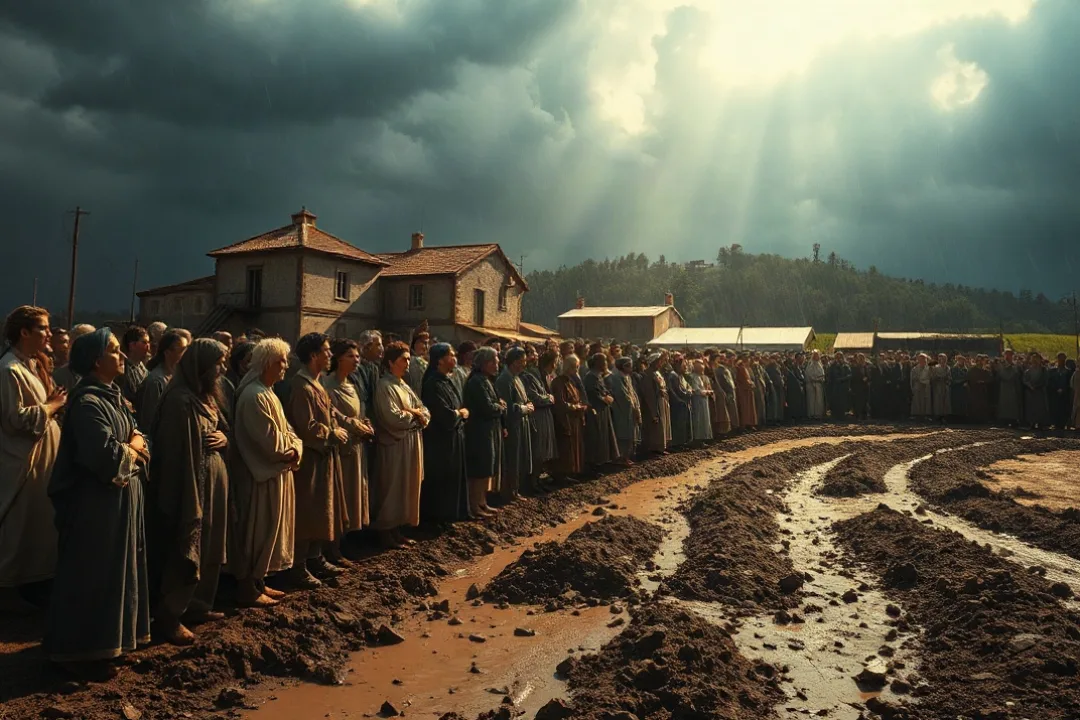
By the sixth and final scheduled appearance, word of a promised miracle had circulated throughout the region. People arrived from Lisbon and other distant towns, some walking for days, despite heavy rain that had turned the fields around the Cova da Iria into mud. Estimates of the crowd size vary, but most historical accounts put the number somewhere between 30,000 and 70,000, with some newspaper estimates going even higher.
Around midday, witnesses reported that the rain stopped and the clouds parted. What followed, according to thousands of independent accounts, included:
- The sun appearing to spin rapidly like a wheel of fire
- Shifts in color, with observers describing reds, yellows, blues, and violets radiating across the sky and the landscape
- The sun seeming to zigzag and plunge toward the earth before returning to its place
- Drenched clothing and the muddy ground reportedly drying out within minutes afterward
Not everyone present described identical details, and the duration people gave for the event ranged from a few minutes to about ten. Some in the crowd reported seeing nothing unusual at all. Still, the sheer number of independent witnesses, many of them not particularly devout or even hostile to the Church beforehand, is part of what has kept the event under historical scrutiny for more than a century.
A detail often overlooked: several people who had come specifically to disprove the children's story, including at least one newspaper editor known for anticlerical views, later wrote accounts describing the same solar phenomenon everyone else did.
How the press and scientists responded at the time
The most frequently cited secular source is a report from O Século, at the time Portugal's largest newspaper and one openly critical of the Church. Its reporter, Avelino de Almeida, published a detailed account of the sun's apparent movement, describing it as something the assembled crowd of believers and skeptics alike could not deny having witnessed.
The sun, at one moment surrounded with scarlet flame, at another aureoled in yellow and deep purple, seemed to be in an incredibly fast and fantastic movement.
That line, paraphrased from period reporting on the event, reflects how even observers without religious motivation struggled to describe what they saw in ordinary terms. Scientific explanations proposed over the decades have included mass hysteria, optical effects from staring at the sun after rain had cleared the atmosphere, and the possibility that people experienced temporary retinal effects from sun-gazing that made normal light appear to shift and move. None of these explanations has fully satisfied everyone, partly because the reported effects were seen by people standing miles apart and because some witnesses claimed their clothes, soaked from hours of rain, were dry by the time they walked home.
What the three secrets of Fatima contained
During the earlier apparitions, the children said the lady shared three messages, later called the three secrets of Fatima. Lucia, the only one of the three who lived into adulthood, eventually wrote these down at the request of Church authorities, decades after the events themselves.
- The first secret is generally described as a vision concerning the fate of souls after death, understood by the children as a warning about the consequences of turning away from God.
- The second secret referred to the end of World War I and warned of a worse conflict to come if people did not change course, along with a request for a specific act of devotion tied to Russia, where political upheaval was already underway in 1917.
- The third secret was kept sealed for decades and was not released by the Vatican until the year 2000. It describes a symbolic vision involving a bishop dressed in white walking through a devastated city, which many later commentators connected to the assassination attempt on Pope John Paul II in 1981.
Lucia herself resisted offering a single definitive interpretation of the more symbolic parts of the message, and Church officials have generally been cautious about reading the secrets as a literal prediction of specific historical events rather than a broader call to prayer and repentance.
What happened to the three children afterward
The aftermath of the apparitions was marked by personal tragedy. Francisco and Jacinta both died within a few years, victims of the influenza pandemic that swept through Europe starting in 1918. Francisco died in 1919 at age ten, and Jacinta died in 1920 at age nine, after a prolonged illness that she reportedly endured with remarkable composure for a child her age.
Lucia lived a far longer life. She entered religious life, eventually becoming a Carmelite nun, and spent decades writing memoirs about the apparitions at the request of Church superiors. She died in 2005 at the age of 97, having outlived her cousins by more than eighty years and having become, in effect, the primary historical witness to everything that had happened at the Cova da Iria.
How the Catholic Church evaluated the events
Formal Church recognition of the Fatima apparitions did not come quickly. Local bishops conducted investigations over several years, interviewing witnesses, reviewing the children's accounts for consistency, and weighing the broader devotional effects on the surrounding community. It was not until 1930 that the bishop of Leiria formally approved devotion connected to Our Lady of Fatima, and subsequent popes gradually lent their own support to pilgrimages and commemorations at the site.
Church teaching treats events like Fatima as what is known as a private revelation, meaning Catholics are not obligated to believe in it as a matter of faith, unlike core doctrines found in scripture. The Church's approval simply means that belief in the apparitions is considered consistent with Catholic faith and that nothing in the children's accounts contradicts established teaching.
Recognition of the children themselves came much later. Pope Francis canonized Francisco and Jacinta Marto as saints in 2017, during a visit to Fatima marking the hundredth anniversary of the apparitions, making them among the youngest non-martyred saints in the Church's history. Lucia's own case for sainthood has moved through preliminary stages in the years since her death.
Worth remembering: the Sanctuary of Our Lady of Fatima remains one of the most visited Catholic pilgrimage sites in the world, drawing millions of visitors annually, many arriving specifically on the thirteenth of the month to mark the anniversary of the original apparitions.
Today, the Cova da Iria has been transformed into a large sanctuary complex with a basilica, a chapel built on the exact spot where the apparitions were reported, and space to accommodate the enormous crowds that still gather each May and October. The persistence of that pilgrimage tradition, more than a century after three shepherd children first reported seeing a figure of light in a Portuguese field, is itself part of what keeps the Fatima story under ongoing public attention.
Frequently asked questions
What exactly did people see during the Miracle of the Sun?
Witnesses described the sun spinning like a wheel, changing colors across the sky and landscape, and appearing to zigzag or plunge toward the earth before returning to its normal position. Accounts varied in detail, and some people in the crowd reported seeing nothing unusual at all.
Did scientists at the time offer an explanation for the event?
Proposed explanations have ranged from mass hysteria to temporary visual effects caused by staring at bright sunlight after rain cleared the sky. No single scientific theory has fully accounted for why witnesses standing far apart reportedly described similar phenomena at the same time.
Why were Francisco and Jacinta Marto made saints while Lucia was not, at least not yet?
Francisco and Jacinta died young, in 1919 and 1920, and were canonized by Pope Francis in 2017 during the apparitions' hundredth anniversary. Lucia lived until 2005, and sainthood cases typically require a longer process after death, so her cause is still moving through earlier stages.
What was the third secret of Fatima and why was it kept hidden for so long?
The third secret describes a symbolic vision involving a bishop in white walking through a devastated city. Church officials withheld it for decades out of caution about its interpretation, finally releasing the text in 2000, after which many commentators linked it to the 1981 attempt on Pope John Paul II's life.
Leave a Reply