
Roman Catholic baptism: what it means and how it works
Baptism is the first of the seven sacraments in the Roman Catholic Church and the doorway into Christian life. Through it, the Church teaches, a person is cleansed of original sin, reborn as a child of God, and welcomed into the Christian community. Whether the person being baptized is a newborn infant or an adult preparing to join the faith, the ritual follows a consistent structure rooted in centuries of tradition and biblical teaching.
What Roman Catholic baptism actually means
In Catholic theology, baptism is not simply a ceremony or a naming tradition. It is understood as a sacrament of initiation, one of three (along with Confirmation and the Eucharist) that bring a person fully into the life of the Church. The Church draws this understanding from passages like John 3:5, where Jesus speaks of the need to be born again of water and the Spirit, and Matthew 28:19, where he instructs his followers to baptize in the name of the Father, the Son, and the Holy Spirit.
Catholic teaching holds that baptism removes the stain of original sin, the condition inherited from humanity's fallen state, and infuses the soul with sanctifying grace. Saint Paul's letter to the Romans (6:3-4) describes this as a kind of spiritual burial and resurrection: the old self dies with Christ, and a new life begins. This is why baptism is often called a spiritual rebirth rather than just a blessing.
Because of this understanding, the Church considers baptism necessary for salvation in the ordinary sense, though it also teaches that God's mercy extends to those who die without the sacrament through no fault of their own, including unbaptized infants, a topic theologians continue to discuss with care rather than certainty.
Who typically receives baptism in the Catholic Church
Most Catholics are baptized as infants, usually within the first few weeks or months of life, but the sacrament is also given to older children and adults who come to the faith later. The circumstances differ, but the sacramental effect is considered the same.
- Infant baptism: Parents bring their baby to the parish, usually within the first two months after birth, based on the belief that the child should not be left without the grace of the sacrament any longer than necessary.
- Baptism of young children: Children past infancy who have not yet reached the age of reason (around seven) are baptized much like infants, with parents and godparents answering on their behalf.
- Adult baptism: Adults who were never baptized and wish to join the Church typically go through the Rite of Christian Initiation of Adults (RCIA), a formation process that can last several months to a year, culminating in baptism, usually at the Easter Vigil.
- Emergency baptism: In cases of serious illness or danger of death, any baptized person, including a layperson, can validly baptize using water and the Trinitarian formula, without needing a priest present.
How to prepare for a Catholic baptism step by step
For parents arranging an infant baptism, the process generally follows a predictable sequence, though details vary slightly from parish to parish.
- Register with a parish. Baptism is typically arranged through the family's home parish or the parish where the ceremony will take place. Some parishes require proof of parish membership or active participation.
- Attend a baptism preparation class. Many dioceses require parents and godparents to attend a short class explaining the meaning of the sacrament and the responsibilities that come with it.
- Choose godparents who meet Church requirements. At least one godparent must be a practicing, confirmed Catholic in good standing with the Church.
- Schedule the date. Baptisms are often held on Sundays, either during Mass or in a separate ceremony afterward, though some parishes offer other days.
- Gather required documents. This usually includes the child's birth certificate and sometimes the parents' marriage certificate if they were married in the Church.
- Prepare practical items. A white garment symbolizing purity and a baptismal candle are traditional, along with clothing that allows the priest or deacon easy access to the baby's head for the pouring of water.
Tip: Contact the parish as early as possible after the baby's birth, since preparation classes and scheduling can take several weeks, especially around busy seasons like Easter or the holidays.
What godparents are required to do
Godparents hold a specific, defined role in Catholic baptism, not just an honorary title. The Church expects them to support the child's faith formation throughout life and, if necessary, to help raise the child in the faith if the parents cannot.
- A godparent must be at least 16 years old, though exceptions can be made with a pastor's approval.
- They must have received the sacraments of Confirmation and the Eucharist themselves.
- They must be living a life consistent with Catholic teaching, meaning, for example, that a godparent who is divorced and remarried outside the Church without an annulment may not be eligible.
- A baptized non-Catholic Christian may serve as a Christian witness alongside a Catholic godparent, but cannot serve as the sole godparent.
- Parents cannot serve as godparents for their own child.
What happens during the baptism ceremony
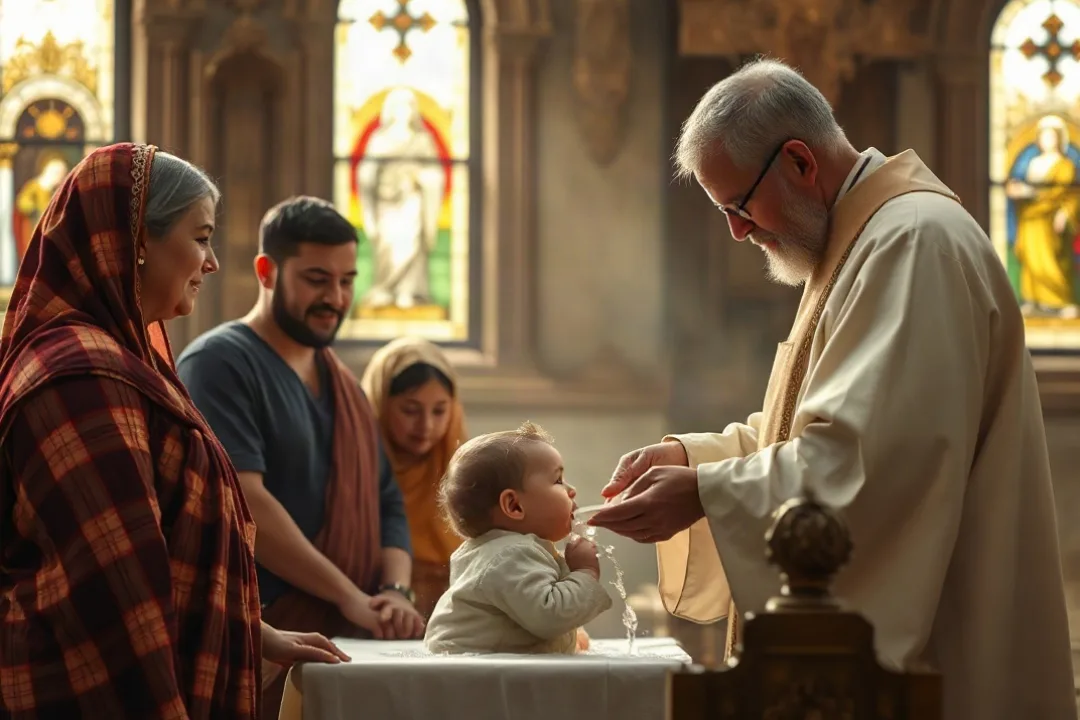
The Rite of Baptism follows a set structure, whether performed during Mass or as a standalone ceremony. Each part carries symbolic weight tied back to scripture and centuries of Church tradition.
- Welcome and signing with the cross. The priest or deacon greets the family and traces the sign of the cross on the child's forehead, a gesture repeated by the parents and godparents, marking the child as belonging to Christ.
- Liturgy of the Word. A short scripture reading, often from the Gospels, reminds those present of the meaning of baptism.
- Exorcism and anointing with the oil of catechumens. This is not a dramatic rite but a simple prayer asking for protection from evil, followed by an anointing on the chest, symbolizing strength for the spiritual life ahead.
- Blessing of the baptismal water. The priest blesses the water, recalling its biblical significance, from the waters of creation to the crossing of the Red Sea to the baptism of Jesus in the Jordan River.
- Renunciation of sin and profession of faith. Parents and godparents answer on the child's behalf, rejecting sin and affirming belief in the core truths of the faith, such as those found in the Apostles' Creed.
- The baptism itself. Water is poured over the child's head three times, or the child may be partially immersed, while the priest says the words that make the sacrament valid.
- Anointing with sacred chrism. The top of the head is anointed with perfumed oil, signifying the child's new identity as part of the priestly, prophetic, and royal people of God.
- Clothing with the white garment. This symbolizes the new life and purity received through baptism.
- Presentation of the lighted candle. Lit from the Easter candle, it represents the light of Christ the child is now called to carry.
- Final blessing. The priest blesses the parents and, separately, the mother, closing the ceremony.
"I baptize you in the name of the Father, and of the Son, and of the Holy Spirit."
This formula, spoken as water is poured, is considered essential to the sacrament's validity across all Catholic baptisms, infant or adult.
Why the symbols used in baptism matter
Every object and gesture in the rite has a specific meaning rooted in scripture or Church tradition, rather than being decorative.
Water
Water represents both cleansing and life. It recalls the Genesis account of creation emerging from water, the Israelites passing through the Red Sea to freedom, and Jesus' own baptism in the Jordan by John the Baptist.
Oil
Two different oils are used. The oil of catechumens is applied before baptism as a sign of strengthening, while the sacred chrism afterward marks the person's new identity, echoing the ancient practice of anointing priests, prophets, and kings.
White garment
The white garment symbolizes the "new creation" described by Paul, a visible sign that the old self has been washed away and a new life has begun.
Candle
Lit from the Easter candle, which itself represents the risen Christ, the baptismal candle is a reminder that the baptized person is now called to live as a visible sign of faith in the world.
How infant and adult baptism differ in practice
The sacramental effect of baptism is considered identical no matter the age of the person receiving it, but the path leading up to it looks quite different.
- Infants are baptized based on the faith of their parents and godparents, who make promises on the child's behalf with the expectation that the child will be raised in the faith and eventually affirm those promises personally, often at Confirmation.
- Adults and older children go through a more extended period of formation, commonly through RCIA, which includes study of Church teaching, participation in parish life, and a series of rites marking their progress toward full initiation.
- Adults are typically baptized, confirmed, and receive first Communion in the same ceremony, often at the Easter Vigil, the most significant liturgical celebration of the Catholic year.
- Infants receive Confirmation and first Communion later, usually in childhood or early adolescence, after additional religious education.
What to know about baptism certificates and records
After the ceremony, the parish records the baptism in its official sacramental register, a practice that has continued in Catholic parishes for centuries and often serves genealogical as well as religious purposes.
Parents and godparents typically receive a baptismal certificate shortly after the ceremony, or they can request one later directly from the parish where the baptism took place. This document is often required later in life for other sacraments, including Confirmation, first Communion, and marriage in the Church, since priests need proof that a person has been validly baptized.
Important: If you need a copy of your own baptismal certificate as an adult, contact the specific parish where you were baptized rather than the diocese, since individual parishes keep their own sacramental records.
Common questions about timing, cost, and practical details
Families often have practical concerns that go beyond the theology of the sacrament.
- Is there a fee? Most parishes do not charge a mandatory fee, though a donation is customary and appreciated, since it helps cover the cost of preparation materials and parish resources.
- Can baptism happen outside Mass? Yes, many parishes schedule baptisms separately, often after a Sunday Mass or at a designated time during the week.
- What if the godparents live far away? They are still expected to be present, since their role involves speaking the responses and performing certain gestures during the rite, though some dioceses allow exceptions with a proxy standing in physically while the actual godparent is recorded.
- Can a baby be baptized in a different parish than where the parents live? Generally yes, with permission from the family's home parish, which issues a letter allowing the baptism to take place elsewhere.
Why the Church insists baptism should not be delayed too long
Canon law encourages parents to have their children baptized within the first few weeks of life, reflecting the Church's view that grace should not be withheld without good reason. At the same time, the Church also expects a reasonable hope that the child will be raised in the Catholic faith, which is part of why preparation classes and parish involvement matter to the process. A priest may delay baptism, though rarely refuse it outright, if there is no realistic expectation that the family will raise the child in the faith at all.
This balance, between urgency and responsibility, shapes much of how parishes handle baptism requests today, and it explains why the preparation process, however brief, is treated as a meaningful part of the sacrament rather than a bureaucratic formality.
Frequently asked questions
Can a baby be baptized Catholic if the parents are not married in the Church?
Yes, a child can usually still be baptized even if the parents were not married in the Church. The priest will typically ask about the family's intention to raise the child in the faith, and may discuss the parents' situation, but marital status alone does not disqualify a child from receiving the sacrament.
How many godparents are required for a Catholic baptism?
Canon law requires at least one godparent, and allows for a maximum of two, one male and one female. If two are chosen, at least one must meet all the requirements of a Catholic godparent, while the other may be a baptized Christian from another denomination serving as a Christian witness.
Can someone be baptized more than once in the Catholic Church?
No. Catholic teaching holds that baptism leaves a permanent spiritual mark on the soul and cannot be repeated. If there is genuine doubt about whether a previous baptism was performed validly, a conditional baptism may be used, but a certain, valid baptism is never repeated.
What happens if a baby dies before being baptized?
The Catholic Church teaches that God's mercy is not limited by the sacraments, and entrusts unbaptized infants who die to God's care and love. While the Church does not claim certainty about their eternal state, it offers prayers and funeral rites of hope for these children and their grieving families.
Leave a Reply