
Bernadette of Lourdes: the story behind the famous apparitions
Every year, millions of people travel to a small town in southwestern France to visit a rocky grotto, fill bottles with water from a spring, and pray where a teenage girl once knelt. That girl was Bernadette Soubirous, known today as Bernadette of Lourdes. Her story began with a simple errand to gather firewood and ended with one of the most visited Catholic shrines in the world.
If you have ever wondered who she really was, what she actually experienced, and why the Church eventually believed her, the answer starts with a poor, sickly fourteen-year-old and a series of strange encounters by a riverbank.
Who was Bernadette Soubirous before the visions began
Bernadette was born in 1844 in Lourdes, a modest market town near the Pyrenees mountains. Her family, the Soubirous, were once millers but had fallen into deep poverty by the time Bernadette was a young girl. They lived for a period in a single damp room known locally as le cachot, a former jail cell, because they had no other housing available to them.
Bernadette suffered from asthma for most of her life and was often described by neighbors as a quiet, uneducated child who had not yet made her First Communion at an age when most children in her village had. She worked as a shepherdess and helped care for younger children in a nearby family, which is partly why she was not in school with other children her age.
- Family situation: her father Francois worked irregular jobs after losing the family mill
- Health: chronic asthma that worsened in cold or damp conditions
- Education: minimal, and she struggled to read and write even into her teenage years
- Language: she spoke mainly a local Pyrenean dialect, not formal French
None of this suggested a girl destined for widespread fame. That is part of what makes her story notable to historians and believers alike: she was not someone with influence, education, or a platform of any kind.
What happened at the grotto in 1858
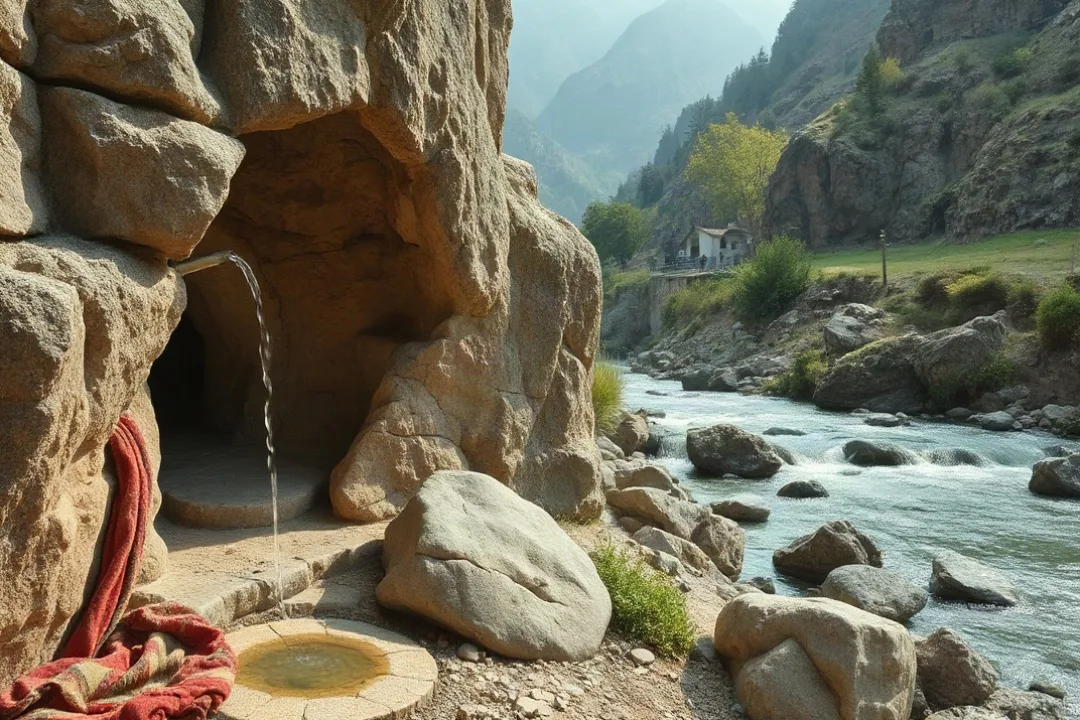
On February 11, 1858, Bernadette went with her sister and a friend to collect firewood near the Gave river, close to a rocky outcropping called Massabielle. While the other girls crossed a stream, Bernadette stayed behind and reported seeing a lady dressed in white standing in a niche in the rock.
Over the following weeks, Bernadette returned to the grotto repeatedly, and she said the figure appeared to her a total of eighteen times between February and July of that year. She described the woman as young, dressed simply in white with a blue sash, holding a rosary.
Several moments from these encounters became central to how the story is remembered:
- Bernadette was told to dig in the dry ground, which eventually produced a spring that still flows at the site today
- She reported being asked to pray for sinners and to encourage penance
- She was told to ask local priests to have a chapel built at the location
- During one apparition, the figure identified herself using words Bernadette did not fully understand at the time, which she later repeated to a local priest almost exactly as spoken, despite not knowing the theological term herself
That detail mattered enormously to Church officials later, because the phrase Bernadette repeated matched a doctrine that had only recently been formally defined by the pope, something an uneducated village girl would have had little reason or means to know in advance.
Key point: Bernadette never claimed to fully understand what she saw. She insisted only on describing exactly what happened, and she consistently resisted elaborating beyond what she had witnessed, even when pressed by curious crowds and skeptical officials.
How the Catholic Church responded to her claims
Word spread quickly through Lourdes and beyond, and the apparitions drew enormous crowds within weeks. Local civil authorities were alarmed by the gatherings and initially tried to stop Bernadette from returning to the grotto, even threatening her family.
Church leaders, meanwhile, were cautious rather than enthusiastic. The local bishop set up a formal commission to investigate the claims, interviewing Bernadette repeatedly and examining the physical evidence, including the spring and reports of healings associated with the water.
The investigation took several years. Officials wanted to rule out:
- Deliberate deception or a hoax staged for attention or money
- Mental illness or hallucination
- Outside coaching by priests or family members with something to gain
- Natural explanations for the spring's sudden appearance
Bernadette's consistent, unembellished account across years of questioning worked in her favor. She never sought money from the growing crowds, never changed her story to please questioners, and reportedly grew uncomfortable with the attention rather than seeking it out.
In 1862, the bishop of Tarbes formally declared the apparitions worthy of belief, a decision that allowed public devotion at the site to continue with the Church's backing. Construction of a church at the grotto, something the figure had reportedly requested, began not long afterward.
What became of Bernadette after the apparitions ended
Fame did not sit well with Bernadette. As pilgrims and curious visitors flooded into Lourdes hoping to see her, she reportedly found the attention exhausting and spiritually distracting. She had little interest in becoming a public figure tied to a religious shrine.
In 1866, at age 22, Bernadette left Lourdes permanently and entered the convent of the Sisters of Charity of Nevers, a religious order far from the pilgrimage site. There, she took the name Sister Marie-Bernarde and tried to live as ordinary a convent life as her health allowed.
Her years in the convent were marked by continued illness. She worked as a sacristan and later helped care for the sick in the infirmary, despite her own ongoing struggles with asthma and, later, a painful bone condition. She rarely spoke publicly about the apparitions after entering religious life, preferring to let the shrine and the Church speak for the events rather than drawing attention to herself.
She reportedly once said something close to this, when asked why she did not try to convince skeptics of what she had seen:
I was not sent to make people believe. I was sent to tell them.
Bernadette died in 1879 at the age of 35, after years of declining health. She was buried at the convent in Nevers, far from the grotto that had made her name known across the world.
Why Lourdes became a major pilgrimage site
The spring Bernadette uncovered by hand in 1858 still flows today, and it forms the center of the shrine's identity. Pilgrims collect water from taps fed by the source, and many bathe in dedicated pools built near the grotto, seeking physical or spiritual healing.
Over the decades, the site grew from a single rock formation into a sprawling sanctuary complex that includes:
- The original grotto of Massabielle, where the statue of the apparition now stands
- A medical bureau that reviews claimed healings according to strict scientific criteria
- Several large basilicas built to accommodate growing crowds
- Facilities built specifically to welcome sick and disabled pilgrims, a group the shrine has always made central to its mission
A small number of healings connected to Lourdes have been formally recognized by the Church as medically unexplained after rigorous, independent investigation by doctors who are not required to be Catholic. The vast majority of claimed cures are not officially recognized, and Church officials themselves have always been cautious about overstating what can be verified.
What draws people to Lourdes today is not only the possibility of physical healing. Many pilgrims describe the trip as an opportunity for quiet reflection, a chance to pray alongside others facing illness or hardship, and a tangible connection to a story that began with one uneducated girl who insisted, against pressure from every direction, that she was simply telling the truth about what she saw.
What Bernadette's story means for people today
Bernadette was canonized in 1933, and she is remembered by the Church primarily for her humility rather than for any dramatic spiritual gifts. She performed no miracles herself, made no theological claims beyond what she was told to repeat, and spent the second half of her life trying to disappear from public attention entirely.
Several qualities about her stand out to people who study her life closely:
- Her consistency under repeated, often hostile questioning over several years
- Her refusal to profit financially from her growing fame
- Her discomfort with celebrity, choosing convent life over continued association with the shrine
- Her insistence on describing events plainly rather than interpreting or dramatizing them
For many visitors to Lourdes, her example matters as much as the water from the spring. She is often held up as a model of simple honesty, someone who reported something extraordinary without trying to build a reputation or a following around it. That combination of an extraordinary claim and an unusually ordinary, reluctant witness is part of why her story has remained compelling for more than a century and a half.
Frequently asked questions
How old was Bernadette when the apparitions began?
Bernadette was fourteen years old when the first apparition occurred in February 1858. She continued to report visions at the grotto periodically until July of that same year, after which the apparitions stopped entirely.
Did Bernadette ever return to Lourdes after becoming a nun?
No. Once she entered the convent in Nevers in 1866, Bernadette never returned to Lourdes for the rest of her life. She preferred to leave the shrine's growth and public devotion to Church officials rather than remain connected to it personally.
Is the water from the Lourdes spring considered miraculous by the Church?
The Church does not claim the water itself has supernatural power. Instead, officials attribute any documented healings to faith and prayer associated with pilgrimage, while a medical bureau independently reviews specific healing claims using strict scientific standards.
When was Bernadette officially declared a saint?
Bernadette Soubirous was canonized by the Catholic Church in 1933, more than fifty years after her death in 1879. Her canonization recognized her humility and consistency rather than any personal miracles she performed.
Leave a Reply