
Who Were Moses' Parents?
Moses stands as one of history's most transformative figures, central to both biblical and Islamic tradition. His story begins not in prominence but in peril—born into a Hebrew family struggling under the weight of Egyptian oppression, where his survival itself became an act of defiance.
Amram: Moses' Father
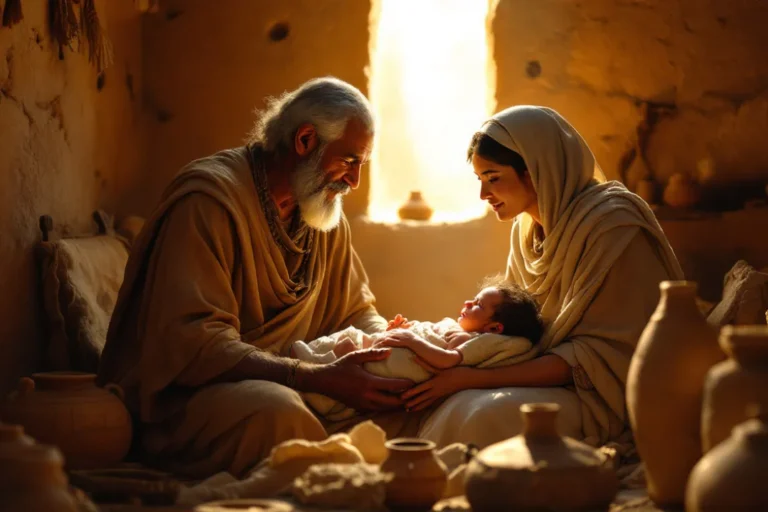
Amram, son of Kohath, came from the tribe of Levi, a lineage that would later form the priesthood of Israel. The Levites held a special status among the Hebrew tribes, descended directly from Levi, one of Jacob's twelve sons. This heritage meant that Amram carried within his family line a spiritual weight and responsibility that would define generations to come.
Amram married Jochebed, his paternal aunt—a union that would have been unusual even by the standards of his time, yet it produced three children who would reshape the course of Hebrew history: Miriam, Aaron, and Moses. While less prominent in biblical narratives than his wife or his children, Amram represented the quiet strength of a man who understood that protecting his family meant more than physical safety. He was part of a community facing systematic erasure, and his willingness to participate in raising Moses—even in the shadow of a death sentence—demonstrated a faith that transcended immediate circumstances.
Jochebed: Moses' Mother
Jochebed (also spelled Yokheved or Yocheved) was the daughter of Levi himself, making her not just a woman of noble lineage but one whose very name connected her to the founding of the Hebrew people. She married her nephew Amram in an arrangement that, while prohibited in later Jewish law, was permitted in their era. Yet her significance extends far beyond genealogy.
Jochebed embodied an extraordinary courage that defined her character. While her husband provided stability, she faced the impossible choice that countless mothers in her time confronted: how to protect a child from a decree designed to eliminate him. She was not a passive figure awaiting rescue but an active agent of her son's survival. The biblical text portrays her as a woman of profound faith—not the abstract faith of theology, but the lived faith of someone who trusted in something beyond the Pharaoh's power.
Moses' Birth and Adoption
The context of Moses' birth was one of systematic terror. During the reign of a Pharaoh whose name remains historically uncertain, the Hebrew population in Egypt had grown large enough to alarm the Egyptian ruler. Fearing that the Israelites might become too powerful or rebel, he instituted a horrifying policy: all male Hebrew babies were to be executed at birth. This was not merely oppression—it was genocide, targeting an entire people through the elimination of their future.
For three months, Jochebed managed the impossible. She kept Moses hidden in her home, away from Egyptian authorities and informants. But concealment has limits. A growing infant cannot remain silent forever, and the risks multiplied daily. When hiding him became untenable, Jochebed made a decision that combined both desperation and hope. She crafted a basket from papyrus reeds and waterproofed it with pitch, then placed her infant son inside and set it adrift on the Nile River.
This act was not surrender but rather a calculated gamble. The Nile was both Egypt's lifeblood and the domain of the Pharaoh's family. The river's banks were frequented by royalty, particularly the women of Pharaoh's household. Jochebed understood the world she inhabited well enough to know that while common Egyptians might drown a Hebrew baby, a royal princess might show mercy.
Her intuition proved correct. Pharaoh's daughter discovered the basket and, finding the infant inside, chose to adopt him as her own son. Moses would be raised in the palace, surrounded by Egyptian wealth and education, yet something crucial remained: Jochebed herself was brought into the household as the child's wet nurse. Through this arrangement, Moses maintained connection to his own people, his own language, his own faith—a thread of identity that would later define his entire mission.
Significance of Moses' Parents
The role of Amram and Jochebed in Moses' life was far more than biographical detail—it was foundational to everything he would become. Their defiance was not dramatic or public; it was quiet, persistent, and rooted in conviction. In a time and place where Hebrew parents had few rights and less power, they exercised the only authority they possessed: the authority to choose faith over fear.
Jochebed's particular legacy was one of active resistance. She did not passively accept the Pharaoh's decree; she acted. She planned. She trusted in something beyond the visible world. Her courage gave Moses life itself, but more than that, it shaped the kind of person he would become—someone willing to challenge authority on behalf of his people.
Amram's role, though quieter, was equally vital. He supported his wife's faith. He participated in raising a child who would ultimately challenge the greatest power on earth. He was part of a family that understood something profound: that love and commitment to one's people could survive even the most systematic attempts at destruction.
Together, Amram and Jochebed provided Moses with both survival and identity. They gave him life and culture, education and faith. The foundation they built—one rooted in courage, love, and unwavering belief in a purpose beyond their own lifetime—enabled Moses to become the leader and liberator of the Israelites. His spiritual journey and his lifelong commitment to his people did not emerge from nowhere; they grew from the sacrifices and faith of parents who chose to fight for their child and their people, even when the odds seemed insurmountable.